
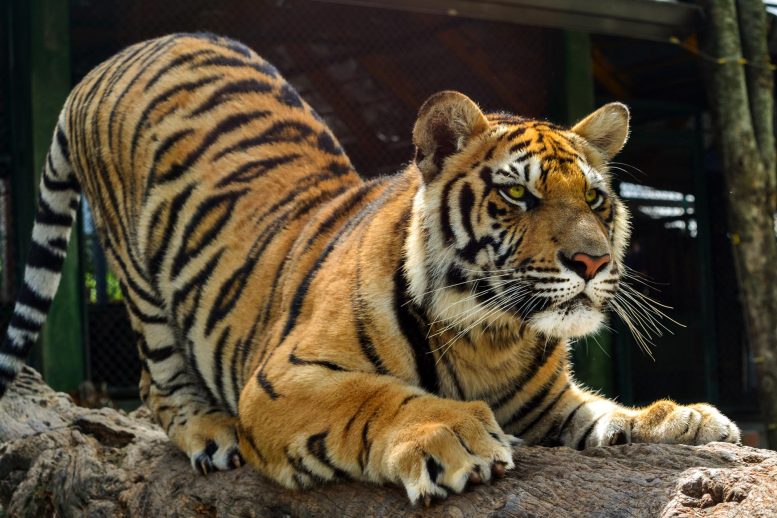
A study shows that declawing significantly impacts the muscular capabilities of large cat species more than smaller cats. Despite it being illegal to surgically modify exotic animals in the U.S., declawing is still performed, especially on lion and tiger cubs.
Declawing house cats to keep them from scratching people and furniture is controversial – and even banned in some countries and areas in the U.S. – but the practice is not limited to house cats. In a new study, researchers looked at the effects of declawing on larger cat species and found that declawing disproportionately impacts their muscular capabilities as compared to their smaller brethren.
“Biomechanically speaking, declawing has a more anatomically devastating effect in larger species.” Lara Martens
Declawing Beyond House Cats
While it is illegal in the U.S. to surgically modify an exotic animal, declawing is still done on large cats like lions and tigers, often in an effort to allow cubs to more safely be handled in photo opportunities or for entertainment purposes.
“What people might not realize is that declawing a cat is not like trimming our fingernails; rather, it is removing part or all of the last bone of each digit,” says Adam Hartstone-Rose, professor of biological sciences at North Carolina State University and corresponding author of the research. “Like us, each cat finger has three bones, and declawing is literally cutting that third bone off at the joint.”
Study Findings and Impact
For the study, the researchers looked at the muscular anatomy of over a dozen exotic cats to determine the effect of declawing on their forelimb musculature. The species ranged from smaller ones including bobcats, servals, and ocelots, to lions and tigers.
They measured muscle density and mass, and also examined muscle fibers from both clawed and declawed exotic cats. They found that for the larger species declawing resulted in 73% lighter musculature in the forearm’s digital flexors. These muscles are involved in unsheathing the claws. They also found that overall, forelimb strength decreased by 46% to 66%, depending on the size of the animal, and that other muscles in the forelimb did not compensate for these reductions.
Specific Implications for Large Cats
“When you think about what declawing does functionally to a housecat, you hear about changes in scratching, walking, or using the litter box,” says Lara Martens, NC State undergraduate student and lead author of the research. “But with big cats, there’s more force being put through the paws. So if you alter them, it is likely that the effects will be more extreme.”
This is because paw size and body mass don’t scale up at a 1:1 ratio. Paw area increases at a slower rate than body mass (which is proportional to volume), so larger cats have smaller feet relative to their body size, and their paws must withstand more pressure.
“Additionally, big cats are more reliant on their forelimbs – they bear most of the weight, and these bigger cats use their forelimbs to grapple because they hunt much larger prey,” Martens says. “So biomechanically speaking, declawing has a more anatomically devastating effect in larger species.”
Closing Remarks
“As scientists, it is our job to objectively document the effects of this surgery on the animals,” Hartstone-Rose says, “but it is hard to ignore the cruelty of this practice. These are amazing animals, and we should not be allowed to cripple them, or any animals, in this way.”
The work was published on July 30 in the journal Animals.
Reference: “The Effects of Onychectomy (Declawing) on Antebrachial Myology across the Full Body Size Range of Exotic Species of Felidae” by Lara L. Martens, Sarah Jessica Piersanti, Arin Berger, Nicole A. Kida, Ashley R. Deutsch, Kathryn Bertok, Lauren Humphries, Angela Lassiter and Adam Hartstone-Rose, 30 July 2023, Animals.
DOI: 10.3390/ani13152462
NC State undergraduates Sarah Piersanti, Arin Berger, and Nicole Kida, and Ph.D. student Ashley Deutsch, also contributed to the research. The work was done in partnership with colleagues from Carolina Tiger Rescue, a sanctuary that rescues exotic carnivores, especially big cats, who have often been neglected or mistreated.
Abstract:
While people are familiar with the practice of declawing domestic cats, “onychectomy” is also performed on non-domesticated species, including pantherines to prolong their use in entertainment opportunities. Although the surgery (the partial or complete removal of the distal phalanx) has clear osteological implications, its myological effects have never been studied. Because the mass of an animal increases cubically as a product of its volume and, the areas of its paws only increase as a square, larger felids have higher foot pressures and therefore the surgery may have particularly substantial functional effects for larger cats. In this study, we evaluate the forearms of clawed and declawed non-domestic felid specimens spanning the body size range of the whole family to evaluate the effects of onychectomy on muscle fiber architecture. We found that the deep digital flexors (the muscles most directly affected by onychectomy) of declawed felids are significantly lighter (~73%) and less powerful (46-66%), and that other muscles do not make up for these reductions. Thus, onychectomy has a substantial effect on the myological capabilities of cats and because these deficiencies are not compensated for in biomechanical disadvantaged larger felids, it is probably functionally even more devastating for these species.
Never miss a breakthrough: Join the SciTechDaily newsletter.
Follow us on Google and Google News.