
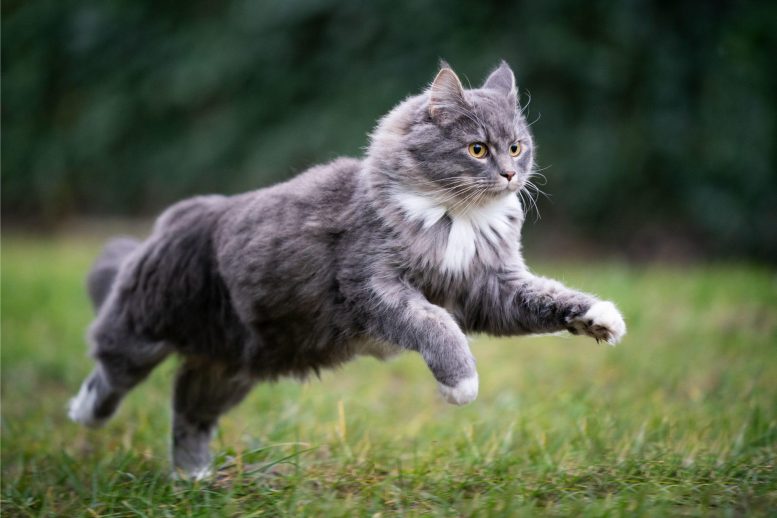
Keeping cats indoors protects both pets and ecosystems by reducing disease risks and preventing harm to native wildlife.
The next time you let your cat outside for its daily adventure, you may want to reconsider. A new study by University of Maryland researchers has found that keeping cats indoors can significantly reduce the risks of transmitting diseases and hunting wildlife, which can have a negative impact on native animal populations and biodiversity.
The study’s findings were based on data from the D.C. Cat Count, a Washington, D.C.–wide survey that used 60 motion-activated wildlife cameras placed across 1,500 sampling locations. The researchers emphasized that humans bear a primary responsibility in reducing these risks by keeping cats indoors.
The cameras recorded what cats preyed on and demonstrated how they overlapped with native wildlife, which helped researchers understand why cats and other wildlife are present in some areas, but absent from others. The paper was recently published in the journal Frontiers in Ecology and Evolution.
Disease Transmission Risks
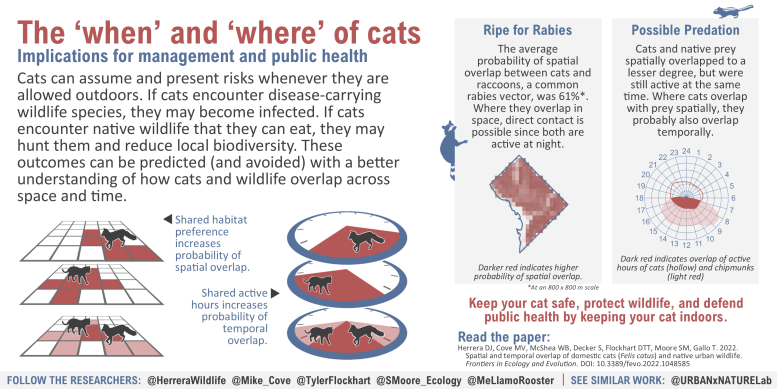
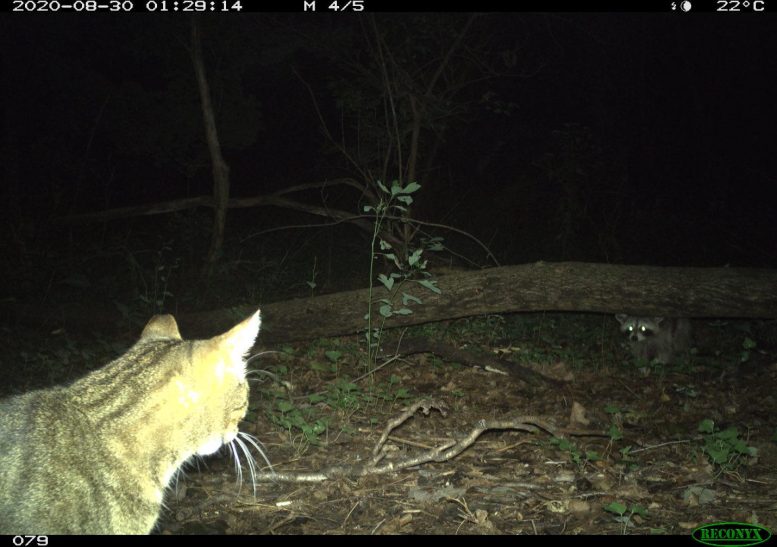
“We discovered that the average domestic cat in D.C. has a 61% probability of being found in the same space as raccoons — America’s most prolific rabies vector — 61% spatial overlap with red foxes, and 56% overlap with Virginia opossums, both of which can also spread rabies,” said Daniel Herrera, lead author of the study and Ph.D. student in UMD’s Department of Environmental Science and Technology (ENST). “By letting our cats outside we are significantly jeopardizing their health.”
In addition to the risk of being exposed to diseases that they can then bring indoors to the humans in their families (like rabies and toxoplasmosis), outdoor cats threaten native wildlife. The D.C. Cat Count survey demonstrated that cats that are allowed to roam outside also share the same spaces with and hunt small native wildlife, including grey squirrels, chipmunks, cottontail rabbits, groundhogs, and white-footed mice. By hunting these animals, cats can reduce biodiversity and degrade ecosystem health.
Misconceptions About Cats and Rodent Control
“Many people falsely think that cats are hunting non-native populations like rats, when in fact they prefer hunting small native species,” explained Herrera. “Cats are keeping rats out of sight due to fear, but there really isn’t any evidence that they are controlling the non-native rodent population. The real concern is that they are decimating native populations that provide benefits to the D.C. ecosystem.”
In general, Herrera found that the presence of wildlife is associated with tree cover and access to open water. On the other hand, the presence of cats decreased with those natural features but increased with human population density. He says that these associations run counter to arguments that free-roaming cats are simply stepping into a natural role in the ecosystem by hunting wildlife.
“These habitat relationships suggest that the distribution of cats is largely driven by humans, rather than natural factors,” explained Travis Gallo, assistant professor in ENST and advisor to Herrera. “Since humans largely influence where cats are on the landscape, humans also dictate the degree of risk these cats encounter and the amount of harm they cause to local wildlife.”
Herrera encourages pet owners to keep their cats indoors to avoid potential encounters between their pets and native wildlife. His research notes that feral cats are equally at risk of contracting diseases and causing native wildlife declines, and they should not be allowed to roam freely where the risk of overlap with wildlife is high – echoing previous calls for geographic restrictions on where sanctioned cat colonies can be established or cared for.
Reference: “Spatial and temporal overlap of domestic cats (Felis catus) and native urban wildlife” by Daniel J. Herrera, Michael V. Cove, William J. McShea, Sam Decker, D. T. Tyler Flockhart, Sophie M. Moore and Travis Gallo, 21 November 2022, Frontiers in Ecology and Evolution.
DOI: 10.3389/fevo.2022.1048585
Never miss a breakthrough: Join the SciTechDaily newsletter.
Follow us on Google and Google News.
15 Comments
“We discovered that the average domestic cat in D.C. has a 61% probability of being found in the same space as raccoons — America’s most prolific rabies vector — 61% spatial overlap with red foxes, and 56% overlap with Virginia opossums, both of which can also spread rabies,”
And yet, cats rarely acquire rabies. Probably because when they do encounter a larger predator they avoid them to avoid being eaten. This is classic propaganda. They make a statement that is (presumably) true, with the implication of something that is not proven. That is, they are warning the public that cats and their owners are at risk of acquiring rabies. However, the speculation is not supported by historical evidence. Unlike dogs, it is rare for any city, county, or state to require vaccination of cats because it is such a rarity to encounter a rabid cat. Where are the supporting statistics on the rate of rabies infection of domestic cats, and the transmission to humans? I think it is safe to assume that if the statistics made their case stronger, they would have presented them. Cherry Picking has no place in science.
Cats serve the same functional role in the ecosystem as native predators that have been exterminated or greatly reduced in population. That is, over-abundant small animals that become a nuisance, and can carry diseases like plague, hanta virus, West Nile virus, etc. are taken in greater abundance, controlling the population. The sick, weak, and careless animals are weeded out, maintaining fit genetics. Removing cats would actually reduce bio-diversity, rather than increasing it.
This article is so one-sided and illogical that I have to conclude it is driven by an unstated agenda that doesn’t include objectivity.
“Cases of human rabies in the United States are rare, with only 1 to 3 cases reported annually. [Out of a population of more than 333 million] Twenty-five cases of human rabies have been reported in the United States in the past decade (2009-2018). Seven of these infections were acquired outside of the U.S. and its territories.”
https://www.cdc.gov/rabies/location/usa/surveillance/human_rabies.html
thanks, I am so tired of this kind of low grade science….
If these people didn’t have a hidden agenda, they would simply be recommending that people vaccinate their outdoor cats against rabies, and support that recommendation with numbers showing the risk.
It is my disgust with poor quality science that motivates me to comment on the articles.
Rabies is also transmitted by saliva. A cat that eats something comtaminated with saliva from another animal with an infectious disease is now exposed to that disease. For cats, this usually refers to FIV or feline leukemia, but rabies is also a concern.
But you’re correct, domesticated cats do often avoid other animals which are aggressive. The thing is, oppossums and cats can get along, in some cases eating out of the same food bowl outside right next to each other, or taking turns. Oppossums are not typically predatory, and rats and mice are not either, but they can carry rabies.
I cannot believe we waste money on useless studies of dumb crap like this.
What you define as “dumb crap”, others define as knowledge.
Make up your bloody minds, scientists. One minute you are tellig us that cats can catch SARS and other diseases from humans and become resident reservoirs and the next you are telling us to keep them locked up (like humans) to save them getting infected.
Follow the science? Sure – but which?
Amazing how many have joined the anti science club. They would fit right in with the Galileo bashers and those who burned Giordano Bruno at the stake. Here’s one definite fact , domestic cats are responsible for many species of birds becoming extinct by killing them in the millions. Keep your cats indoors , for them and for the birds.
Where is the research that supports this claim? Presumably you have it, as a member of the pro-science club.
Everything I’ve read about possums say that they do not carry rabies.
I’ll start paying attention to those urging us to keep cats indoors when their advice is accompanied by suggestions on how to deal with the inevitable behaviour problems some cats develop directly due to their boredom. I’ve read dozens of articles like this one; so far, I have seen no practical advice.
Only every internet search indicates Virginia Opossums do not contract rabies as their body temps are too low for the virus to replicate. One source – https://dem.ri.gov/sites/g/files/xkgbur861/files/programs/bnatres/fishwild/pdf/opossum.pdf – states there were only 25 confirmed cases between 2004 and 2014. Racoons and foxes definitely contract rabies but for all practical purposed opossums do not. This sounds like a study funded by the song bird enthusiasts although there is not mention of the amount of birds killed by domestic cats.
Build catios so your cats won’t be bored.
Help save the lives of millions of birds killed annually by cats.
Veternarians in England are pushing their cat people to let their cats outside. It is mentally not good for them to be inside 100%of the time. Their brain needs the stimulation of the outdoors. I take offense to the fact that cats don’t catch mice or rats! Mine all do. I have frequent Rat and mice bodies outside my doors. Your study isn’t the law and the English Vets would totally shoot down your findings.