

A new Jell-O-like material could replace metals as electrical interfaces for pacemakers, cochlear implants, and other electronic implants.
Do an image search for “electronic implants,” and you’ll draw up a wide assortment of devices, from traditional pacemakers and cochlear implants to more futuristic brain and retinal microchips aimed at augmenting vision, treating depression, and restoring mobility.
Some implants are hard and bulky, while others are flexible and thin. But no matter their form and function, nearly all implants incorporate electrodes — small conductive elements that attach directly to target tissues to electrically stimulate muscles and nerves.
Implantable electrodes are predominantly made from rigid metals that are electrically conductive by nature. But over time, metals can aggravate tissues, causing scarring and inflammation that in turn can degrade an implant’s performance.
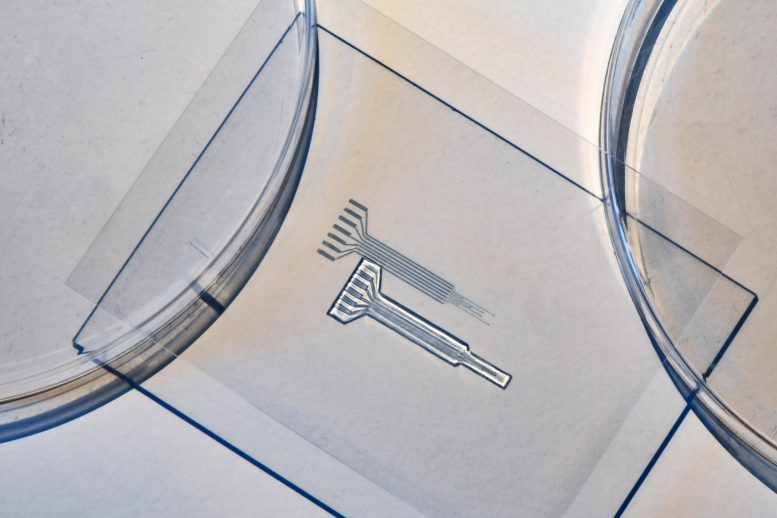
Now, MIT engineers have developed a metal-free, Jell-O-like material that is as soft and tough as biological tissue and can conduct electricity similarly to conventional metals. The material can be made into a printable ink, which the researchers patterned into flexible, rubbery electrodes. The new material, which is a type of high-performance conducting polymer hydrogel, may one day replace metals as functional, gel-based electrodes, with the look and feel of biological tissue.
“This material operates the same as metal electrodes but is made from gels that are similar to our bodies, and with similar water content,” says Hyunwoo Yuk SM ’16 PhD ’21, co-founder of SanaHeal, a medical device startup. “It’s like an artificial tissue or nerve.”
“We believe that for the first time, we have a tough, robust, Jell-O-like electrode that can potentially replace metal to stimulate nerves and interface with the heart, brain, and other organs in the body,” adds Xuanhe Zhao, professor of mechanical engineering and of civil and environmental engineering at MIT.
Zhao, Yuk, and others at MIT and elsewhere report their results in Nature Materials. The study’s co-authors include first author and former MIT postdoc Tao Zhou, who is now an assistant professor at Penn State University, and colleagues at Jiangxi Science and Technology Normal University and Shanghai Jiao Tong University.
A True Challenge
The vast majority of polymers are insulating by nature, meaning that electricity does not pass easily through them. But there exists a small and special class of polymers that can in fact pass electrons through their bulk. Some conductive polymers were first shown to exhibit high electrical conductivity in the 1970s — work that was later awarded a Nobel Prize in Chemistry.
Recently, researchers including those in Zhao’s lab have tried using conductive polymers to fabricate soft, metal-free electrodes for use in bioelectronic implants and other medical devices. These efforts have aimed to make soft yet tough, electrically conductive films and patches, primarily by mixing particles of conductive polymers, with hydrogel — a type of soft and spongy water-rich polymer.
Researchers hoped the combination of conductive polymer and hydrogel would yield a flexible, biocompatible, and electrically conductive gel. But the materials made to date were either too weak and brittle, or they exhibited poor electrical performance.
“In gel materials, the electrical and mechanical properties always fight each other,” Yuk says. “If you improve a gel’s electrical properties, you have to sacrifice mechanical properties, and vice versa. But in reality, we need both: A material should be conductive, and also stretchy and robust. That was the true challenge and the reason why people could not make conductive polymers into reliable devices entirely made out of gel.”
Electric Spaghetti
In their new study, Yuk and his colleagues found they needed a new recipe to mix conductive polymers with hydrogels in a way that enhanced both the electrical and mechanical properties of the respective ingredients.
“People previously relied on homogenous, random mixing of the two materials,” Yuk says.
Such mixtures produced gels made of randomly dispersed polymer particles. The group realized that to preserve the electrical and mechanical strengths of the conductive polymer and the hydrogel respectively, both ingredients should be mixed in a way that they slightly repel — a state known as phase separation. In this slightly separated state, each ingredient could then link its respective polymers to form long, microscopic strands, while also mixing as a whole.
“Imagine we are making electrical and mechanical spaghetti,” Zhao offers. “The electrical spaghetti is the conductive polymer, which can now transmit electricity across the material because it is continuous. And the mechanical spaghetti is the hydrogel, which can transmit mechanical forces and be tough and stretchy because it is also continuous.”
The researchers then tweaked the recipe to cook the spaghettified gel into an ink, which they fed through a 3D printer, and printed onto films of pure hydrogel, in patterns similar to conventional metal electrodes.
“Because this gel is 3D-printable, we can customize geometries and shapes, which makes it easy to fabricate electrical interfaces for all kinds of organs,” says first author Zhou.
The researchers then implanted the printed, Jell-O-like electrodes onto the heart, sciatic nerve, and spinal cord of rats. The team tested the electrodes’ electrical and mechanical performance in the animals for up to two months and found the devices remained stable throughout, with little inflammation or scarring to the surrounding tissues. The electrodes also were able to relay electrical pulses from the heart to an external monitor, as well as deliver small pulses to the sciatic nerve and spinal cord, which in turn stimulated motor activity in the associated muscles and limbs.
Going forward, Yuk envisions that an immediate application for the new material may be for people recovering from heart surgery.
“These patients need a few weeks of electrical support to avoid heart attack as a side effect of surgery,” Yuk says. “So, doctors stitch a metallic electrode on the surface of the heart and stimulate it over weeks. We may replace those metal electrodes with our gel to minimize complications and side effects that people currently just accept.”
The team is working to extend the material’s lifetime and performance. Then, the gel could be used as a soft electrical interface between organs and longer-term implants, including pacemakers and deep-brain stimulators.
“The goal of our group is to replace glass, ceramic, and metal inside the body, with something like Jell-O so it’s more benign but better performance, and can last a long time,” Zhao says. “That’s our hope.”
Reference: “3D Printable High Performance Conducting Polymer Hydrogel for All-Hydrogel Bioelectronic Interfaces” by Tao Zhou, Hyunwoo Yuk, Faqi Hu, Jingjing Wu, Fajuan Tian, Heejung Roh, Zequn Shen, Guoying Gu, Jingkun Xu, Baoyang Lu and Xuanhe Zhao, 15 June 2023, Nature Materials.
DOI: 10.1038/s41563-023-01569-2
This research is supported, in part, by the National Institutes of Health.
Never miss a breakthrough: Join the SciTechDaily newsletter.
Follow us on Google and Google News.