
Close Menu
    Facebook X (Twitter) Instagram
    SciTechDaily
    • Biology
    • Chemistry
    • Earth
    • Health
    • Physics
    • Science
    • Space
    • Technology
    Facebook X (Twitter) Pinterest YouTube RSS
    SciTechDaily
    Home»Technology»Biomedical Imaging Breakthrough: Silver Nanoislands Amplify Signals 10,000,000x
    Technology

    Biomedical Imaging Breakthrough: Silver Nanoislands Amplify Signals 10,000,000x

    By Light Publishing Center, Changchun Institute of OpticsOctober 31, 2024No Comments3 Mins Read
    Facebook Twitter Pinterest Telegram LinkedIn WhatsApp Email Reddit
    Share
    Facebook Twitter LinkedIn Pinterest Telegram Email Reddit
    Long-Range Interaction Between Metal Nanoparticles and Target Molecules
    Schematic illustration of long-range interaction between metal nanoparticles and target molecules. Credit: Takeo Minamikawa, Reiko Sakaguchi, Yoshinori Harada, Hiroki Tanioka, Sota Inoue, Hideharu Hase, Yasuo Mori, Tetsuro Takamatsu, Yu Yamasaki, Yukihiro Morimoto, Masahiro Kawasaki, and Mitsuo Kawasaki

    Researchers at Osaka University have developed a new method for enhancing fluorescence and Raman spectroscopy signals using a dense random array of silver nanoislands and a protective silica layer.

    This breakthrough significantly amplifies the detection capabilities without damaging the cells, offering potential applications in environmental monitoring and medical diagnostics.

    Advanced Spectroscopy Techniques

    Today’s biologists can explore the intricate structures inside living cells with tools far beyond the traditional light microscope. Techniques like fluorescence and Raman spectroscopy have become essential for monitoring biological processes non-invasively.

    These methods use a light source—typically a laser—to stimulate electronic transitions in fluorescence or molecular vibrations in Raman spectroscopy.
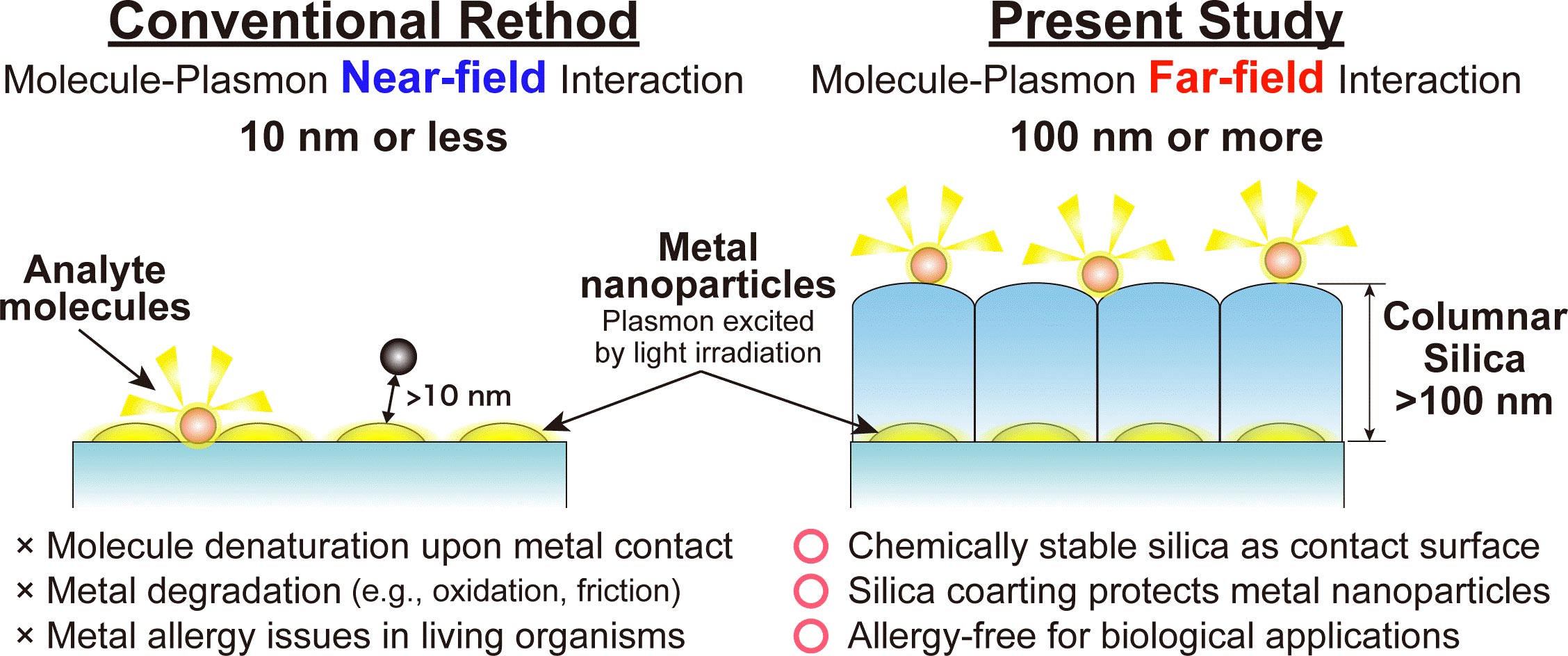
    Interactions Between Molecules and Plasmons
    Short-range interactions between molecules and plasmons as previously known, compared to the long-range interactions revealed in this study. Credit: Takeo Minamikawa

    Challenges in Current Spectroscopic Methods

    Despite their usefulness, these techniques come with challenges. Fluorescent tags can interfere with normal cell functions, and Raman signals are often very weak. Increasing the laser’s power or exposure time to strengthen the signal can damage sensitive biological molecules.

    To overcome this, researchers have developed surface-enhanced versions of these methods using metal substrates or nanostructures to amplify the signal. However, these enhancements can also pose risks to cell integrity.

    Breakthrough in Signal Enhancement

    Now, in a study published on October 28 in the journal Light: Science & Applications, scientists from Osaka University described a new method for the long-range enhancement of fluorescence and Raman signals using a dense random array of Ag nanoislands.

    The analyte molecules are kept separate from metal structures using a 100-nm thick column-structured silica layer. This layer is thick enough to protect the molecules being studied, but at the same time thin enough for the collective electromagnetic oscillations in the metal layer, called plasmons, to enhance the spectroscopic signal.

    “We demonstrated that the range of influence of plasmons in metals can exceed 100 nanometers, far beyond what conventional theory predicted,” lead author Takeo Minamikawa says.

    Highly Sensitive Molecular Detection Through Long-Range Molecule-Plasmon Interactions
    Highly sensitive molecular detection with chemical stability and mechanical robustness through long-range molecule-plasmon interactions. Credit: Takeo Minamikawa, Reiko Sakaguchi, Yoshinori Harada, Hiroki Tanioka, Sota Inoue, Hideharu Hase, Yasuo Mori, Tetsuro Takamatsu, Yu Yamasaki, Yukihiro Morimoto, Masahiro Kawasaki, and Mitsuo Kawasaki

    Implications for Biosensing Technology

    The researchers showed that using these biocompatible sensor substrates could increase the signal an amazing ten million times. In addition, because the metal nanostructures never come in direct contact with the molecules being studied, they are ideal for biological systems that could be damaged by conventional methods.

    “The chemical stability and mechanical robustness of our substrates make them suitable for a wide range of applications, including environmental pollutant detection or medical diagnosis,” senior author Mitsuo Kawasaki says.

    Additionally, the sensor substrates can be produced quickly and at large scales using a thin-film fabrication technique called sputtering. As a result, new biosensing devices can be more affordable when deployed in industrial and healthcare settings.

    Reference: “Long-range enhancement for fluorescence and Raman spectroscopy using Ag nanoislands protected with column-structured silica overlayer” by Takeo Minamikawa, Reiko Sakaguchi, Yoshinori Harada, Hiroki Tanioka, Sota Inoue, Hideharu Hase, Yasuo Mori, Tetsuro Takamatsu, Yu Yamasaki, Yukihiro Morimoto, Masahiro Kawasaki and Mitsuo Kawasaki, 28 October 2024, Light: Science & Applications.
    DOI: 10.1038/s41377-024-01655-3

    Never miss a breakthrough: Join the SciTechDaily newsletter.
    Follow us on Google and Google News.

    Biotechnology Chinese Academy of Sciences Imaging Medical Imaging Optics Spectroscopy
    Share. Facebook Twitter Pinterest LinkedIn Email Reddit

    Related Articles

    Revolutionary Two-Photon Microscope Captures Brain Activity in Real-Time

    See Only What You Should: UCLA’s Game-Changing Imaging Tech

    Pioneering Single-Pixel Technology Achieves 3D Imaging of Living Cells

    New Microscopy Imaging Technique: RESORT Unveils Living Systems Like Never Before

    Avalanching Nanoparticles Break Barriers to Imaging Cells in Real Time

    Innovation Spins Spider Web Architecture Into 3D Biomedical Imaging Technology

    Microscope Lens Inspired by Lighthouses Makes It Easier to Observe Molecular-Level Details of Biological Processes

    Mosquito Eye Inspires Artificial Compound Lens That Could Lead to New Vision Systems [Video]

    MIT Develops New Imaging System with Open-Ended Bundle of Optical Fibers

    Leave A Reply Cancel Reply

    • Facebook
    • Twitter
    • Pinterest
    • YouTube

    Don't Miss a Discovery

    Subscribe for the Latest in Science & Tech!

    Trending News

    AI Could Detect Early Signs of Alzheimer’s in Under a Minute – Far Before Traditional Tests

    What if Dark Matter Has Two Forms? Bold New Hypothesis Could Explain a Cosmic Mystery

    This Metal Melts in Your Hand – and Scientists Just Discovered Something Strange

    Beef vs. Chicken: Surprising Results From New Prediabetes Study

    Alzheimer’s Breakthrough: Scientists Discover Key Protein May Prevent Toxic Protein Clumps in the Brain

    Quantum Reality Gets Stranger: Physicists Put a Lump of Metal in Two Places at Once

    Scientists May Have Found the Key to Jupiter and Saturn’s Moon Mystery

    Scientists Uncover Brain Changes That Link Pain to Depression

    Follow SciTechDaily
    • Facebook
    • Twitter
    • YouTube
    • Pinterest
    • Newsletter
    • RSS
    SciTech News
    • Biology News
    • Chemistry News
    • Earth News
    • Health News
    • Physics News
    • Science News
    • Space News
    • Technology News
    Recent Posts
    • A Medieval Japanese Diary Just Helped Scientists Detect a Dangerous Solar Event
    • Humans Returned to Britain 500 Years Earlier Than Scientists Thought
    • 250-Million-Year-Old Egg Solves One of Evolution’s Biggest Mysteries
    • Living With Roommates Might Be Changing Your Gut Microbiome Without You Knowing
    • Simple and Cheap Blood Test Could Detect Cancer and Other Diseases Before Symptoms Appear
    Copyright © 1998 - 2026 SciTechDaily. All Rights Reserved.
    • Science News
    • About
    • Contact
    • Editorial Board
    • Privacy Policy
    • Terms of Use

    Type above and press Enter to search. Press Esc to cancel.