
Close Menu
    Facebook X (Twitter) Instagram
    SciTechDaily
    • Biology
    • Chemistry
    • Earth
    • Health
    • Physics
    • Science
    • Space
    • Technology
    Facebook X (Twitter) Pinterest YouTube RSS
    SciTechDaily
    Home»Physics»Bizarre Breakthrough – Scientists Discover Unusual “Floppy” Crystals
    Physics

    Bizarre Breakthrough – Scientists Discover Unusual “Floppy” Crystals

    By University of AmsterdamApril 25, 20231 Comment2 Mins Read
    Facebook Twitter Pinterest Telegram LinkedIn WhatsApp Email Reddit
    Share
    Facebook Twitter LinkedIn Pinterest Telegram Email Reddit
    Floppy Crystals
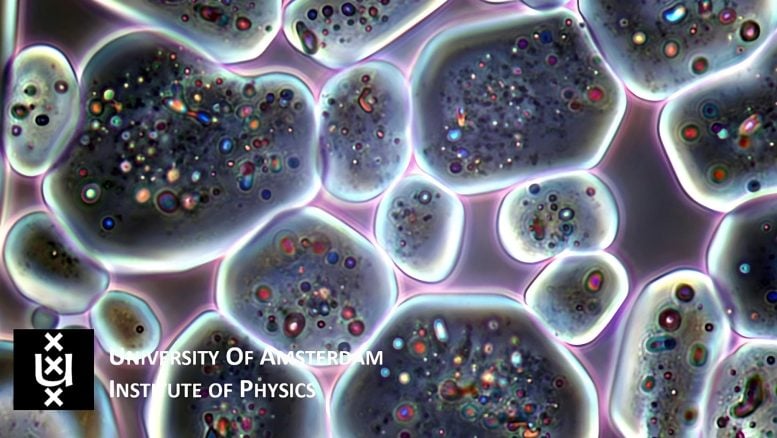
    Floppy crystals. Salts that contain water in their crystalline structure can become soft and floppy. Credit: UvA

    When it comes to crystals, we tend to imagine solid, rigid structures with distinct, repeating patterns, such as ice, salt, and quartz. However, new research conducted by Noushine Shahidzadeh, a physicist from the University of Amsterdam Institute of Physics, reveals a different reality: crystals can also be soft and pliable, lacking the recognizable facets that we typically associate with them.

    The results of this research were recently published in the journal Nature Communications.

    Floppy Crystals

    Crystals are generically hard solids and are usually identified by their well-defined geometrical shape that reflects the underlying highly ordered molecular structure. In their paper, the physicists show that surprisingly, some salts that contain water in their crystalline structure (so-called hydrated salts) can behave remarkably differently.

    When these salts are slowly dissolved through contact with humid air, they become soft, deformable, and lose their facets. This is in contrast to regular crystals, which keep their faceted shape and stay hard while dissolving. Thus, the microcrystals that were studied simultaneously are crystalline in the bulk of the material but show liquid-like molecular mobility at their surfaces.

    Reference: “Softness of hydrated salt crystals under deliquescence” by Rozeline Wijnhorst, Menno Demmenie, Etienne Jambon-Puillet, Freek Ariese, Daniel Bonn, and Noushine Shahidzadeh, 25 February 2023, Nature Communications.
    DOI: 10.1038/s41467-023-36834-0

    The paper was selected by the editors of that journal as one of the featured articles for the Editors’ Highlights webpage of recent research in the section Materials science and chemistry. The Editors’ Highlights pages aim to showcase the 50 best papers recently published in an area.

    Never miss a breakthrough: Join the SciTechDaily newsletter.
    Follow us on Google and Google News.

    Crystals Popular University of Amsterdam
    Share. Facebook Twitter Pinterest LinkedIn Email Reddit

    Related Articles

    Scientists Discover a Mysterious Transition in an Exotic Electronic Crystal

    MIT Physicists Watch As Ultracold Atoms Form a Crystal of Quantum Tornadoes

    Groundbreaking Technique Yields Extraordinary Results – Limits on Long-Theorized “Fifth Force” of Nature

    Novel Metal Discovered Where Electrons Flow in the Same Way Water Flows in a Pipe

    Ghost Polaritons: New Type of Infrared Polaritons Discovered at the Surface of Bulk Crystals

    Scientists Discover New Crystal That Exhibits Exotic Form of Magnetism

    A Crystal Made Exclusively of Electrons – “Holy Grail” Wigner Crystals Observed for First Time

    Quantum Melting of Wigner Crystals: Creating a System for Studying Quantum Phase Transitions

    See World’s First Video of a Space-Time Crystal

    1 Comment

    1. Ralph Johnson on April 30, 2023 9:55 am

      This new observation of the floppy crystal makes me ponder, could the existence of floppy crystals in conjunction with our biological state of Life fit, with quantum states of our cells in our body’s our need for water, salt, oils, and conductive minerals some parts of flexible tissue. Of course my observation does not include all Coggs on the gear but a consideration should be given to the mechanics of life and intelligent thinking, We do know in computer sciences that crystals can hold information, and form piezoelectric impulses, etc..

      Reply
    Leave A Reply Cancel Reply

    • Facebook
    • Twitter
    • Pinterest
    • YouTube

    Don't Miss a Discovery

    Subscribe for the Latest in Science & Tech!

    Trending News

    Artificial Sweeteners May Harm Future Generations, Study Suggests

    Splashdown! NASA Artemis II Returns From Record-Breaking Moon Mission

    What If Consciousness Exists Beyond Your Brain

    Scientists Finally Crack the 100-Million-Year Evolutionary Mystery of Squid and Cuttlefish

    Beyond “Safe Levels”: Study Challenges What We Know About Pesticides and Cancer

    Researchers Have Found a Dietary Compound That Increases Longevity

    Scientists Baffled by Bizarre “Living Fossil” From 275 Million Years Ago

    Your IQ at 23 Could Predict Your Wealth at 27, Study Finds

    Follow SciTechDaily
    • Facebook
    • Twitter
    • YouTube
    • Pinterest
    • Newsletter
    • RSS
    SciTech News
    • Biology News
    • Chemistry News
    • Earth News
    • Health News
    • Physics News
    • Science News
    • Space News
    • Technology News
    Recent Posts
    • Geologists Reveal the Americas Collided Earlier Than We Thought
    • 20x Difference: Study Reveals True Source of Airborne Microplastics
    • Scientists Uncover Hidden Force Powering Yellowstone’s Supervolcano
    • This Metal Melts in Your Hand – and Scientists Just Discovered Something Strange
    • Why Losing Too Much Fat Can Be Just As Dangerous as Obesity
    Copyright © 1998 - 2026 SciTechDaily. All Rights Reserved.
    • Science News
    • About
    • Contact
    • Editorial Board
    • Privacy Policy
    • Terms of Use

    Type above and press Enter to search. Press Esc to cancel.