
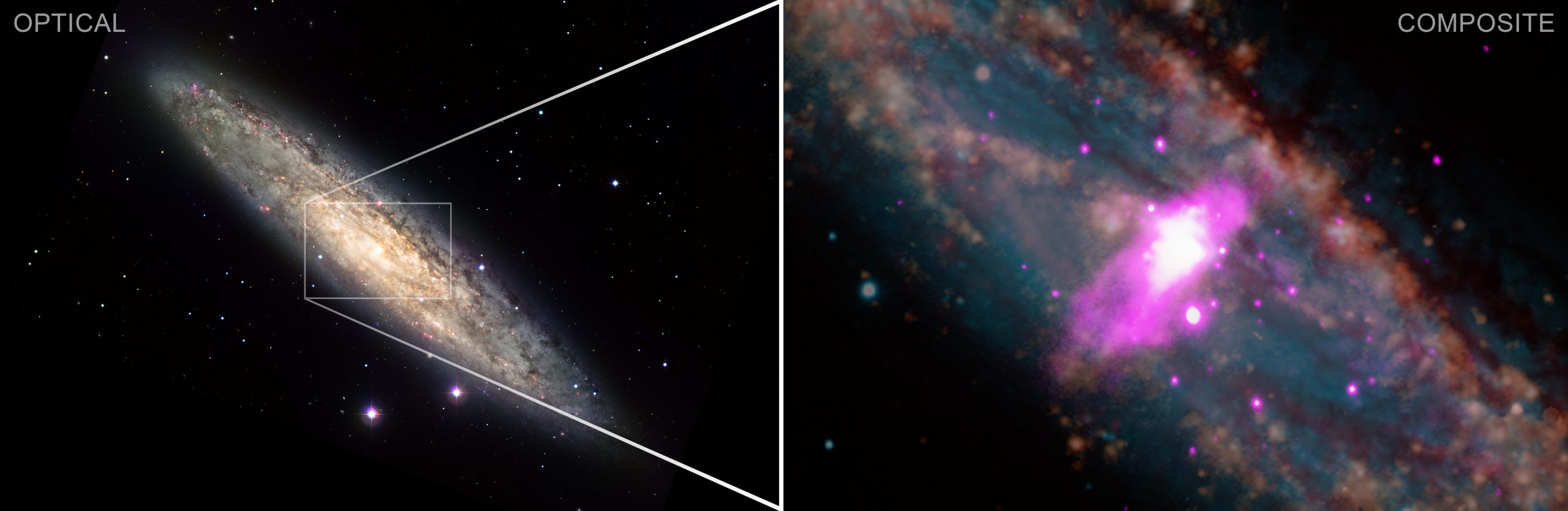
Researchers using NASA’s Chandra X-ray Observatory have studied the powerful winds in the center of the spiral galaxy NGC 253, which play a crucial role in the life cycle of stars and galaxies. The study challenges earlier models by showing that these winds are not spherical but more focused, and decrease in density and temperature with distance from the galaxy’s center.
- NGC 253 shows the effect of powerful winds being launched in opposite directions from the center of the galaxy.
- Although it is a spiral like our Milky Way galaxy, NGC 253 is forming stars at a higher rate.
- These young massive stars and their supernova explosions propel the winds that play an important role in the lifecycle of stars and the galaxy.
- Researchers used NASA’s Chandra X-ray Observatory (inset) and other telescopes to study NGC 253.
On Earth, wind can transport particles of dust and debris across the planet, with sand from the Sahara ending up in the Caribbean or volcanic ash from Iceland being deposited in Greenland. Wind can also have a big impact on the ecology and environment of a galaxy, just like on Earth, but on much larger and more dramatic scales.
A Stellar Wind Tunnel in NGC 253
A new study using NASA’s Chandra X-ray Observatory shows the effects of powerful winds launched from the center of a nearby galaxy, NGC 253, located 11.4 million light-years from Earth. This galactic wind is composed of gas with temperatures of millions of degrees that glows in X-rays. An amount of hot gas equivalent to about two million Earth masses blows away from the galaxy’s center every year.
NGC 253 is a spiral galaxy, making it similar to our Milky Way. However, stars are forming in NGC 253 about two to three times more quickly than in our home galaxy. Some of these young stars are massive and generate a wind by ferociously blowing gas from their surfaces. Even more powerful winds are unleashed when, later in their relatively short lives, these stars explode as supernovae, and hurl waves of material out into space.
NGC 253 gives astronomers a keyhole through which to study this important phase in the stellar life cycle. The material that the young stars send out into intergalactic space across hundreds of light-years is enriched with elements forged in their interior. These elements, which include many responsible for life on Earth, are folded into the next generations of stars and planets.
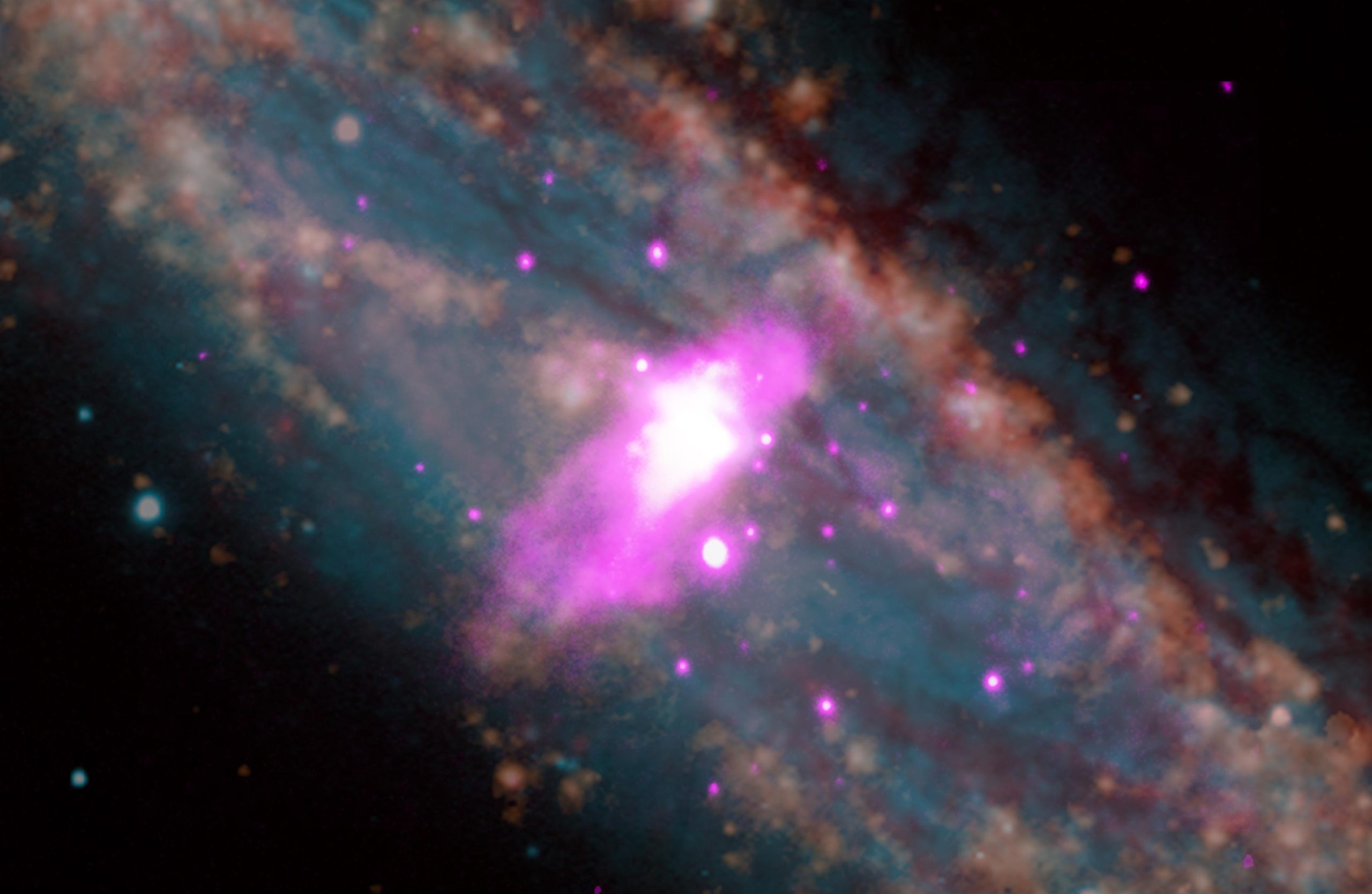
A new composite image of NGC 253 in the inset includes Chandra data (pink and white) showing that these winds blow in two opposite directions away from the center of the galaxy, to the upper right and lower left. Also shown in this image is visible light data (cyan) and emission from hydrogen (orange), both from a 0.9 meter telescope at Kitt Peak Observatory, and infrared data from NASA’s Spitzer Space Telescope (red). From Earth’s vantage point, NGC 253 appears nearly edge-on, as seen in the wider image in the graphic, which shows an optical image from the European Southern Observatory’s La Silla Observatory in Chile.
Unexpected Findings
A team led by Sebastian Lopez of The Ohio State University in Columbus, Ohio, used deep Chandra observations, taken over four days, to study the properties of the wind. They found that the densities and temperatures of the gas in the wind are the highest in regions less than about 800 light-years from the center of the galaxy — and then decrease with distance farther away.
These results disagree with an early model where the winds from so-called starburst galaxies like NGC 253 are spherical. Instead, recent theoretical work predicts that a more focused wind should be formed by a ring of “super star clusters” located near the center of NGC 253. Super star clusters contain large numbers of young, massive stars.
The focused nature of the wind observed by Lopez and his team, therefore, supports the idea that the super star clusters are a major source of the wind. However, there is not complete agreement between theory and observations, suggesting there is physics missing from the theory.
A hint about what is missing comes from the team’s observation that the wind cools rapidly as it moves away from the center of the galaxy. This suggests that the wind is plowing up cooler gas, causing the wind to cool and slow down. Such a ‘wind plow’ effect might be the extra physics required to produce better agreement between theory and observations.
Lopez and his colleagues also studied the composition of the wind, including how elements like oxygen, neon, magnesium, silicon, sulfur, and iron are scattered across the structure. They found that these elements become much more diluted farther away from the center of the galaxy. Astronomers did not see such a rapid decrease in the amounts of these elements in the wind from another well-studied galaxy undergoing a burst of star formation, M82.
Astronomers will need future observations of other galaxies with winds to understand whether this difference is related to the general properties of the galaxies, such as the total mass of the stars they contain.
Reference: “X-Ray Properties of NGC 253’s Starburst-driven Outflow” by Sebastian Lopez, Laura A. Lopez, Dustin D. Nguyen, Todd A. Thompson, Smita Mathur, Alberto D. Bolatto, Neven Vulic and Amy Sardone, The Astrophysical Journal.
DOI: 10.3847/1538-4357/aca65e
A paper describing these results was published in The Astrophysical Journal. The authors are Sebastian Lopez, Laura Lopez, Dustin Nguyen, Todd Thompson, and Smita Mathur (The Ohio State University); Alberto Bolatto (University of Maryland, College Park); Neven Vulic (Eureka Scientific); and Amy Sardone (Ohio State).
NASA’s Marshall Space Flight Center manages the Chandra program. The Smithsonian Astrophysical Observatory’s Chandra X-ray Center controls science operations from Cambridge, Massachusetts, and flight operations from Burlington, Massachusetts.
Never miss a breakthrough: Join the SciTechDaily newsletter.
Follow us on Google and Google News.
4 Comments
Fake
Please, Please, Please
A science publication should get the science correct.
The first sentence “Data from Chandra show the effects of powerful winds launched from the center of a nearby galaxy” ill serves a scientific publication. As even we laypersons know there are no winds in outer space, matter is moved there only by gravatational forces.
“Wind” actually exists in space. It is just not typical wind. You can google cosmic/solar wind if you want to learn more.
shalom, glorious blog on fatlike loss. parallel helped.