

On the night of March 13 or early March 14, the Moon will transform into a stunning red orb as it moves into Earth’s shadow during a total lunar eclipse. No special equipment is needed to enjoy this rare event, though binoculars or a telescope will enhance the view.
The eclipse unfolds in phases, from a subtle dimming to full totality, when the Moon takes on its eerie red glow. The phenomenon occurs due to Earth’s atmosphere filtering sunlight, much like the effect of a fiery sunset. Along with the eclipse, skywatchers can catch sight of Jupiter, Mars, and a spectacular display of stars.
On March 14, 2025 (the night of March 13), the Moon enters the Earth’s shadow, creating a total lunar eclipse, the first since November of 2022. This animation shows the changing appearance of the Moon as it travels into and out of the Earth’s shadow, along with times at various stages. Celestial north is up in this imagery, corresponding to the view from mid-northern latitudes. Rotating the images by 180 degrees would create the south-up view for southern hemisphere observers. Credit: NASA’s Scientific Visualization Studio
The Moon will move into Earth’s shadow on the night of March 13 or early on March 14, depending on your time zone. During this total lunar eclipse, the Moon will take on a reddish hue, creating a striking celestial display.
What is a Lunar Eclipse?
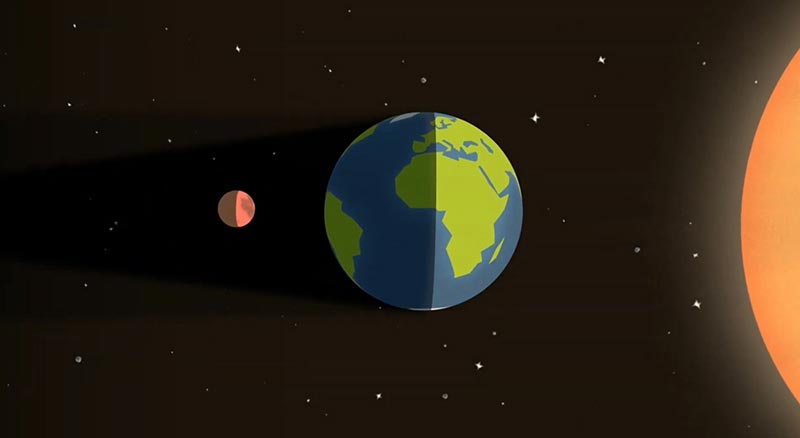
A lunar eclipse happens when the Sun, Earth, and Moon align, causing the Moon to pass through Earth’s shadow. In a total lunar eclipse, the entire Moon enters the darkest part of the shadow, known as the umbra, which gives it a reddish-orange glow. This effect, often called a “Blood Moon,” occurs because Earth’s atmosphere filters and scatters sunlight, allowing only red and orange wavelengths to reach the Moon.
How to Watch the Eclipse
You don’t need any special equipment to see a lunar eclipse—just step outside and look up! However, using binoculars or a telescope can enhance the view. For the best experience, find a dark location away from city lights.
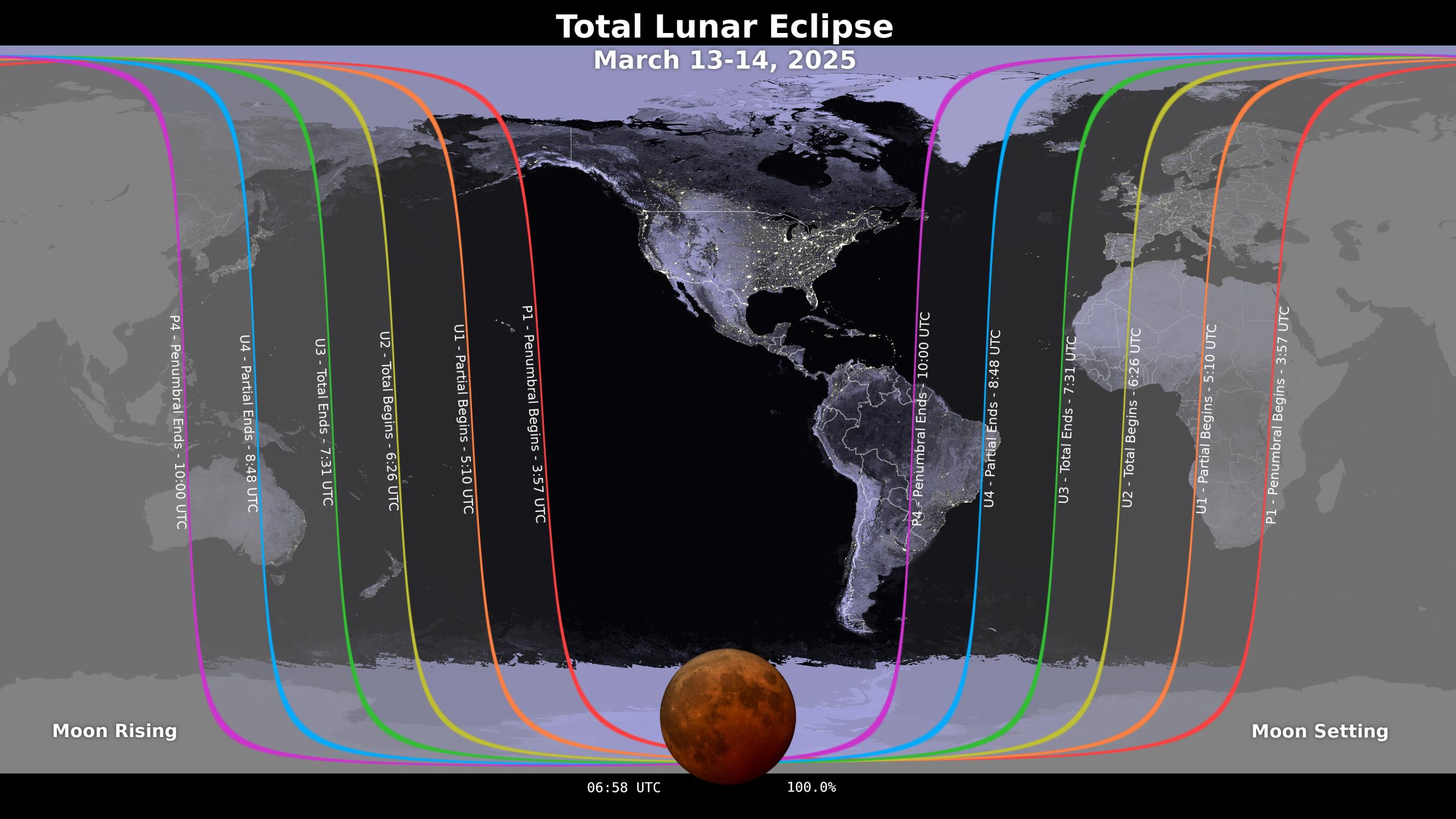
This total lunar eclipse will be visible across the Western Hemisphere, offering a spectacular sight to skywatchers in many regions.
The appearance of the Moon during the March 2025 total lunar eclipse. Includes annotations of the contact times and various eclipse statistics. Credit: NASA’s Scientific Visualization Studio
What can I expect to observe?
| Milestone: | What’s happening: |
| Penumbral eclipse begins (8:57 p.m. PDT, 11:57 p.m. EDT, 03:57 UTC) | The Moon enters the Earth’s penumbra, the outer part of the shadow. The Moon begins to dim, but the effect is quite subtle. |
| Partial eclipse begins (10:09 p.m. PDT, 1:09 a.m. EDT, 05:09 UTC) | The Moon begins to enter Earth’s umbra and the partial eclipse begins. To the naked eye, as the Moon moves into the umbra, it looks like a bite is being taken out of the lunar disk. The part of the Moon inside the umbra appears very dark. |
| Totality begins (11:26 p.m. PDT, 2:26 a.m. EDT, 06:26 UTC) | The entire Moon is now in the Earth’s umbra. The Moon is tinted a coppery red. Try binoculars or a telescope for a better view. If you want to take a photo, use a camera on a tripod with exposures of at least several seconds. |
| Totality ends (12:31 a.m. PDT, 3:31am EDT, 07:31 UTC) | As the Moon exits Earth’s umbra, the red color fades. It looks as if a bite is being taken out of the opposite side of the lunar disk from before. |
| Partial eclipse ends (1:47 a.m. PDT, 4:47 a.m. EDT, 08:47 UTC) | The whole Moon is in Earth’s penumbra, but again, the dimming is subtle. |
| Penumbral eclipse ends (3:00 a.m. PDT, 6:00 a.m. EDT, 10:00 UTC) | The eclipse is over. |

Why does the Moon turn red during a lunar eclipse?
The same phenomenon that makes our sky blue and our sunsets red causes the Moon to turn reddish-orange during a lunar eclipse. Sunlight appears white, but it actually contains a rainbow of components—and different colors of light have different physical properties. Blue light scatters relatively easily as it passes through Earth’s atmosphere. Reddish light, on the other hand, travels more directly through the air.
When the Sun is high on a clear day, we see blue light scattered throughout the sky overhead. At sunrise and sunset, when the Sun is near the horizon, incoming sunlight travels a longer, low-angle path through Earth’s atmosphere to observers on the ground. The bluer part of the sunlight scatters away in the distance (where it’s still daytime), and only the yellow-to-red part of the spectrum reaches our eyes.
During a lunar eclipse, the Moon appears red or orange because any sunlight that’s not blocked by our planet is filtered through a thick slice of Earth’s atmosphere on its way to the lunar surface. It’s as if all the world’s sunrises and sunsets are projected onto the Moon.
What else can I observe on the night of the eclipse?
Look to the western sky on the night of the eclipse for a glimpse of planets Jupiter and Mars. The Moon will be in the constellation Leo, under the lion’s hind paw, at the beginning of the eclipse; soon afterward, it will cross into the constellation Virgo. As Earth’s shadow dims the Moon’s glow, constellations may be easier to spot than usual.
Visit the What’s Up guide for more March 2025 skywatching tips.
Never miss a breakthrough: Join the SciTechDaily newsletter.
Follow us on Google and Google News.
1 Comment
In india ir is not visible