
A new study suggests different species may rely on a shared principle for neural network formation.
In all species, brain function relies on an intricate network of connections that allows neurons to send information back and forth between one another, commanding thought and physical activity. But within those networks a small number of neurons share much stronger connections to one another than all the others. These abnormally strong connections—known as “heavy tailed” based on the shape of their distribution—are thought to play an outsized role in brain function.
Research on Neural Network Connections
Researchers have long wondered how neural networks are able to rearrange to form these rare connections and whether the formation process is species specific or governed by a deeper shared principle. With the publication of a new paper today (January 17) in the journal Nature Physics, scientists at the CUNY Graduate Center Initiative for the Theoretical Sciences (ITS), Yale, University of Chicago, and Harvard are getting closer to answering these questions.
Understanding Strong Neural Connections
“To understand these very strong connections between neurons, you can think of a social network: Some connections, like those with your best friends and family, are much stronger than most, and these are very important in the network,” explains Christopher Lynn, the paper’s first author, previously a postdoctoral fellow with the ITS program and now an Assistant Professor of Physics at Yale.
“Until recently, we didn’t have a way of teasing out the mechanism by which these rare connections come together, but advances in particular forms of microscopy and imaging now allow us to take a peek into how it happens.”
Comparative Analysis Across Species
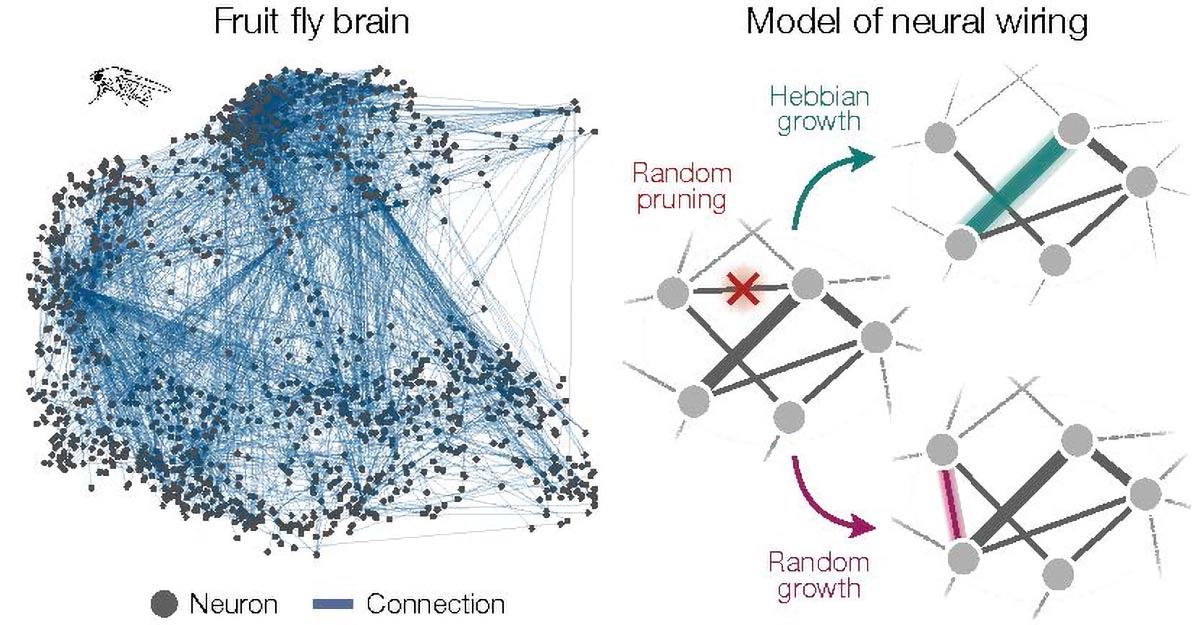
The researchers analyzed large, openly available datasets of the wiring between neurons in fruit flies, mice, and two worm species (C. elegans and Platynereis). The catalogued data, which was collected using volume electron microscopy and high-throughput image processing, allowed them to compare networks across multiple species, looking for similarities and differences in the way heavy tailed connections form.
Mathematical Modeling and Key Findings
The scientists created a mathematical model to describe how they believed wiring between neurons can rearrange to develop these strong connections. This model was based on a decades-old mechanism from neuroscience known as Hebbian plasticity, which says when neurons fire together, they wire together. The researchers showed that this Hebbian plasticity leads neurons to form the types of heavy tailed connections they observed in the data. What’s more, when they included neural activity in the model, a second key feature of neural network structure emerged: clustering, or the tendency for neurons to form tightly knit groups.
Universal Principles of Neural Networks
“Our model was based on the assumption that neurons rearrange and connect under a mixture of Hebbian and random dynamics,” said Lynn, noting that neurons sometimes connect for specific reasons, but other times randomly.
The research team’s model proved applicable across species, showing how simple and general principles of cellular self-organization can lead to the very strong connections and tightly connected networks that exist in the brain. The findings suggest that neuronal network formation isn’t dependent on species-specific mechanisms, but instead might be governed by a simple principle of self-organization.
This new knowledge could provide an important foundation for investigating brain structure in other animals and may even help to better understand human brain function.
Reference: “Heavy-tailed neuronal connectivity arises from Hebbian self-organization” by Christopher W. Lynn, Caroline M. Holmes and Stephanie E. Palmer, 17 January 2024, Nature Physics.
DOI: 10.1038/s41567-023-02332-9
Never miss a breakthrough: Join the SciTechDaily newsletter.
Follow us on Google and Google News.
4 Comments
According to topological vortex gravitational field theory, the information about the existence and evolution of matter lies within its spatial structure.
Isotopes exhibit completely different properties due to their different spatial structures.
The rotation of topological vortices is spin. Spin generates gravitation, spin generates energy, spin generates time, spin generates evolution. The synchronous effect of different topological vortices is the basis for the formation and evolution of all things. The information about the existence and evolution of matter has always been present in the spatial structure of topological vortex interactions. If the spatial structure of topological vortex interactions never dies, matter never dies.
Oh Zhang what have you been smoking….back to basics for you…