
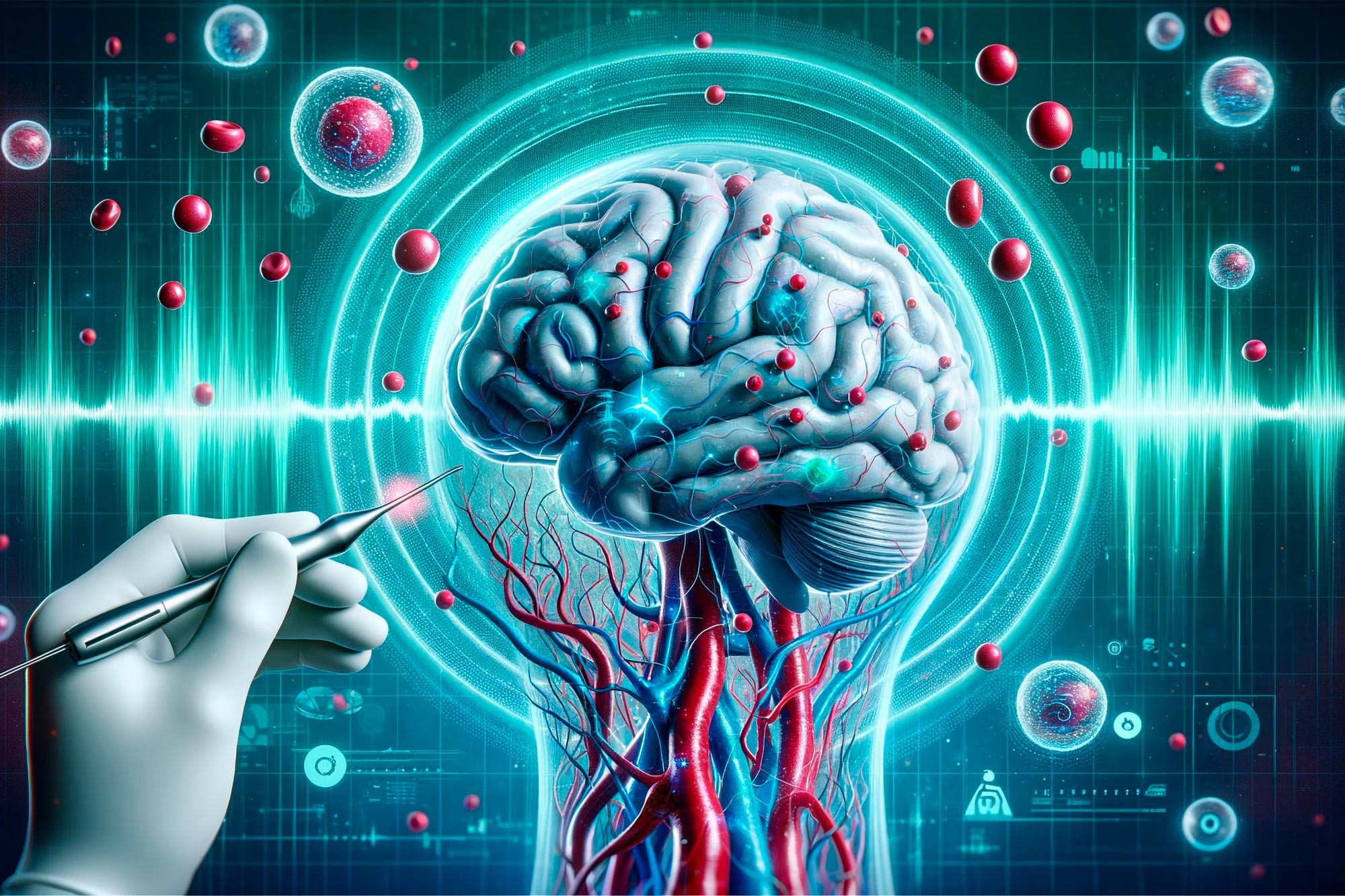
ETH Zurich researchers have shown for the first time that microvehicles can be steered through blood vessels in the brains of mice using ultrasound. They hope that this will eventually lead to treatments capable of delivering drugs with pinpoint precision.
- A technology developed at ETH Zurich over the past few years for controlling microvehicles using ultrasound also works in the brain, as researchers have now been able to show.
- These microvehicles are gas bubbles, which are harmless and dissolve once their job is done.
- In the future, these microvehicles could be equipped with medications and deliver them to specific points in the brain. This may increase the efficacy of the drugs and reduce their side effects.
Brain tumors, brain hemorrhages, and neurological and psychological conditions are often hard to treat with medication. And even when effective drugs are available, these tend to have severe side effects because they circulate throughout the brain and not just the area they are meant to treat. In light of this situation, researchers have high hopes of one day being able to provide a more targeted approach that would deliver medications to very specifically defined locations. To this end, they are in the process of developing mini-transporters that can be guided through the dense maze of blood vessels.
Researchers at ETH Zurich, the University of Zurich, and the University Hospital Zurich have now managed for the first time to guide microvehicles through the blood vessels in the brain of an animal using ultrasound.

Ultrasound Instead of Magnetism
Compared to alternative navigation technologies such as those based on magnetic fields, ultrasound offers certain benefits. Daniel Ahmed, Professor of Acoustic Robotics at ETH Zurich and supervisor of the study, explains: “In addition to being widely used in the medical field, ultrasound is safe and penetrates deep into the body.”
For their microvehicle, Ahmed and his colleagues used gas-filled microbubbles coated in lipids – the same substances that biological cell membranes are made of. The bubbles have a diameter of 1.5 micrometers and are currently used as contrast material in ultrasound imaging.
Advantages of Ultrasound-Guided Microbubbles
As the researchers have now shown, these microbubbles can be guided through blood vessels. “Since these bubbles, or vesicles, are already approved for use in humans, it’s likely that our technology will be approved and used in treatments for humans more quickly than other types of microvehicles currently in development,” Ahmed says. He was awarded a Starting Grant by the European Research Council ERC in 2019 for his project to research and develop this technology.
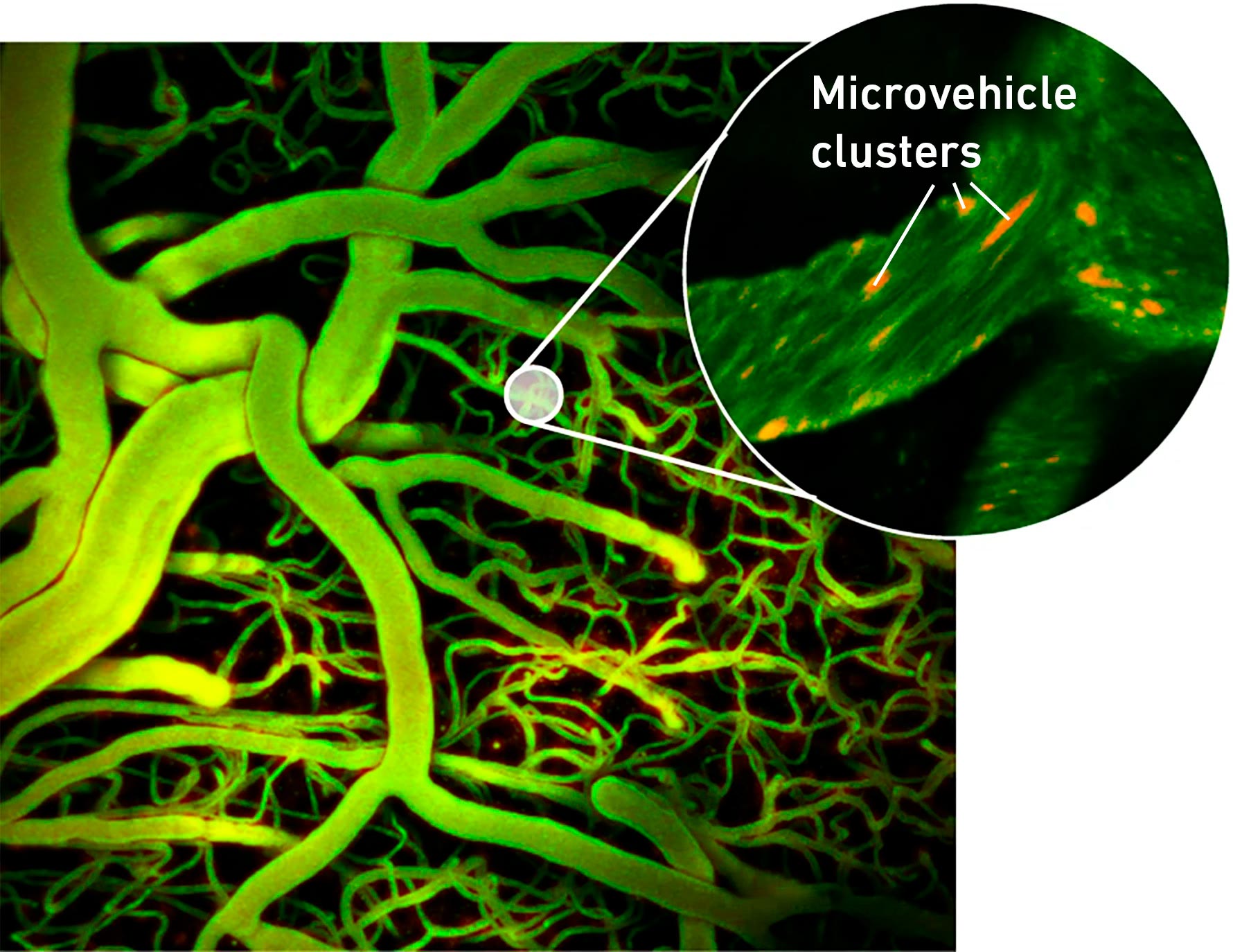
Another benefit of the ultrasound-guided microbubbles is that they dissolve in the body once they’ve done their job. When using another approach, magnetic fields, the microvehicles have to be magnetic, and it’s not easy to develop biodegradable microvehicles. Moreover, the microbubbles developed by the ETH Zurich researchers are small and smooth. “This makes it easy for us to guide them along narrow capillaries,” says Alexia Del Campo Fonseca, a doctoral student in Ahmed’s group and lead author of the study.
Going Against the Flow
Over the past few years, Ahmed and his group have been working in the lab to develop their method for guiding microbubbles through narrow vessels. Now, in collaboration with researchers from the University of Zurich and University Hospital Zurich, they have tested this method on blood vessels in the brains of mice. The researchers injected the bubbles into the rodents’ circulatory system, where they are swept along in the bloodstream without any outside help. However, the researchers managed to use ultrasound to hold the vesicles in place and guide them through the brain vessels against the direction of blood flow. The researchers were even able to guide the bubbles through convoluted blood vessels or get them to change direction multiple times in order to steer them into the narrowest branches of the bloodstream.
To control the microvehicles’ movements, the researchers also attached four small transducers to the outside of each mouse’s skull. These devices generate vibrations in the ultrasonic range, which spread through the brain as waves. At certain points in the brain, the waves emitted by two or more transducers can either amplify each other or cancel each other out. The researchers guide the bubbles using a sophisticated method of adjusting the output of each individual transducer. Real-time imaging shows them what direction the bubbles are moving in.
Future Plans
To create the imaging for this study, the researchers used two-photon microscopy. In the future, they also want to use ultrasound itself for imaging and plan to enhance ultrasound technology for this purpose.
In this study, the microbubbles were not equipped with medications. The researchers first wanted to show that they could guide the microvehicles along blood vessels and that this technology is suitable for use in the brain. That’s where there are promising medical applications, including in the treatment of cancer, stroke, and psychological conditions. The researchers’ next step will be to attach drug molecules to the outside of the bubble casing for transport. They want to enhance the entire method to the point at which it can be used in humans, hoping it will one day provide the basis for the development of new treatments.
Reference: “Ultrasound trapping and navigation of microrobots in the mouse brain vasculature” by Alexia Del Campo Fonseca, Chaim Glück, Jeanne Droux, Yann Ferry, Carole Frei, Susanne Wegener, Bruno Weber, Mohamad El Amki and Daniel Ahmed, 21 September 2023, Nature Communications.
DOI: 10.1038/s41467-023-41557-3
Never miss a breakthrough: Join the SciTechDaily newsletter.
Follow us on Google and Google News.
1 Comment
Had this read to me by artifact and got an aha.
Anna couldn’t have surgery get a stent to her blood clot down crooked tiny blood vessels and so has had stroke damage.
These bubbles afford local delivery and they do say at the bottom of the article that they are good for strokes.
I would recommend they deliver a blood thinner to the clot with the ultrasound.