
Close Menu
    Facebook X (Twitter) Instagram
    SciTechDaily
    • Biology
    • Chemistry
    • Earth
    • Health
    • Physics
    • Science
    • Space
    • Technology
    Facebook X (Twitter) Pinterest YouTube RSS
    SciTechDaily
    Home»Physics»Breaking Barriers: World’s First Dual-Beamline Photoelectron Momentum Microscope Unveiled in Japan
    Physics

    Breaking Barriers: World’s First Dual-Beamline Photoelectron Momentum Microscope Unveiled in Japan

    By National Institutes of Natural SciencesMay 18, 2024No Comments3 Mins Read
    Facebook Twitter Pinterest Telegram LinkedIn WhatsApp Email Reddit
    Share
    Facebook Twitter LinkedIn Pinterest Telegram Email Reddit
    Dual Beamline Photoelectron Momentum Microscope
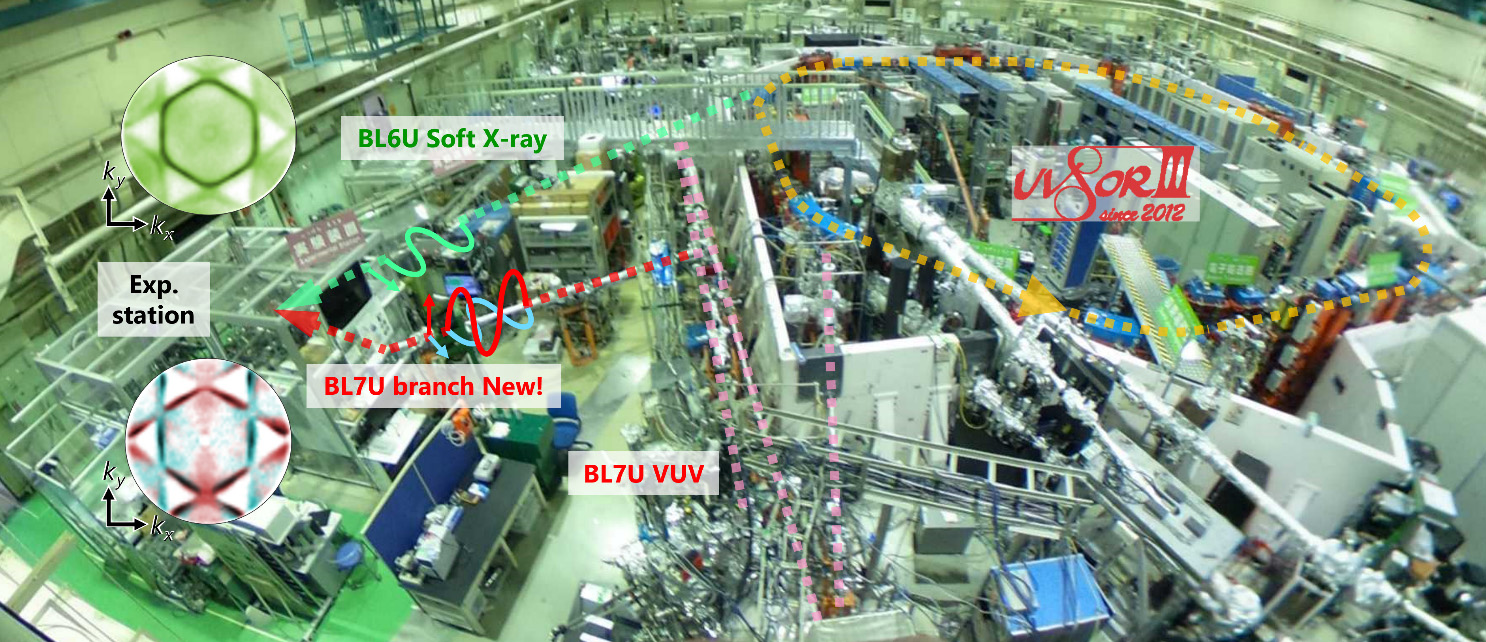
    Beamlines BL6U, BL7U, the newly constructed BL7U branch, and electron storage ring are highlighted in dotted lines. The upper (lower) left inset shows the photoelectron momentum pattern of the Au(111) surface measured using BL6U (the BL7U branch). Credit: Prof. Fumihiko Matsui Group, Institute for Molecular Science

    Japan’s UVSOR Facility unveils the first dual-beamline photoelectron momentum microscope, enhancing the study of electron behaviors in materials and advancing materials science.

    The world’s first dual-beamline photoelectron momentum microscope has been developed at the UVSOR Synchrotron Facility in Japan. This innovative experimental station brings breakthroughs in studying the behavior of electrons in materials governing material properties, particularly in analyzing valence orbitals.

    Understanding the behavior of electrons in materials is crucial for the advancement of materials science and device engineering. Conventional photoelectron spectroscopy provides deep insight into the nature of the electronic structure of solids. Currently, the challenge of researching electronic structures on the micrometer scale is being pursued all over the world. A state-of-the-art momentum-resolved photoelectron spectroscopy apparatus with additional microscopic function, called a “photoelectron momentum microscope,” was constructed at the UVSOR Synchrotron Facility, Institute for Molecular Science, Japan, revolutionizing micrometer-scale analyses of the behavior of electrons.

    Collaboration and Technological Upgrade

    Researchers from the Institute for Molecular Science / The Graduate University for Advanced Studies, SOKENDAI in collaboration with Osaka University have upgraded this advanced analyzer and experimental station to use two undulator beamlines as excitation sources. By branching the existing vacuum ultraviolet (VUV) beamline BL7U, VUV light has now become simultaneously available at the photoelectron momentum microscope in addition to a soft-X ray beam from the beamline BL6U.

    This world’s first “dual-beamline photoelectron momentum microscope” allows 1) element-selective measurements using the grazing-incidence soft X-ray light and 2) highly symmetric measurements using the normal-incidence VUV light. Taking advantage of the flexibility of these light sources creates a new pathway for multimodal analyses of the behavior of electrons. Particularly, we stress that photoelectron spectroscopy in the normal-incidence configuration is only available with this apparatus at UVSOR worldwide. Highly symmetric configuration with such normal incidence facilitates, especially, precise analyses of valence orbital via photon polarization-dependent transition-matrix-element analysis. In this work, we applied this approach to the valence electrons of the Au(111) surface.

    This unique dual-beamline photoelectron momentum microscopy offers deeper insights into the behavior of electrons in materials, innovating fields of condensed matter physics, molecular science, and materials science.

    Reference: “Development of dual-beamline photoelectron momentum microscopy for valence orbital analysis” by Kenta Hagiwara, Eiken Nakamura, Seiji Makita, Shigemasa Suga, Shin-ichiro Tanaka, Satoshi Keraa and Fumihiko Matsui, May 2024, Journal of Synchrotron Radiation.
    DOI: 10.1107/S1600577524002406

    The research was funded by the MEXT Fostering Joint International Research (B), and a MEXT Grant-in-Aid for Scientific Research(S).

    Never miss a breakthrough: Join the SciTechDaily newsletter.
    Follow us on Google and Google News.

    Electron Microscopy Microscope National Institutes of Natural Sciences
    Share. Facebook Twitter Pinterest LinkedIn Email Reddit

    Related Articles

    Not Just Geometry: Organic Superconductors Flip Physics Rules

    Quantum Chill: Developing Japan’s First “Cold (Neutral) Atom” Quantum Computers

    Seemingly “Defying the Laws of Physics” – Distinguishing Between Right and Left With Magnets

    High-Speed Moving Fusion Plasma Turbulence Discovered for the First Time in the World

    Ultrafast Intra-atom Electron Motion Tracked Using Synchrotron Radiation

    Pathbreaking Platform for Quantum Simulation: A Metal-Like Quantum Gas

    Attosecond Control of an Atomic Electron Cloud Using Synchrotron Radiation

    High-Energy Radiation is Refracted Setting the Stage for Gamma Optics

    Leave A Reply Cancel Reply

    • Facebook
    • Twitter
    • Pinterest
    • YouTube

    Don't Miss a Discovery

    Subscribe for the Latest in Science & Tech!

    Trending News

    Your Blood Pressure Reading Could Be Wrong Because of One Simple Mistake

    Astronomers Stunned by Ancient Galaxy With No Spin

    Physicists May Be on the Verge of Discovering “New Physics” at CERN

    Scientists Solve 320-Million-Year Mystery of Reptile Skin Armor

    Scientists Say This Daily Walking Habit May Be the Secret to Keeping Weight Off After Dieting

    New Therapy Rewires the Brain To Restore Joy in Depression Patients

    Giant Squid Detected off Western Australia in Stunning Deep-Sea Discovery

    Popular Sugar-Free Sweetener Linked to Liver Disease, Study Warns

    Follow SciTechDaily
    • Facebook
    • Twitter
    • YouTube
    • Pinterest
    • Newsletter
    • RSS
    SciTech News
    • Biology News
    • Chemistry News
    • Earth News
    • Health News
    • Physics News
    • Science News
    • Space News
    • Technology News
    Recent Posts
    • Common Blood Pressure Drug Supercharges Cancer Treatment in Surprising New Study
    • Key Magic Mushroom Ingredient Increases Laziness and Reduces Aggression
    • Researchers Solve 15-Year Mystery Behind Cancer-Causing Gut Toxin
    • One of the World’s Most Popular Weedkillers May Be Fueling Deadly Superbugs
    • Scientists Create Laser “Whirlpools” That Spin Tiny Cells Without Touching Them
    Copyright © 1998 - 2026 SciTechDaily. All Rights Reserved.
    • Science News
    • About
    • Contact
    • Editorial Board
    • Privacy Policy
    • Terms of Use

    Type above and press Enter to search. Press Esc to cancel.