
Close Menu
    Facebook X (Twitter) Instagram
    SciTechDaily
    • Biology
    • Chemistry
    • Earth
    • Health
    • Physics
    • Science
    • Space
    • Technology
    Facebook X (Twitter) Pinterest YouTube RSS
    SciTechDaily
    Home»Chemistry»Breaking Boundaries: Enhancing Catalysis With Co-Cu Alloy Nanoparticles
    Chemistry

    Breaking Boundaries: Enhancing Catalysis With Co-Cu Alloy Nanoparticles

    By Science China PressAugust 9, 2024No Comments2 Mins Read
    Facebook Twitter Pinterest Telegram LinkedIn WhatsApp Email Reddit
    Share
    Facebook Twitter LinkedIn Pinterest Telegram Email Reddit
    Cu Mediated Controllable Preparation and Performance Optimization for Co Nanoparticles
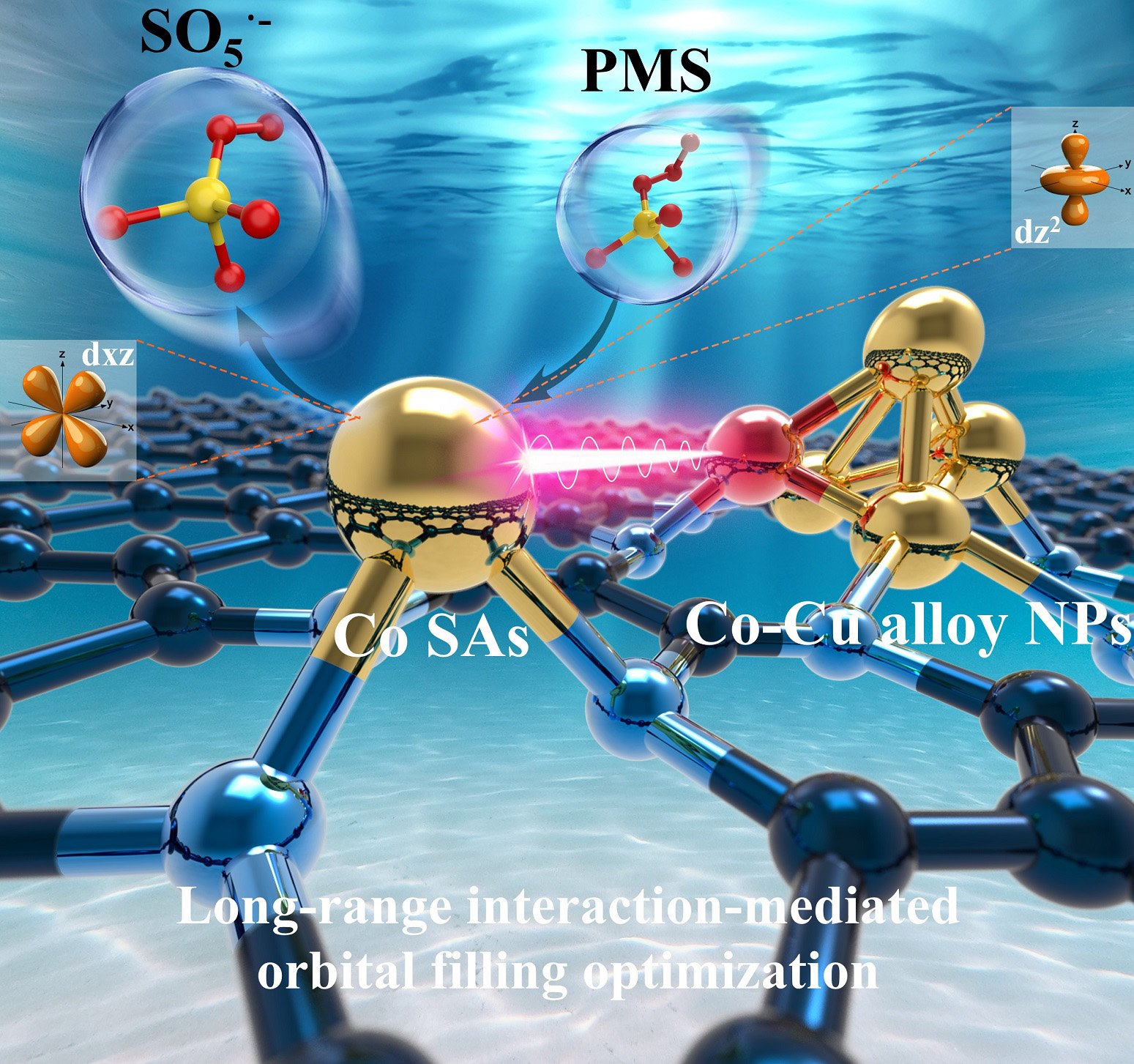
    Cu heteroatoms in Co nanoparticles−mediated long−range interaction regulates dz2/dxz orbital occupancy of satellite Co single atom to enhance Fenton−like reaction. Credit: Science China Press

    Scientists have developed Co-Cu alloy nanoparticles that efficiently activated chemical reactions for pollutant degradation, outperforming traditional methods and providing insights into atomic-level interactions in catalysts.

    Recent research has focused on the combined effects of atomic clusters (ACs) or nanoparticles (NPs) and single atoms. However, prior studies have typically concentrated on basic interactions between pure NPs and single atoms (SAs), offering a limited perspective. They have not fully explored how modifications to NPs or ACs could enhance the overall activity of the complete metal NPs/ACs@M-N-C entity. Consequently, there is still much to learn about the precise construction and performance enhancement of the entire metal NPs/ACs@M-N-C structure.

    In a new study, Co-Cu alloy NPs@Co-N-C (CC@CNC) was constructed using Co/Cu-modified zeolitic imidazolate framework-8 (ZIF-8) as precursor, followed by the pyrolysis and acid etching. The incorporation of Cu-induced formation of Co-Cu alloy NPs, originating from the low Tammann temperature of Cu, which was verified by the negative cohesive energy of Co10Cu3 (−0.06454, intending to aggregation) compared to that of Co13 (+1.690995, intending to dispersion).

    Enhanced Efficiency in Chemical Reactions

    The Co-Cu alloy NPs-supported Co SAs showed superior PMS activation efficiency compared to Co NPs-supported Co SAs (Co NPs@Co-N-C, C@CNC), evidenced by the decreased energy barriers of PMS adsorption (increased Co–O bond length)/PMS oxidation (increased O-H bond length and decreased O-O bond length) and SO5·- desorption (increased Co-O bond length), through optimizing dz2-O (PMS) and dxz-O (SO5·-) interaction.

    Therefore, the CC@CNC highly efficiently removed 80.67% of 20 mg/L carbamazepine (CBZ) within 5 min, which was superior to the C@CNC counterpart (58.99% within 5 min). The serial quasi in situ techniques indicated the occurred PMS oxidation reaction on Co SAs, which can selectively generate 1O2 to effectively eliminate CBZ. This study can lay a solid foundation for the performance optimization strategy and underlying mechanism revelation in metal multiple-atom assembly@metal SAs catalysts at the atomic orbital level.

    Reference: “Cu-optimized long-range interaction between Co nanoparticles and Co single atoms: Improved Fenton-like reaction activity” by Fan Mo, Zelin Hou, Qixing Zhou, Xixi Chen, Weitao Liu, Wendan Xue, Qi Wang, Jianling Wang, Tong Zheng and Zongxin Tao, 11 May 2024, Science Bulletin.
    DOI: 10.1016/j.scib.2024.05.002

    Never miss a breakthrough: Join the SciTechDaily newsletter.
    Follow us on Google and Google News.

    Materials Science Nanotechnology Science China Press
    Share. Facebook Twitter Pinterest LinkedIn Email Reddit

    Related Articles

    Powerful New Electronics Could Be Created at the Edge of Chaos

    Novel Carbon Coating Technology of Li-Rich Layered Oxide Cathode

    Luminescent Carbon Nanoparticles Exhibit Reversible Switching in Cancer Cells

    Scientists Discover Structural Change in Manganese Steel

    Researchers Develop a Better Method for Making Perovskite Solar Cells

    Copper Foam Provides a New Way to Turn CO2 into Useful Chemicals

    Researchers Grow Single-Walled Carbon Nanotubes with Identical Electronic Properties

    Researchers Identify a New Form of Carbon: Grossly Warped ‘Nanographene’

    Scientists Examine Platinum-Based Catalyst Design

    Leave A Reply Cancel Reply

    • Facebook
    • Twitter
    • Pinterest
    • YouTube

    Don't Miss a Discovery

    Subscribe for the Latest in Science & Tech!

    Trending News

    Popular Supplement Ingredient Linked to Shorter Lifespan in Men

    Scientists May Have Found a Way To Repair Nerve Damage in Multiple Sclerosis

    “Totally Unexpected” – Scientists Discover Pancreatic Cancer’s Fatal Addiction

    A Strange Quantum Effect May Explain One of Biology’s Greatest Mysteries

    James Webb Telescope Reveals the Universe’s Hidden Cosmic Web in Stunning Detail

    Scientists Identify Simple Supplement That Greatly Reduces Alzheimer’s Damage

    You May Have a Dangerous Type of Cholesterol Even if Your Tests Look Normal

    Your Blood Pressure Reading Could Be Wrong Because of One Simple Mistake

    Follow SciTechDaily
    • Facebook
    • Twitter
    • YouTube
    • Pinterest
    • Newsletter
    • RSS
    SciTech News
    • Biology News
    • Chemistry News
    • Earth News
    • Health News
    • Physics News
    • Science News
    • Space News
    • Technology News
    Recent Posts
    • After 50 Years of Mystery, Researchers Identify New Human Blood Group
    • Leading Climate Scientist Rebuts “Factually Incorrect” US Government Climate Claims
    • You’re Breathing Plastic: Study Finds 4% of City Air Pollution Is Microplastics
    • Cancer Mystery Solved: Scientists Discover How Melanoma Becomes “Immortal”
    • Scientists Uncover Cancer-Fighting Power of Popular Fatty Liver Drug
    Copyright © 1998 - 2026 SciTechDaily. All Rights Reserved.
    • Science News
    • About
    • Contact
    • Editorial Board
    • Privacy Policy
    • Terms of Use

    Type above and press Enter to search. Press Esc to cancel.