
Skyrmions could revolutionize computing, but simulating them in real-time has been a challenge—until now.
Researchers have devised a method that bridges the gap between simulations and real-world dynamics, paving the way for faster innovation in energy-efficient computing.
Magnetic Whirls: The Future of Data Storage?
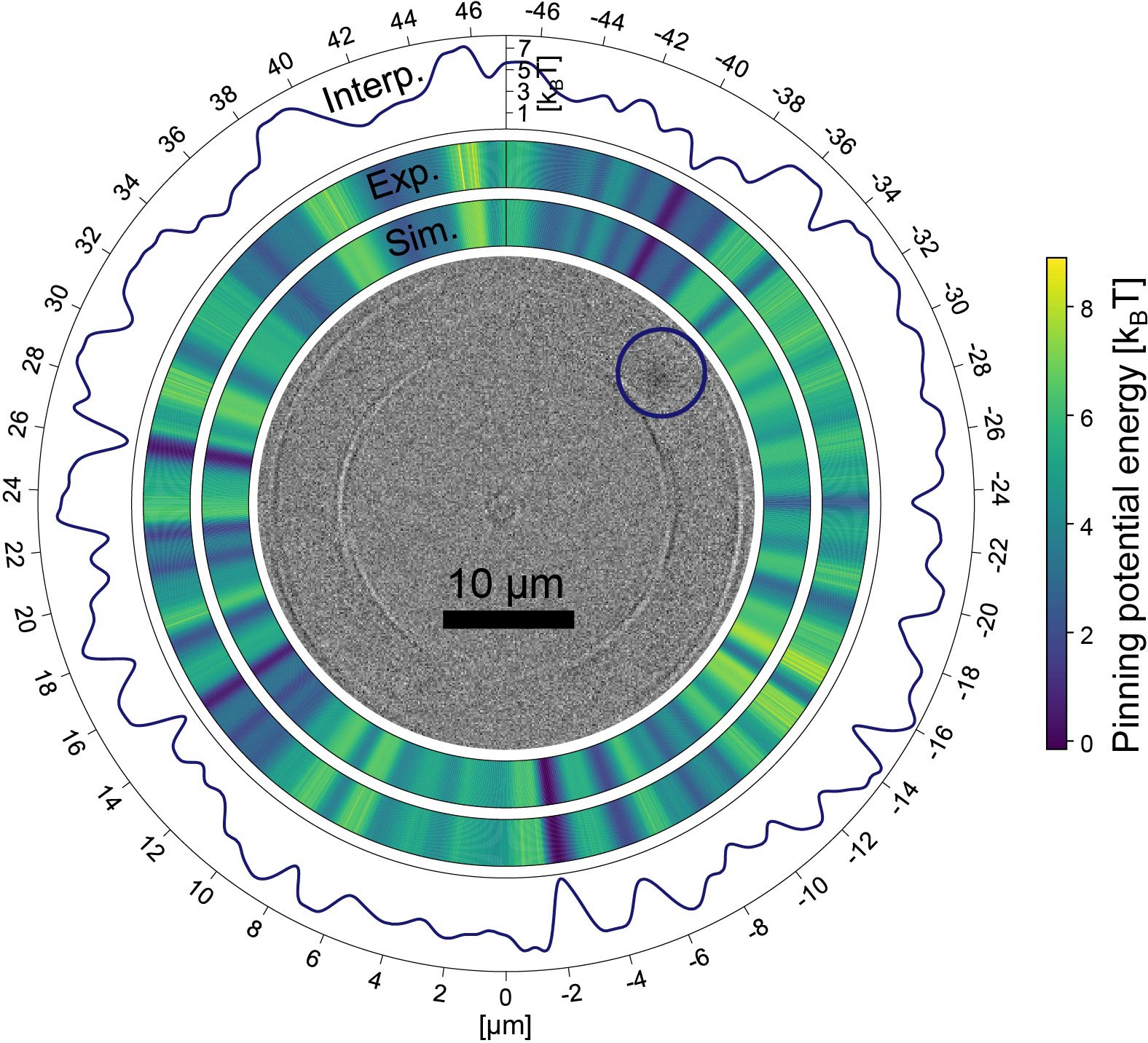
Skyrmions are tiny magnetic whirlpools, ranging from nanometers to micrometers in size, that behave like particles and can be easily controlled with electrical currents.
These unique properties make them promising candidates for next-generation data storage and computing. However, simulating their complex internal structure is computationally expensive, making device optimization challenging.
One potential solution is to model skyrmions as particles, similar to how molecules are simulated in biophysics. Until now, though, there has been no reliable way to match simulation time with experimental real-time.
Collaboration of Theory and Experiment
To meet this challenge, the theoretical physics group of Professor Peter Virnau and the experimental physics group of Professor Mathias Kläui at Johannes Gutenberg University Mainz (JGU) have joined forces. The method for determining the time conversion combines experimental measurement techniques with analysis methods from statistical physics.
Breakthrough in Simulating Skyrmion Dynamics
“We can now not only quantitatively predict the dynamics of skyrmions, but the simulations are also similar in speed to the experiments,” explained theoretical physicist Maarten A. Brems, who developed the method.
“The predictive power of the new simulations will significantly accelerate the development of skyrmion-based applications,” emphasized Professor Mathias Kläui, “especially with regard to novel, alternative energy-saving computer architectures, which are the focus of JGU’s Top-level Research Area ‘TopDyn – Dynamics and Topology’, amongst others.”
The results have been published in Physical Review Letters and highlighted as an Editors’ Suggestion.
Reference: “Realizing Quantitative Quasiparticle Modeling of Skyrmion Dynamics in Arbitrary Potentials” by Maarten A. Brems, Tobias Sparmann, Simon M. Fröhlich, Leonie-C. Dany, Jan Rothörl, Fabian Kammerbauer, Elizabeth M. Jefremovas, Oded Farago, Mathias Kläui and Peter Virnau, 28 January 2025, Physical Review Letters.
DOI: 10.1103/PhysRevLett.134.046701
Never miss a breakthrough: Join the SciTechDaily newsletter.
Follow us on Google and Google News.
3 Comments
Until now, though, there has been no reliable way to match simulation time with experimental real-time.
VERY GOOD!
Ask the researchers:
1. How do you understand time?
2. Is your real-time Earth time, solar time, atomic time, or something else?
3. How do you define simulation time?
What one researcher see or touch about an elephant will be different, and what different researchers see or touch will be even more different. It is a scientific phenomenon, not the essence of nature. Scientific research guided by correct theories can enable researchers to think more.
According to the Topological Vortex Theory (TVT), spins create everything, spins shape the world. There are substantial distinctions between Topological Vortex Theory (TVT) and traditional physical theories. Grounded in the inviscid and absolutely incompressible spaces, TVT introduces the concept of topological phase transitions and employs topological principles to elucidate the formation and evolution of matter in the universe, as well as the impact of interactions between topological vortices and anti-vortices on spacetime dynamics and thermodynamics.
Within TVT, low-dimensional spacetime matter serves as the foundation for high-dimensional spacetime matter, and the hierarchical structure of matter and its interaction mechanisms challenge conventional macroscopic and microscopic interpretations. The conflict between Quantum Physics and Classical Physics can be attributed to their differing focuses: Quantum Physics emphasizes low-dimensional spacetime matter, whereas Classical Physics centers on high-dimensional spacetime matter.
Subatomic particles in the quantum world often defy the familiar rules of the physical world. The fact repeatedly suggests that the familiar rules of the physical world are pseudoscience. In the familiar rules of the physical world, two sets of cobalt-60 can form the mirror image of each other by rotating in opposite directions, and should receive the Nobel Prize for physics.
Please witness the grand performance of some so-called peer review publications (including PRL, PNAS, Nature, Science, etc.). https://scitechdaily.com/microscope-spacecrafts-most-precise-test-of-key-component-of-the-theory-of-general-relativity/#comment-854286. Some so-called academic publications (including PRL, PNAS, Nature, Science, etc.) are addicted to their own small circles and have deviated from science for a long time.
If the researchers are truly interested in time, please read: The Challenge of Topological Vortex Theory (TVT) to Traditional Time Concepts (https://scitechdaily.com/microscope-spacecrafts-most-precise-test-of-key-component-of-the-theory-of-general-relativity/#comment-869260).
In the topological vortex architecture, the distinction between science and pseudoscience becomes evident. Topological Vortex Theory (TVT) can play a crucial role in elucidating the foundations of physics, establishing its principles, and combating pseudoscience. TVT may encounter significant opposition and resistance from traditional peer review publications. The field of physics faces an ongoing challenge in maintaining scientific rigor and integrity in the face of pervasive pseudoscientific claims. Fighting against rampant pseudoscience, physics still has a long way to go.
Ask the researchers again:
Physical Review Letters (PRL) is stubbornly believe that two sets of cobalt-60 can form the mirror image of each other by rotating in opposite directions. It a publication that respects science?
As the background of various material interactions and movements, space exhibits isotropic physical characteristics. It may form various forms of spacetime vortices through topological phase transitions. Hence, vortex phenomena are ubiquitous in cosmic space, from vortices of quantum particles and living cells to tornados and black holes. Stars and radioactive elements are one of the most active topological nodes in spacetime. Utilizing them is more valuable and meaningful than simulating them. Small or micro power topology intelligent batteries may be the direction of future energy research and development for human society.
Under the topological vortex architecture, science and pseudoscience are clear at a glance. Topological Vortex Theory (TVT) can play a crucial role in elucidating the foundations of physics, establishing its principles, and combating pseudoscience. Therefore, TVT has been strongly opposed and boycotted by traditional so-called peer review publications (such as PRL, PNAS, Nature, Science, etc.).
These so-called peer review publications (including PRL, PNAS, Nature, Science, etc.) mislead the direction of science and are known for their various absurdities and wonders. They collude together, reference each other, and use so-called Impact Factor (IF) to deceive people around, and hardly know what is dirty and ugly.
The field of physics faces an ongoing challenge in maintaining scientific rigor and integrity in the face of pervasive pseudoscientific claims. Fighting against rampant pseudoscience, physics still has a long way to go.
So it’s about to happen we have just began the situation that we are all already living In …. SMH now here comes the annunoki to takes Elon home