
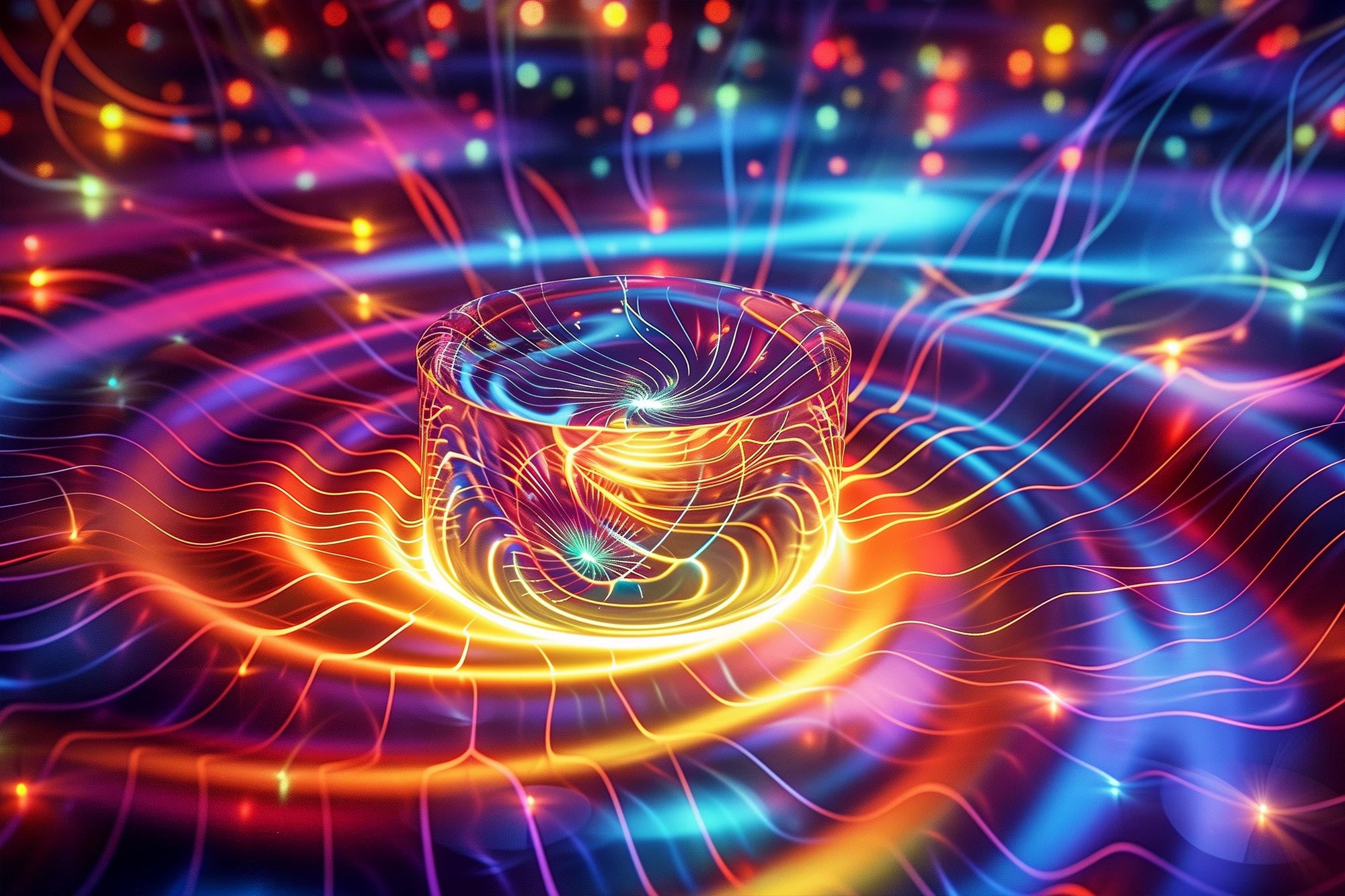
Brownian reservoir computing allows to detect human hand gestures on the basis of diffusion and displacement of skyrmions.
Researchers have advanced Brownian reservoir computing by successfully recording and recognizing simple hand gestures using skyrmions, a type of magnetic whirl. This method proves not only to be as accurate as traditional neural network software but also significantly more energy-efficient. Their findings demonstrate potential for future applications in non-conventional computing and data storage.
Brownian Reservoir Computing
Scientists at Johannes Gutenberg University Mainz (JGU) have managed to enhance the framework of Brownian reservoir computing by recording and transferring hand gestures to the system which then used skyrmions to detect these individual gestures.
“We were impressed to see that our hardware approach and concept worked so well – and even better than energy-intensive software solutions that employ neural networks,” said Grischa Beneke, a member of Professor Mathias Kläui’s research group at the JGU Institute of Physics.
In collaboration with other experimental and theoretical physicists, Beneke was able to demonstrate that simple hand gestures can be recognized by means of Brownian reservoir computing with a relatively high degree of precision.
Advantages of Reservoir Computing
Reservoir computing systems are similar to artificial neural networks. Their advantage is that they do not need extensive training, which reduces their overall energy consumption. “All we have to do is train a simple output mechanism to map the result,” explained Beneke.
The exact computing processes remain unclear and are not important in detail. The system can be compared to a pond in which stones have been thrown, creating a complex wave pattern on the surface. In the same way that the waves hint to the number and position of stones thrown, the output mechanism of the system provides information on the original input.

Innovative Gesture Recognition Using Skyrmions
In their latest paper recently published in Nature Communications, the researchers describe how they recorded simple hand gestures such a swipe left or right with Range-Doppler radar, employing two Infineon Technologies radar sensors. The radar data is then converted into corresponding voltages to be fed into the reservoir that, in this case, consists of a multilayered thin film stack of various materials that is formed into a triangle with contacts at each of its corners. Two of the contacts supply the voltage, which causes the skyrmion to move within the triangle.
“In reaction to the supplied signals, we detect complex motions,” described Grischa Beneke. “These movements of the skyrmion enable us to deduce the movements that the radar system has recorded.” Skyrmions are chiral magnetic whirls that are considered to have major potential for use in non-conventional computing devices and as information carriers in innovative data storage devices.
“Skyrmions are really astonishing. We first regarded them only as candidates for data storage but they also have great potential for applications in computing combined with sensor systems,” emphasized Professor Mathias Kläui as supervisor of this field of research at JGU.
Advancing Computational Efficiency and Collaboration
Comparison of the results obtained using Brownian reservoir computing with those recorded using a software-based approach shows that the accuracy of gesture recognition is similar or even better in the case of Brownian reservoir computing. The benefit of the combination of reservoir computing with a Brownian computing concept is that skyrmions are free to perform random motions because local differences in magnetic properties have less influence on how they react.
This means that skyrmions, in contrast with how they usually respond, can be made to move with just very low currents – which demonstrates a significant improvement in energy efficiency in comparison with the software approach. As the data collected by the Doppler radar and the intrinsic dynamics of the reservoir operate on similar time scales, the sensor data can be input directly into the reservoir. The time scales of the system can be adapted to resolve a variety of other problems.
“We find that the radar data of different hand gestures is detected in our hardware reservoir with a fidelity that is at least as good as a state-of-the-art software-based neural network approach,” the researchers concluded in their paper in Nature Communications. According to Beneke, further improvement should be possible in terms of the read-out process, which currently uses a magneto-optical Kerr-effect (MOKE) microscope. The employment of a magnetic tunnel junction instead could help to reduce the size of the whole system. The signals provided by a magnetic tunnel junction are already being emulated to demonstrate the capacity of the reservoir.
Potential for Future Development
Back in November 2022, Professor Mathias Kläui’s research team at JGU reported initial breakthroughs in Brownian reservoir computing. In cooperation with Professor Johan Mentink of Radboud University in Nijmegen in the Netherlands, they had been able to produce a prototype system that combined these two computing methods. The research now published in Nature Communications also involved chip manufacturer Infineon Technologies.
Additional support was provided by the Transregional Collaborative Research Center 173 “Spin+X – Spin in its collective environment,” funded by the German Research Foundation (DFG), JGU’s Top-level Research Area “TopDyn – Dynamics and Topology” at JGU as well as the Emergent Algorithmic Intelligence project sponsored by the Carl Zeiss Foundation. Furthermore, the research was funded by the European Union as part of the ERC Synergy Grant project 3D MAGiC and the NIMFEIA project.
Professor Mathias Kläui expects that Brownian reservoir computing is likely to undergo rapid further development in the future, particularly with the help of commercial partners that provide real-life use cases.
Reference: “Gesture recognition with Brownian reservoir computing using geometrically confined skyrmion dynamics” by Grischa Beneke, Thomas Brian Winkler, Klaus Raab, Maarten A. Brems, Fabian Kammerbauer, Pascal Gerhards, Klaus Knobloch, Sachin Krishnia, Johan H. Mentink and Mathias Kläui, 16 September 2024, Nature Communications.
DOI: 10.1038/s41467-024-52345-y
Never miss a breakthrough: Join the SciTechDaily newsletter.
Follow us on Google and Google News.
4 Comments
Researchers have advanced Brownian reservoir computing by successfully recording and recognizing simple hand gestures using skyrmions, a type of magnetic whirl. This method proves not only to be as accurate as traditional neural network software but also significantly more energy-efficient. Their findings demonstrate potential for magnetic whirl (or wortex) applications in non-conventional computing and data storage.
VERY GOOD!
The universe is a superposition, deflection, and entanglement of geometric shapes. It is the interaction and synchronization effect of countless topological vortices and their fractal structures. The formation of energy gaps between topological vortices is crucial for the evolution of spatiotemporal motion from low dimensional spacetime to high-dimensional spacetime.
Scientific research guided by correct theories can help humanity avoid detours, failures, and pomposity. Please witness the exemplary collaboration between theoretical physicists and experimentalists ( https://scitechdaily.com/microscope-spacecrafts-most-precise-test-of-key-component-of-the-theory-of-general-relativity/#comment-854286 ).
Love that right there. You know the truth 🖤🖤🖤🖤🖤💛💛💛💛🤍🤍🤍🤍🤍🩵🩵🩵🩵💚💚💚💚💙💙💙💙💜💜💜💜💖💖💖💖💖🧠🧠🧠🧠. That’s on my heart, remember you have a heart. Remember it’s never good bye, it’s only till next time. Love you. My name is Jason Lee Black. Location is, Shelby, North Carolina.
Thank you for your kindness. I will never forget anyone who truly loves science.
Hi.good.for.futre.humanyty.tecnolgy