
Close Menu
    Facebook X (Twitter) Instagram
    SciTechDaily
    • Biology
    • Chemistry
    • Earth
    • Health
    • Physics
    • Science
    • Space
    • Technology
    Facebook X (Twitter) Pinterest YouTube RSS
    SciTechDaily
    Home»Space»Breathtaking Hubble Image of Spiral Galaxy NGC 7331
    Space

    Breathtaking Hubble Image of Spiral Galaxy NGC 7331

    By SciTechDailyJanuary 29, 20182 Comments2 Mins Read
    Facebook Twitter Pinterest Telegram LinkedIn WhatsApp Email Reddit
    Share
    Facebook Twitter LinkedIn Pinterest Telegram Email Reddit
    Amazing Hubble Image of Spiral Galaxy NGC 7331
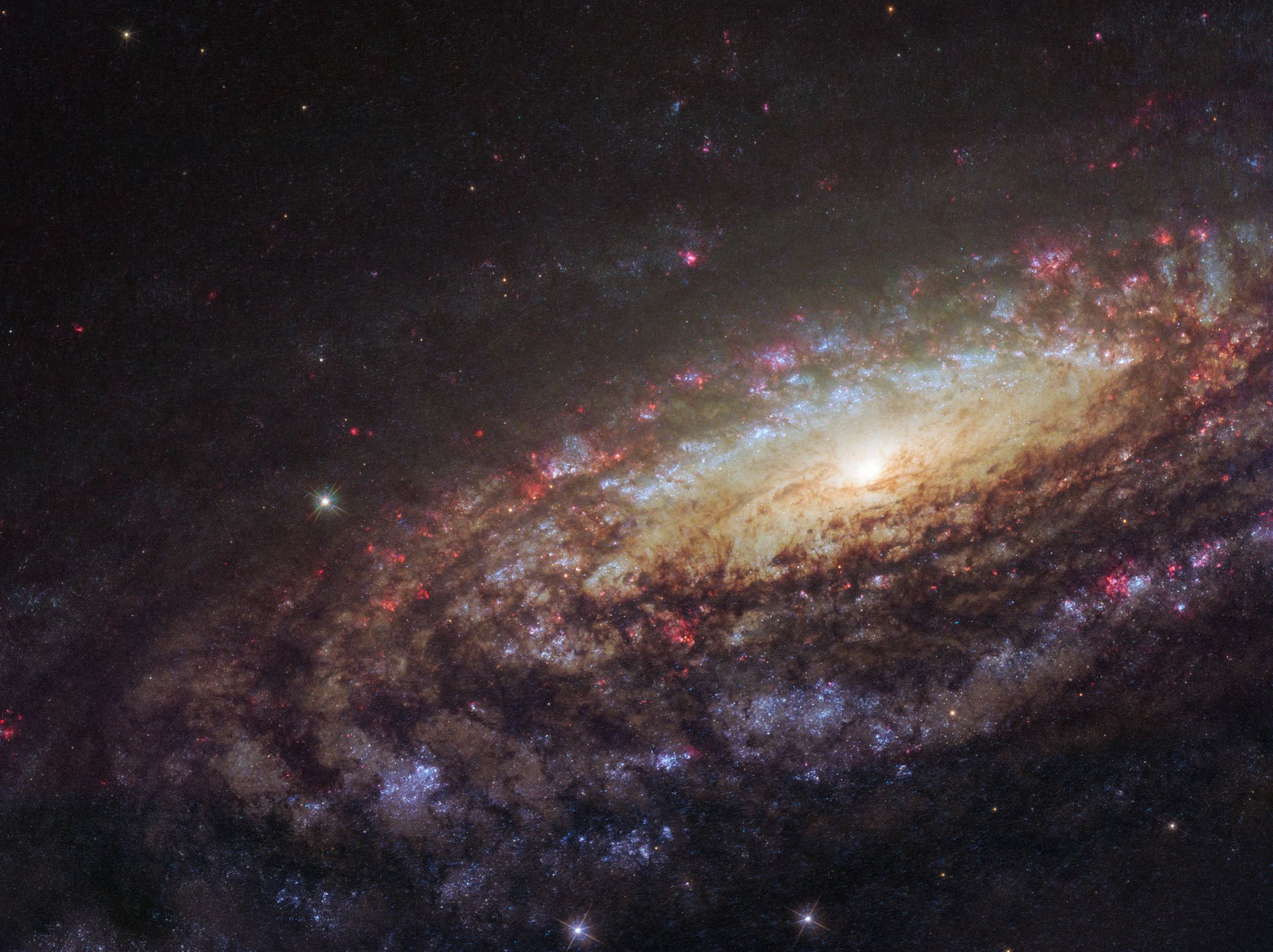
    NGC 7331 is an unbarred spiral galaxy located about 45 million light-years away in the constellation of Pegasus (The Winged Horse). Facing us partially edge-on, displaying its striking swirling arms like a whirlpool around its luminous center. Credit: ESA/Hubble & NASA/D. Milisavljevic (Purdue University)

    This NASA/ESA Hubble Space Telescope image shows a spiral galaxy known as NGC 7331. First spotted by the prolific galaxy hunter William Herschel in 1784, NGC 7331 is located about 45 million light-years away in the constellation of Pegasus (The Winged Horse). Facing us partially edge-on, the galaxy showcases its beautiful arms which swirl like a whirlpool around its bright central region.

    Astronomers took this image using Hubble’s Wide Field Camera 3 (WFC3), as they were observing an extraordinary exploding star — a supernova — which can still be faintly seen as a tiny red dot near the galaxy’s central yellow core. Named SN2014C, it rapidly evolved from a supernova containing very little Hydrogen to one that is Hydrogen-rich — in just one year. This rarely observed metamorphosis was luminous at high energies and provides unique insight into the poorly understood final phases of massive stars.

    NGC 7331 is similar in size, shape, and mass to the Milky Way. It also has a comparable star formation rate, hosts a similar number of stars, has a central supermassive black hole and comparable spiral arms. The primary difference between our galaxies is that NGC 7331 is an unbarred spiral galaxy — it lacks a “bar” of stars, gas and dust cutting through its nucleus, as we see in the Milky Way. Its central bulge also displays a quirky and unusual rotation pattern, spinning in the opposite direction to the galactic disc itself.

    By studying similar galaxies we hold a scientific mirror up to our own, allowing us to build a better understanding of our galactic environment which we cannot always observe, and of galactic behavior and evolution as a whole.


    Never miss a breakthrough: Join the SciTechDaily newsletter.
    Follow us on Google and Google News.

    Astronomy European Space Agency Hubble Space Telescope Purdue University
    Share. Facebook Twitter Pinterest LinkedIn Email Reddit

    Related Articles

    A Diamond Necklace of Cosmic Proportions

    Hubble Snaps a Stunning Close-Up of a Magnificent Spiral Galaxy

    Extraordinary Hubble Image: Light Bends From the Beyond

    Hubble Space Telescope Sees Volcanic Activity Reforming the Atmosphere on a Rocky Exoplanet

    Hubble Spies a Luminous Heart With Dark Tendrils

    Spectacular Return to the Veil Nebula

    Hubble Spots a Peculiar Sight: Unusual Spiral Galaxy With a Heavy Arm

    A Flash of Life: Hubble Spies an Unusual Planetary Nebula

    Through the Cosmic Clouds: Hubble Spots a Beautiful Stellar Nursery

    2 Comments

    1. Valeriy on January 29, 2018 2:19 pm

      There are some very complicated issues of galaxy formation. Unfortunately, here is the same problem as with the stars. The origin of galaxies remains unclear, in spite of huge activity in the field. What the “formation” means? It means that we have the material that is assembling into galaxies.

      Reply
    2. Valeriy on January 30, 2018 6:41 pm

      There are some very complicated issues of galaxy formation. Unfortunately, here is the same problem as with the stars. The origin of galaxies remains unclear, in spite of huge activity in the field. What the “formation” means? It means that we have the material that is assembling into galaxies.
      https://www.academia.edu/26879556/The_Galaxies_Where_Do_They_Come_From

      Reply
    Leave A Reply Cancel Reply

    • Facebook
    • Twitter
    • Pinterest
    • YouTube

    Don't Miss a Discovery

    Subscribe for the Latest in Science & Tech!

    Trending News

    Scientists Discover How Coffee Impacts Memory, Mood, and Gut Health

    Why Did the Neanderthals Disappear? Scientists Reveal Humans Had a Hidden Advantage

    Physicists Propose Strange Experiment Where Time Goes Quantum

    Magnesium Magic: New Drug Melts Fat Even on a High-Fat, High-Sugar Diet

    Weight-Loss Drugs Like Ozempic May Come With an Unexpected Cost

    Mezcal “Worm” in a Bottle Mystery: DNA Testing Reveals a Surprise

    New Research Reveals That Your Morning Coffee Activates an Ancient Longevity Switch

    This Is What Makes You Irresistible to Mosquitoes

    Follow SciTechDaily
    • Facebook
    • Twitter
    • YouTube
    • Pinterest
    • Newsletter
    • RSS
    SciTech News
    • Biology News
    • Chemistry News
    • Earth News
    • Health News
    • Physics News
    • Science News
    • Space News
    • Technology News
    Recent Posts
    • Harvard Scientists Reveal Secret Structure Behind How You Smell
    • Scientists Just Discovered the Hidden Trick That Keeps Your Cells Alive
    • This Simple Movement Could Be Secretly Cleaning Your Brain
    • Male Birth Control Breakthrough: Scientists Find Way To Turn Sperm Production Off and Back On
    • A Common Vitamin Could Hold the Key to Treating Fatty Liver Disease
    Copyright © 1998 - 2026 SciTechDaily. All Rights Reserved.
    • Science News
    • About
    • Contact
    • Editorial Board
    • Privacy Policy
    • Terms of Use

    Type above and press Enter to search. Press Esc to cancel.