
Close Menu
    Facebook X (Twitter) Instagram
    SciTechDaily
    • Biology
    • Chemistry
    • Earth
    • Health
    • Physics
    • Science
    • Space
    • Technology
    Facebook X (Twitter) Pinterest YouTube RSS
    SciTechDaily
    Home»Earth»Brown Carbon “Tarballs” Detected in Himalayan Atmosphere – May Accelerate Melting of Glaciers
    Earth

    Brown Carbon “Tarballs” Detected in Himalayan Atmosphere – May Accelerate Melting of Glaciers

    By American Chemical SocietyNovember 4, 2020No Comments3 Mins Read
    Facebook Twitter Pinterest Telegram LinkedIn WhatsApp Email Reddit
    Share
    Facebook Twitter LinkedIn Pinterest Telegram Email Reddit
    Himalayan Tarballs
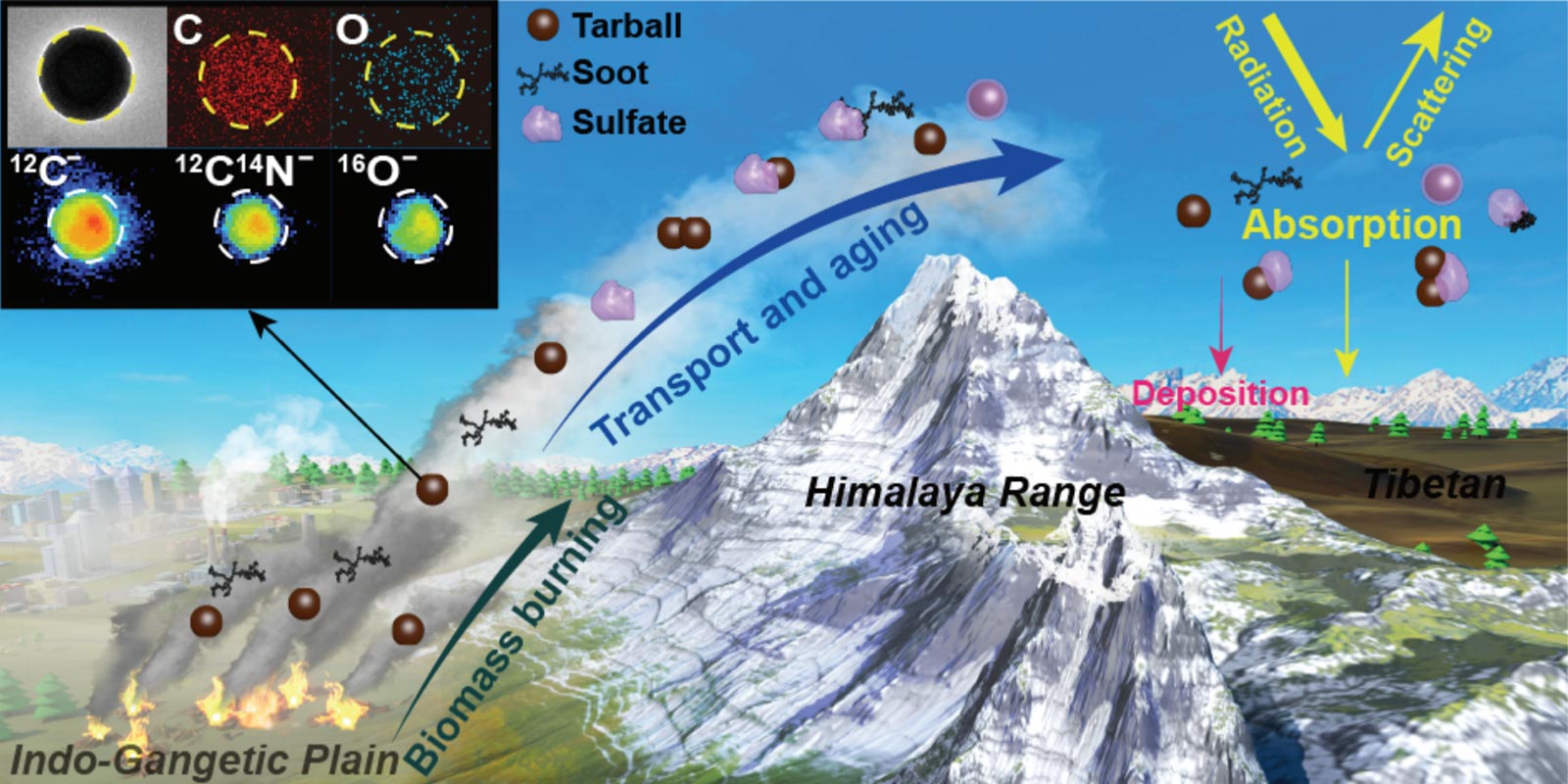
    Scientists have identified light-absorbing “tarballs” in the Himalayan atmosphere, potentially contributing to glacial melt. Credit: ACS / Environmental Science & Technology Letters

    Some people refer to the Himalaya-Tibetan Plateau as the “third pole” because the region has the largest reserve of glacial snow and ice outside of the north and south poles. The glaciers, which are extremely sensitive to climate change and human influence, have been retreating over the past decade. Now, researchers reporting in ACS’ Environmental Science & Technology Letters have detected light-absorbing “tarballs” in the Himalayan atmosphere, which could contribute to glacial melt.

    Burning biomass or fossil fuels releases light-absorbing, carbonaceous particles that can deposit on snow and ice, possibly hastening the melting of glaciers. Previous research has shown that one type of particle, called black carbon, can be transported long distances by wind to the Himalayan atmosphere. But much less is known about the presence of brown carbon, a particle that can form tarballs — small, viscous spheres consisting of carbon, oxygen, and small amounts of nitrogen, sulfur and potassium. Weijun Li and colleagues wanted to see what types of individual aerosol particles were present in air samples taken at a remote, high-altitude research station on the northern slope of the Himalayas.
    Himalayan Atmosphere Tarballs
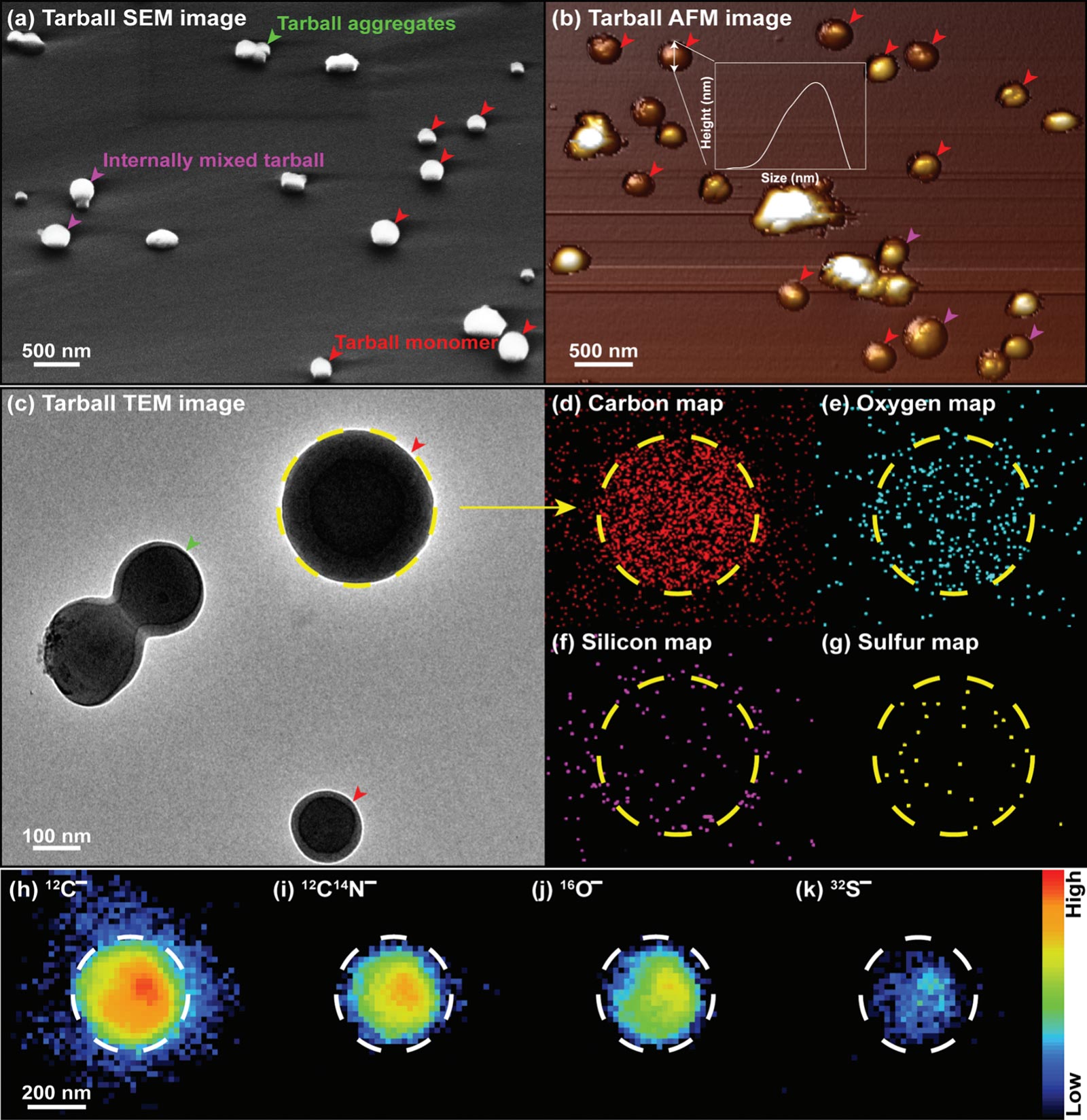
    Microscope images of tarballs. (a) SEM image at 60° tilt angle of tarballs. (b)AFM image of tarballs. (c) TEM bright-field image of tarballs. (d−g) TEM-EDS elemental maps of C, O, Si, and S of a tarball monomer. (h−k) NanoSIMS ion intensity maps of 12C¯, 16O¯, 12C14N¯, and 32S¯ of a tarball monomer. Credit: ACS / Environmental Science & Technology Letters

    Using electron microscopy, the researchers unexpectedly found that about 28% of the thousands of particles in the air samples from the Himalayan research station were tarballs, and the percentage increased on days with elevated levels of pollution. Analyzing wind patterns and satellite data revealed that a dense array of active fire spots, corresponding to large-scale wheat-residue burning on the Indo-Gangetic Plain, occurred along the pathways of air masses that reached the Himalayan research station during sampling. Through modeling calculations, the team estimated that tarballs deposited on glacial surfaces could contribute to a significant warming effect. As a result, future climate models should consider the long-range transport of tarballs to the Himalayas, the researchers say.

    Reference: “Evidence for Large Amounts of Brown Carbonaceous Tarballs in the Himalayan Atmosphere” by Qi Yuan, Jianzhong Xu, Lei Liu, Aoxing Zhang, Yanmei Liu, Jian Zhang, Xin Wan, Mengmeng Li, Kai Qin, Zhiyuan Cong, Yuhang Wang, Shichang Kang, Zongbo Shi, Mihály Pósfai and Weijun Li, 4 November 2020, Environmental Science & Technology Letters.
    DOI: 10.1021/acs.estlett.0c00735

    The authors acknowledge funding from the National Natural Science Foundation of China, the China Postdoctoral Science Foundation, the Research Funding of School of Earth Sciences of Zhejiang University, the Hundred Talents Program in Zhejiang University and the Second Tibetan Plateau Scientific Expedition and Research Program.

    Never miss a breakthrough: Join the SciTechDaily newsletter.
    Follow us on Google and Google News.

    American Chemical Society Atmospheric Science Climate Science Pollution
    Share. Facebook Twitter Pinterest LinkedIn Email Reddit

    Related Articles

    New Research Shows Just 25 Mega-Cities Produce 52% of the World’s Urban Greenhouse Gas Emissions

    Laser “Comb” Systems Now Measure All Primary Greenhouse Gases in the Air

    Ozone Pollution Has Increased in Antarctica – From Both Natural and Human Sources

    Mapping Intermittent Methane Emissions Across the Permian Basin – The Largest Oil- and Gas-Producing Region in the U.S.

    The Burning Question of Bonfire Night Pollution

    The Science Behind the Bright Apocalyptic Orange Sky That Was Seen on the West Coast [Video]

    Geoengineering Is a Solution to Fight Climate Change – But Not by Itself

    New Research Shows Half of the World’s Population Exposed to Increasing Air Pollution

    New Findings Call Into Question Current Understanding of Earth’s Sulfur Cycle

    Leave A Reply Cancel Reply

    • Facebook
    • Twitter
    • Pinterest
    • YouTube

    Don't Miss a Discovery

    Subscribe for the Latest in Science & Tech!

    Trending News

    One of the Universe’s Largest Stars May Be Getting Ready To Explode

    Scientists Discover Enzyme That Could Supercharge Ozempic-Like Weight Loss Drugs

    Popular Sweetener Linked to DNA Damage – “It’s Something You Should Not Be Eating”

    Ancient “Rock” Microbes May Reveal How Complex Life Began

    Researchers Capture Quantum Interference in One of Nature’s Rarest Atoms

    “A Plague Is Upon Us”: The Mass Death That Changed an Ancient City Forever

    Scientists Discover Game-Changing New Way To Treat High Cholesterol

    This Small Change to Your Exercise Routine Could Be the Secret to Living Longer

    Follow SciTechDaily
    • Facebook
    • Twitter
    • YouTube
    • Pinterest
    • Newsletter
    • RSS
    SciTech News
    • Biology News
    • Chemistry News
    • Earth News
    • Health News
    • Physics News
    • Science News
    • Space News
    • Technology News
    Recent Posts
    • Scientists Prove There Are Just Six Degrees of Separation in a Social Network
    • Bee Bacteria Could Fix a Major Flaw in Plant-Based Milk
    • Scientists Discover a Surprising Way To Make Bread Healthier and More Nutritious
    • Natural Compounds Boost Bone Implant Success While Killing Bacteria and Cancer Cells
    • After 60 Years, Scientists Uncover Unexpected Brain Effects of Popular Diabetes Drug Metformin
    Copyright © 1998 - 2026 SciTechDaily. All Rights Reserved.
    • Science News
    • About
    • Contact
    • Editorial Board
    • Privacy Policy
    • Terms of Use

    Type above and press Enter to search. Press Esc to cancel.