
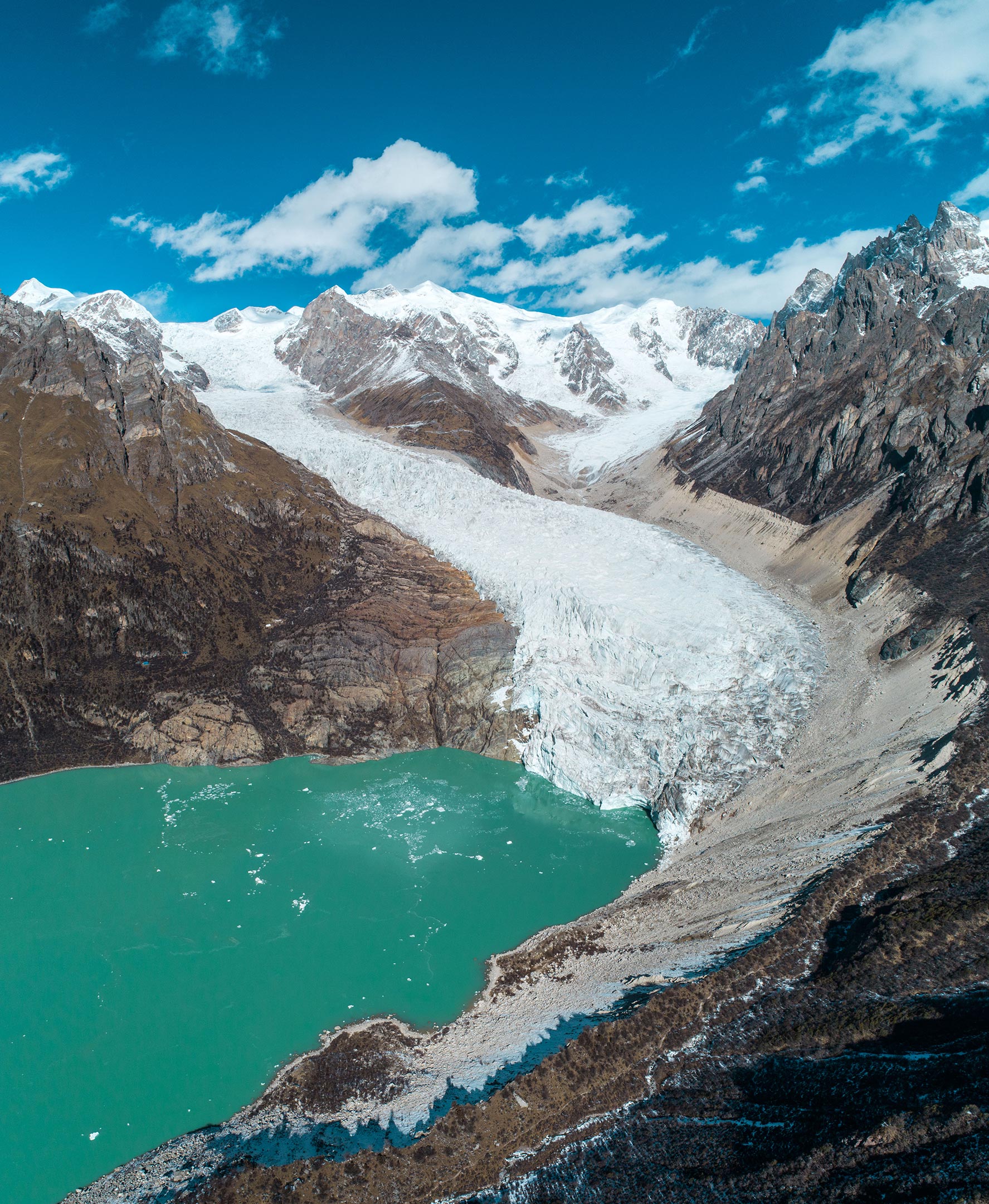
A team of Swiss and international climate scientists has shown that the risk of glacial lake outburst floods in the Himalayan region and the Tibetan plateau could triple in the coming decades.
The “Third Pole” of the Earth, the high mountain ranges of Asia, bears the largest number of glaciers outside the polar regions. A Sino-Swiss research team has revealed the dramatic increase in flood risk that could occur across Earth’s icy Third Pole in response to ongoing climate change. Focusing on the threat from new lakes forming in front of rapidly retreating glaciers, a team, led by researchers from the University of Geneva (UNIGE), Switzerland, demonstrated that the related flood risk to communities and their infrastructure could almost triple. Important new hotspots of risk will emerge, including within politically sensitive transboundary regions of the Himalaya and Pamir. With significant increases in risk already anticipated over the next three decades, the results of the study, published in Nature Climate Change, underline the urgent need for forward-looking, collaborative, long-term approaches to mitigate future impacts in the region.
The Hindu Kush-Himalaya, Tibetan Plateau, and surrounding mountain ranges are widely known as the Third Pole of the Earth. Due to global warming, the widespread and accelerated melting of glaciers over most of the region has been associated with the rapid expansion and formation of new glacial lakes. When water is suddenly released from these lakes through failure or overtopping of the dam, glacial lake outburst floods can devastate lives and livelihoods up to hundreds of kilometers downstream, extending across international borders to create transboundary risks. Despite the severe threat that these extreme events pose for sustainable mountain development across the Third Pole, there has been a lack of understanding regarding where and when related risks would evolve in the future.
Himalayan Hotspot
Swiss and Chinese climatologists used satellite imagery and topographic modeling to establish the risk associated with 7,000 glacial lakes presently located across the Third Pole. This approach allowed us to accurately classify 96% of glacial lakes known to have produced floods in the past as high or very high risk. “We then compared our results with a catalog of past glacial lake floods, which allowed us to validate our approaches,” explains Simon Allen, a researcher at the Institute of Environmental Sciences of the UNIGE and co-director of the study. “Once we confirmed that the approaches accurately identified current dangerous lakes, we could then apply these methods to future scenarios.” Overall, the study revealed that one in six (1,203) of current glacial lakes posed a high to very high risk to downstream communities, most notably in the eastern and central Himalayan regions of China, India, Nepal, and Bhutan.
New Threats in New Places
Looking to the future, glacial retreat, lake formation, and associated flood risk were considered under three different CO2 emission scenarios. Under the highest emission scenario (sometimes referred to as the “business-as-usual” scenario), the study shows that much of the Third Pole could already be approaching a state of peak risk by the end of the 21st century, or even mid-century in some regions. In addition to the larger potential flood volumes resulting from the expansion of more than 13,000 lakes, over time the lakes will grow closer towards steep unstable mountain slopes that can crash into the lakes and provoke small tsunamis. “The speed at which some of these new hazardous situations are developing surprised us,” says Markus Stoffel, Professor at the Institute for Environmental Sciences of the UNIGE. “We are talking a few decades not centuries – these are timeframes that demand the attention of authorities and decision-makers.”
If global warming continues on its current path, the number of lakes classified as high or very high risk increases from 1,203 to 2,963, with new hotspots of risk emerging in the Western Himalaya, Karakorum, and into Central Asia. “These regions have experienced glacial lake outburst floods before, but these events have tended to be repetitive and linked to advancing glaciers. Authorities and communities will be less familiar with the types of spontaneous events we consider here in a deglaciating landscape, so this calls for awareness raising and education on the new challenges that will emerge,” adds Stoffel.
Complex Political Challenges
The mountain ranges of the Third Pole span eleven nations, giving rise to potential transboundary natural disasters. Findings of the study show that the number of future potential transboundary glacial flood sources could roughly double (an additional 464 lakes), with 211 of these lakes classified in the highest risk categories. The border region of China and Nepal will remain a major hotspot (42% of all future transboundary lake sources), while the Pamir mountains between Tajikistan and Afghanistan emerge as a major new transboundary hotspot (currently 5% of transboundary lake sources increasing to 36% in the future). “Transboundary regions are of particular concern to us,” says Allen. “Political tensions and lack of trust can be a real barrier that prevents timely data sharing, communication, and coordination needed for effective early warning and disaster mitigation.”
Researchers stress the importance of exploring disaster risk management strategies to reduce the exposure of people and property and minimize the vulnerability of society. “The findings of this research should motivate relevant nations and the international research communities to urgently work together to prevent future glacial flood disasters in the Third Pole region,” concludes Stoffel.
Reference: “Increasing risk of glacial lake outburst floods from future Third Pole deglaciation” by Guoxiong Zheng, Simon Keith Allen, Anming Bao, Juan Antonio Ballesteros-Cánovas, Matthias Huss, Guoqing Zhang, Junli Li, Ye Yuan, Liangliang Jiang, Tao Yu, Wenfeng Chen and Markus Stoffel, 6 May 2021, Nature Climate Change.
DOI: 10.1038/s41558-021-01028-3
Never miss a breakthrough: Join the SciTechDaily newsletter.
Follow us on Google and Google News.