
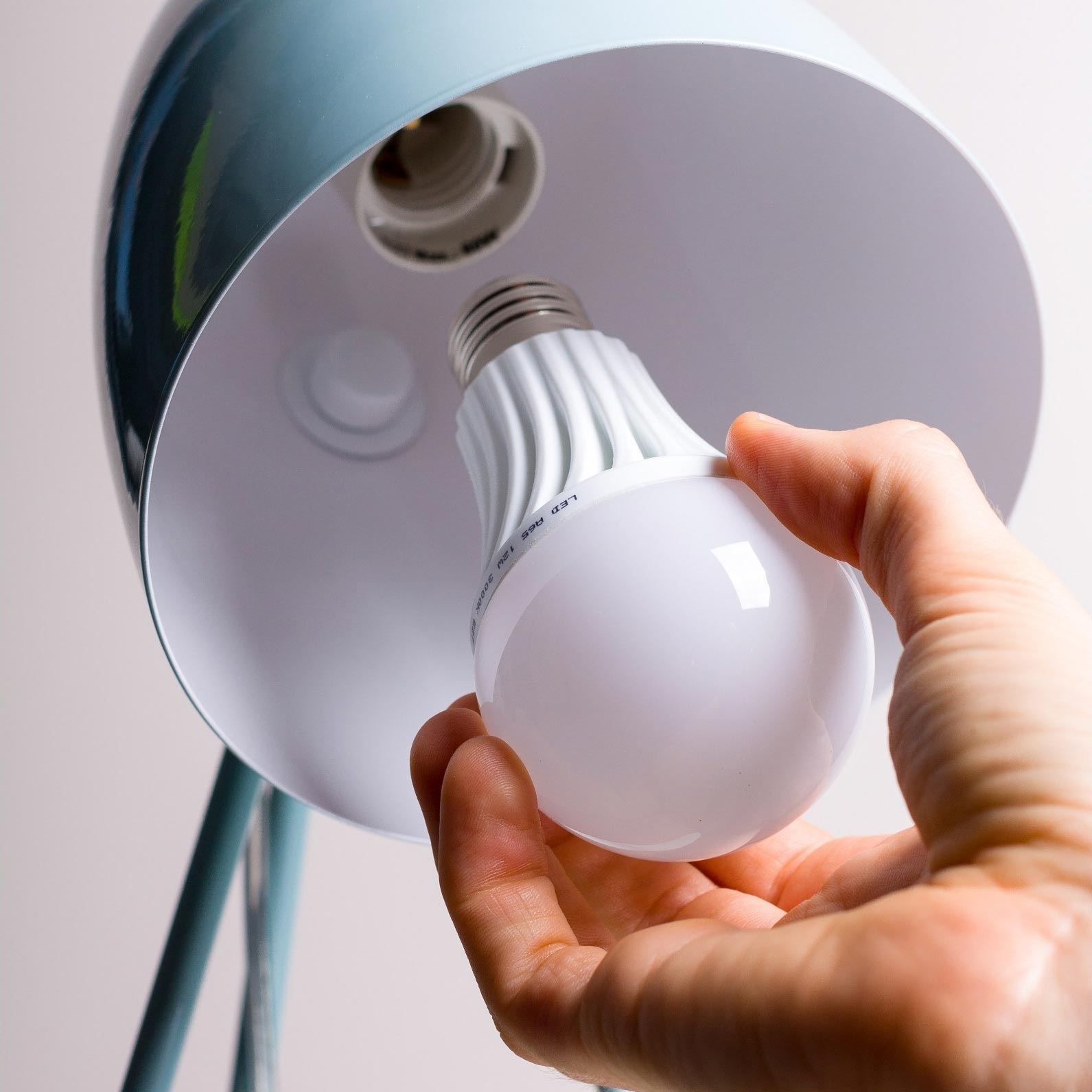
Scientists are replacing blue LED cores with violet ones to reduce health risks, creating energy-efficient, circadian-friendly bulbs using custom phosphors.
LED lightbulbs offer considerable advantages over other types of lighting. Being more efficient, they require much less electricity to operate. They do not give off unwanted heat the way old-school incandescent bulbs do, and the best of them long outlast even fluorescent lightbulbs.
But LEDs are not problem-free. Questions linger over suspected links between health concerns such as fatigue, mood disorders, and insomnia from overexposure to the blue-tinted light produced by today’s standard LED bulbs. Plus, higher prices can prompt lightbulb shoppers to weigh other options.
A University of Houston research team led by Jakoah Brgoch, associate professor of chemistry in the College of Natural Sciences and Mathematics and principal investigator in the Texas Center for Superconductivity, is developing an LED bulb that emits most of its energy from the safer violet segment of the visible light spectrum. Instead of just masking the blue light, they are developing a unique class of luminescent materials called phosphors that absorb a violet LED’s single-color emission and convert the light to cover the majority of the visible spectrum.

Moving Toward Violet-Based Lighting
“Our group is creating phosphors that operate, not with the conventional blue LED chip that nearly every LED light bulb uses today, but with a violet LED chip. This basically moves away from blue to violet as the base source and then converts the violet LED light into the broad-spectrum white light that we see,” Brgoch explained. “Our ultimate goal is for this new violet-based bulb to be as energy efficient as possible and also cheap, eventually making new lighting technology marketable to consumers.”
Results of their research were recently published in ACS Applied Materials and Interfaces, a journal of the American Chemical Society.
At this point, you might be looking at your favorite lamp’s standard LED bulb and finding its white light to be just fine. But technically speaking, there actually is no such thing as pure white light.
Hold a prism up to that bulb, and you’ll see its light separated into wavelengths that show a beautiful array of color bands ranging from violet to red; this is what scientists call the visible spectrum of light. (If your prism isn’t handy, then imagine having your own tiny rainbow. It would look much the same.)
Your lamp light looks white because your eyes and brain work together to blend human perception of those separate bands of color into a white light that may, at this moment, be illuminating the words you read. Different types of lightbulbs emphasize different parts of the visible spectrum of light.
Engineers at lighting companies manipulate the balance to create a specific ambiance. A little more red yields a warm, mellow white light that is nice in a living room, while cool blue tones give off crisp white light better for office lighting. But outside the laboratory, the LEDs’ tendency toward blue has been hard to avoid.
“Sometimes you recognize it – those are the cheapest LED lightbulbs. And then sometimes it looks like a nice warm white light. But even in the most expensive lightbulbs, if it’s based on a blue LED, there is still a significant component of blue light sneaking through,” the professor explained.
Light and Health
Lately scientists have been focusing on how light frequencies affect health.
“With the advent of LED lighting, companies have started trying to understand how humans interact with light and, more importantly, how light interacts with humans,” Brgoch said. “As you sit in your office, the blue hues in your light are a great thing because they help you stay alert. But that same light at night might keep you awake. This is the balance you have to strike. It’s about following a natural circadian cycle without disruption.”
Sleep studies reveal that nighttime overexposure to blue frequencies can alter hormones like melatonin, sometimes leading to insomnia, disturbed sleep cycles, and other problems. Too much blue-light exposure also is suspected in cataract formation. Interestingly, urban dwellers living amid LED-based street lights, traffic lights, and lighted commercial signs are exposed to more day-and-night LED exposure than suburbanites.
“That’s not to say we should just remove all the blue light from your lightbulbs. You need some of the blue spectrum. It’s not about eliminating the blue, it’s about keeping it to a reasonable level. That’s what we’re seeking with our work,” said graduate research assistant Shruti Hariyani, an author of the paper.
Developing Violet-Compatible Phosphors for Cost and Health
Back in the lab, Brgoch and his team are focused on identifying phosphors and discovering which are most feasible, in energy efficiency and economy, to advance to prototype bulbs. “We look at finding new materials as a way to also help reduce the cost of these lights. Whenever you have more materials available, patent licensing costs go down and that makes the bulbs cheaper. So that’s one of our driving forces,” Brgoch said.
In the quest for what Hariyani calls a human-friendly light, the research team is busy testing those potential materials.
“Hearing myself say, ‘this is different, this is new’ when we find the right phosphor that can pair with violet – I guess that is my Eureka moment,” she said.
For research not directly tied to the LED project, Brgoch and Hariyani recently were honored with the 2021 Chemistry of Materials Lectureship and Best Paper Award. The award, from the American Chemical Society Division of Inorganic Chemistry, recognizes outstanding influence across the field of materials chemistry and recognition of research as a team endeavor.
Reference: “Advancing Human-Centric LED Lighting Using Na2MgPO4F:Eu2+” by Shruti Hariyani and Jakoah Brgoch, 30 March 2021, ACS Applied Materials and Interfaces.
DOI: 10.1021/acsami.1c00909
Never miss a breakthrough: Join the SciTechDaily newsletter.
Follow us on Google and Google News.
5 Comments
… Yeah, the blue light might be a problem, … to be more specific, it will make you a trouble sleeping, but there is a quick fix for that issue…
…One can purchase a green light, and before you go to sleep just let it all be green for half an hour, and it helps.
…
That Troublesome Blue Light
yeah meanwhile they keep replacing street lights with white LEDs. Genius
I will not look at any adds/stories of information with that bug eyed idiot AOC’s picture within my sight!
This idea (using a violet pump LED) is not exactly new. SORAA, Yuji International, Waveform Lighting and others have/are doing this for years. It would be nice to see an acknowledgement of previous work, then what distinguishes the present research. It sounds like new phosphors are being developed. I got the sense the new ones might be more efficient or cheaper, though the distinction isn’t clear. Is the violet a different wavelength, say 410 nm instead of 420? (Of course that may be proprietary).
Most LEDs use a blue pump around 450nm to 460nm. I just not sure dropping to 400nm to 410nm will have much of an effect. If you drop below 400nm you begin to create new problems with color fading of materials in the space. Simply choose warmer CCTs and use less blues in your decor. Studies have shown the wall color of a room has more impact on the occupants than the light source.