
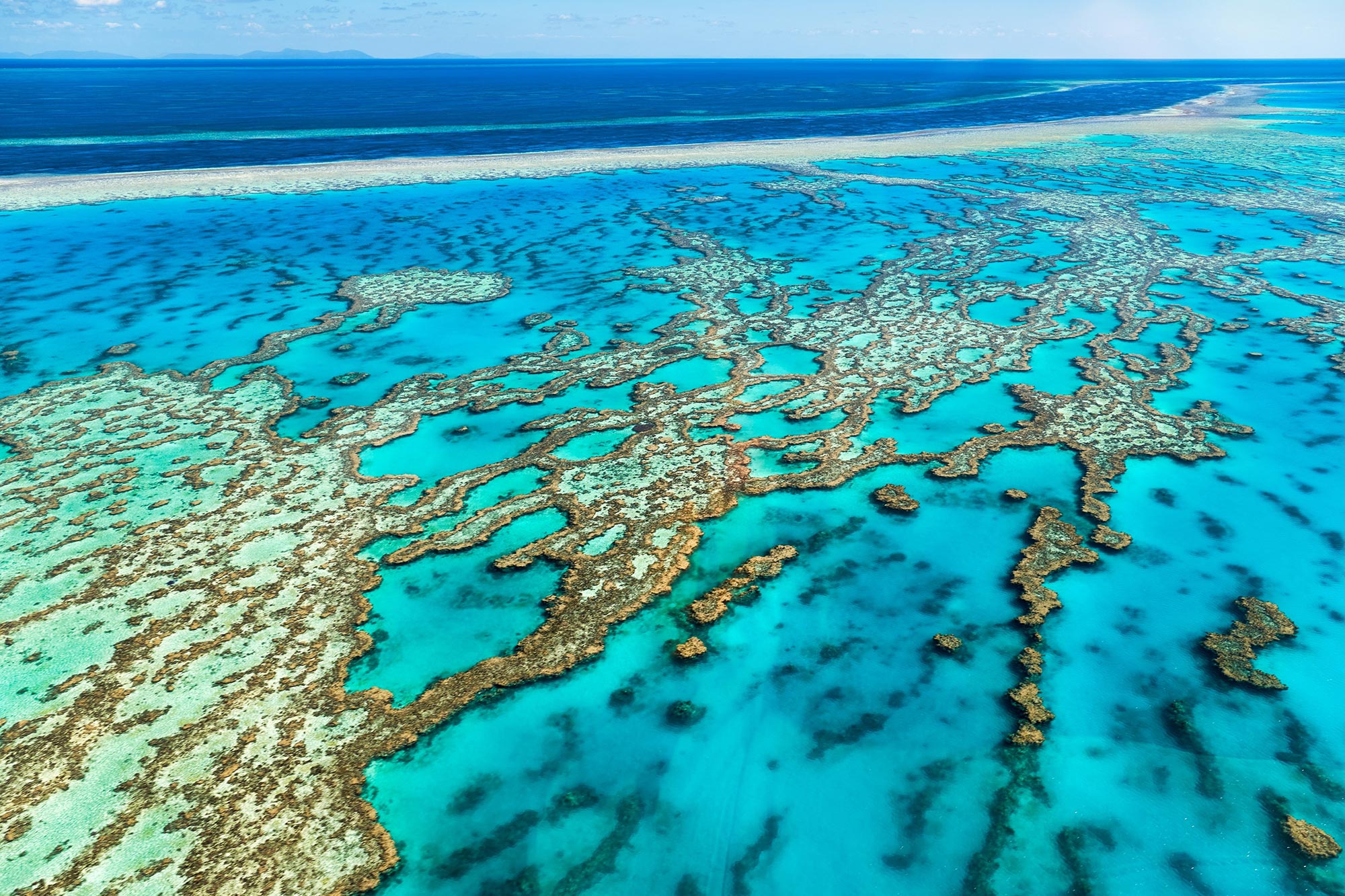
Scientists are using AI and remote sensing to create a real-time coral reef monitoring system, improving conservation through data integration and predictive modeling.
Australian researchers are developing a real-time global monitoring system to help protect the world’s coral reefs from further decline, primarily due to bleaching driven by global warming.
Coral reefs are deteriorating at an alarming rate, with 75% experiencing heat stress at bleaching levels over the past two years.
The Great Barrier Reef (GBR), a UNESCO World Heritage site and one of Australia’s most valuable ecological and tourism assets, has suffered severe bleaching events since 2016. These impacts have been worsened by crown-of-thorns starfish outbreaks and coastal development.
A research team led by the University of South Australia (UniSA), in collaboration with experts from Queensland and Victoria, is combining remote sensing technology with machine learning, artificial intelligence, and Geographic Information Systems (GIS). This integrated approach aims to track reef health in real-time and mitigate damage to these fragile marine ecosystems.
A multimodal platform will distill all research data relating to coral reefs, including underwater videos and photographs, satellite images, text files, and time-sensor readings, onto a central dashboard for real-time global monitoring.
A Centralized System for Real-Time Predictions
UniSA data analyst and lead researcher Dr. Abdullahi Chowdhury says that a single centralized model will integrate all factors affecting coral reefs and provide environmental scientists with real-time predictions.
“At the moment we have separate models that analyze substantial data on reef health – including bleaching levels, disease incidence, juvenile coral density, and reef fish abundance – but these data sets are not integrated, and they exist in silos,” Dr. Chowdhury says.
“Consequently, it is challenging to see the ‘big picture’ of reef health or to conduct large scale, real-time analyses.”
The researchers say an integrated system will track bleaching severity and trends over time; monitor crown-of-thorns starfish populations and predation risks; detect disease outbreaks and juvenile coral levels; and assess reef fish abundance, diversity, length, and biomass.
“By centralizing all this data in real-time, we can generate predictive models that will help conservation efforts, enabling earlier intervention,” according to Central Queensland University PhD candidate Musfera Jahan, a GIS data expert.
“Our coral reefs are dying very fast due to climate change – not just in Australia but across the world – so we need to take serious action pretty quickly,” Ms Jahan says.
A Global Effort for Coral Reef Conservation
Coral reefs are often referred to as the “rainforests of the sea.” They make up just 1% of the world’s ocean area but they host 25% of all marine life.
The technology will bring together datasets from organizations like the National Oceanic and Atmospheric Administration (NOAA), the Monterey Bay Aquarium Research Institute (MBARI), the Hawaii Undersea Research Laboratory (HURL), and Australia’s CSIRO.
“The future of coral reef conservation lies at the intersection of technology and collaboration. This research provides a roadmap for harnessing these technologies to ensure the survival of coral reefs for generations to come,” the researchers say.
Reference: “Coral Reef Surveillance with Machine Learning: A Review of Datasets, Techniques, and Challenges” by Abdullahi Chowdhury, Musfera Jahan, Shahriar Kaisar, Mahbub E. Khoda, S M Ataul Karim Rajin and Ranesh Naha, 19 December 2024, Electronics.
DOI: 10.3390/electronics13245027
Never miss a breakthrough: Join the SciTechDaily newsletter.
Follow us on Google and Google News.
2 Comments
Well, how could it when the AI is bad for the environment itself…
How does this relate to your other story about how the reef is doing just fine?
https://scitechdaily.com/highest-coral-cover-in-central-northern-great-barrier-reef-since-monitoring-began-36-years-ago/
Silly article about a non problem.