
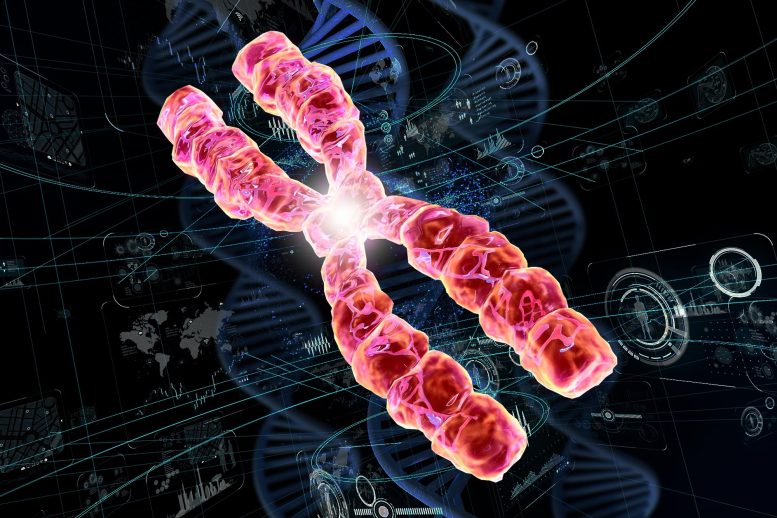
Researchers have discovered a new structure of telomeric DNA with the aid of physics and a tiny magnet. Telomeres are seen by many scientists as the key to living longer. They protect genes from damage but get a bit shorter each time a cell divides. If they become too short, the cell dies. This breakthrough discovery will help us understand aging and disease.
When you hear DNA mentioned, physics is usually not the first scientific discipline that springs to mind. However, John van Noort from the Leiden Institute of Physics (LION) in the Netherlands is one of the scientists who found the new DNA structure. As a biophysicist, he uses methods from physics for biological experiments. This also caught the attention of biologists from Nanyan Technological University in Singapore, who asked him to help study the DNA structure of telomeres. They published the results on September 14 in the scientific journal Nature.
String of Beads
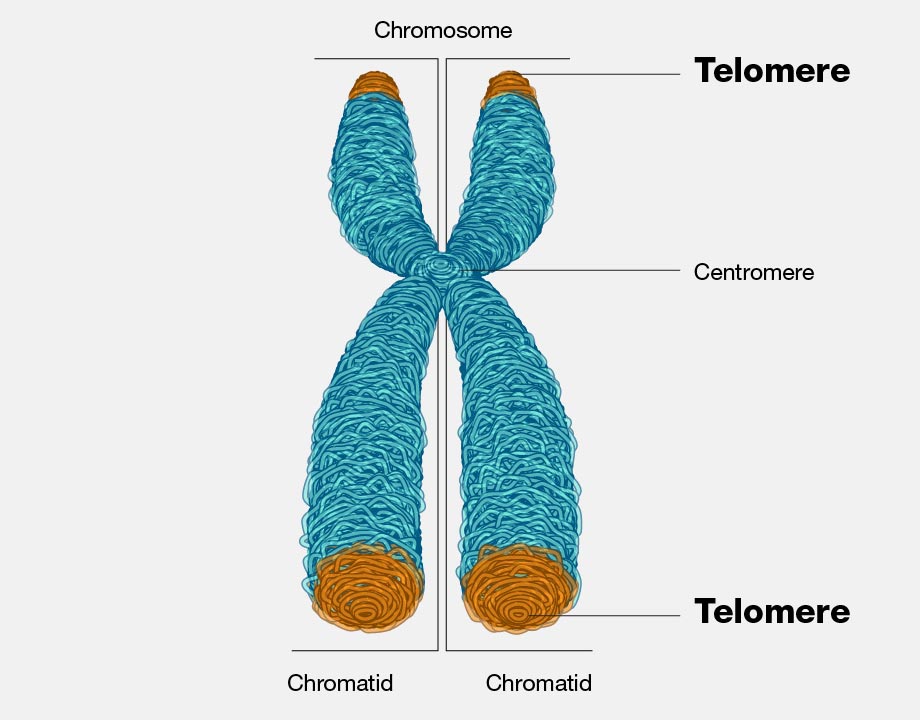
Every cell of our bodies contains chromosomes that carry genes that determine our characteristics (what we look like, for instance). At the ends of these chromosomes are telomeres, which protect the chromosomes from damage. They’re a bit like aglets, the plastic tips at the ends of shoelaces.
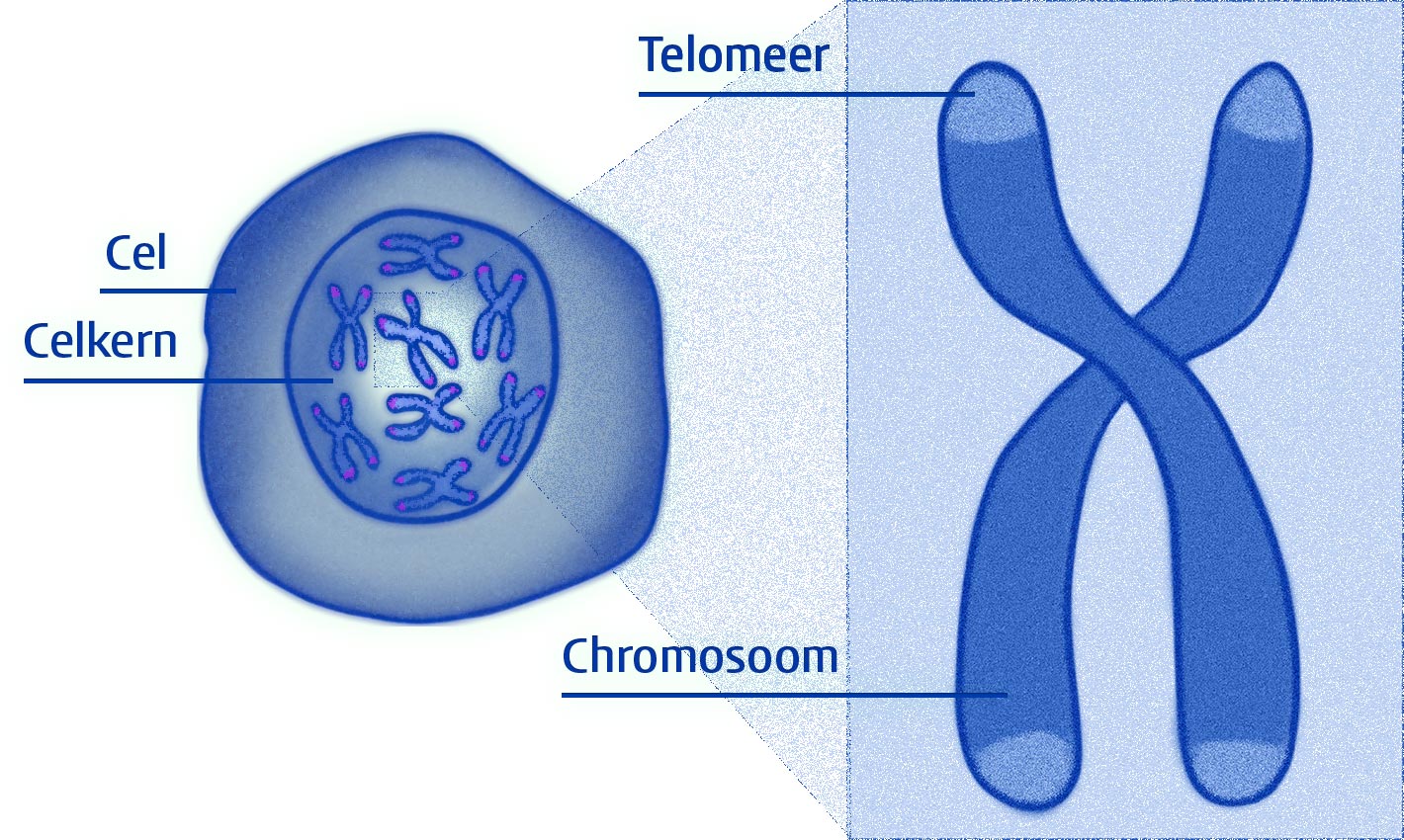
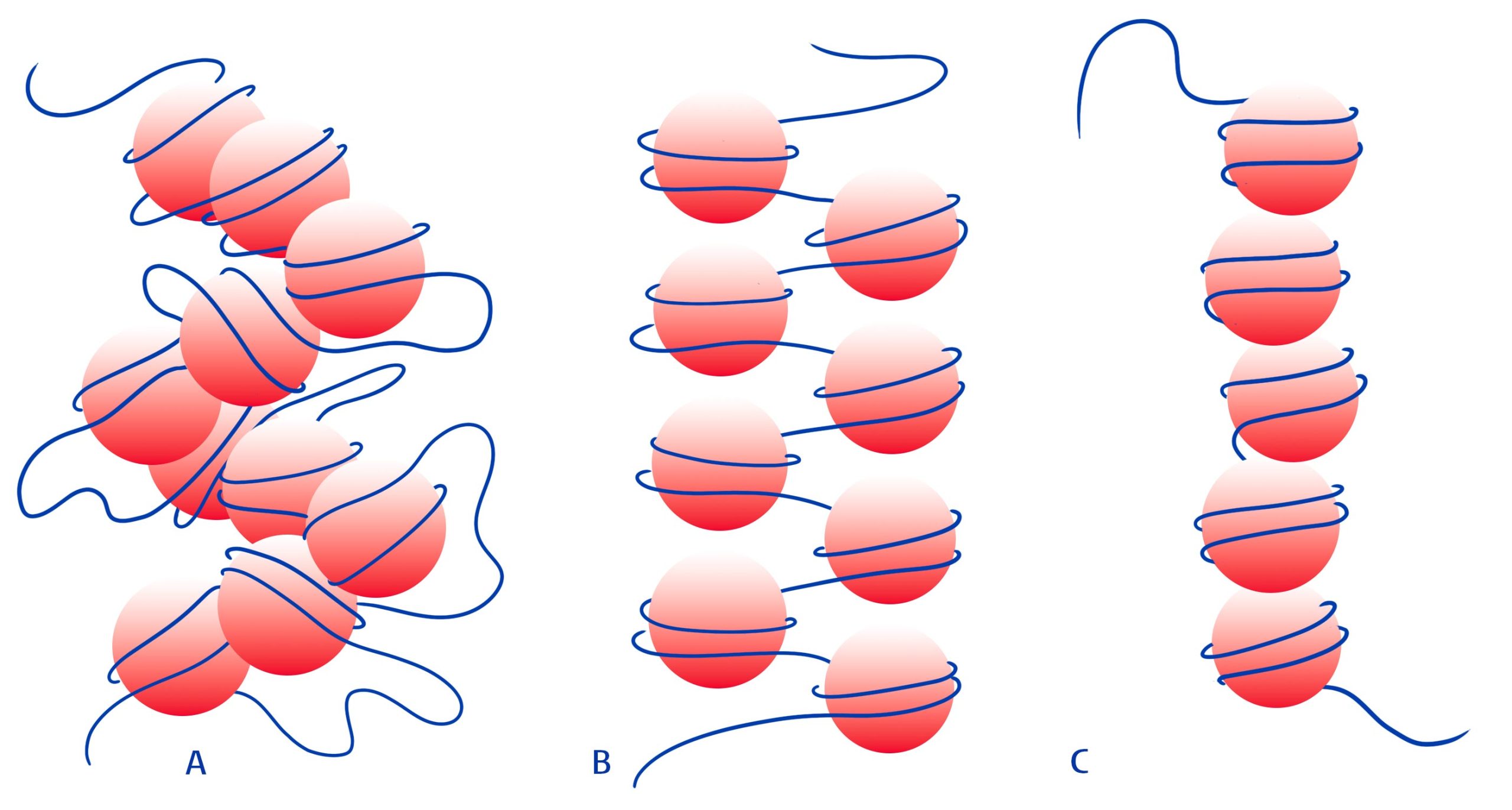
Because the DNA between the telomeres is two meters long, it has to be folded to fit in a cell. This is achieved by wrapping the DNA around packages of proteins. Together, the DNA and proteins are known as a nucleosome. These are arranged into something similar to a string of beads, with a nucleosome, a piece of free (or unbound) DNA, a nucleosome, and so on.
This string of beads then folds up even more. How it does so depends on the length of the DNA between the nucleosomes, the beads on the string. Two structures that occur after folding were already known. In one of them, two adjacent beads stick together and free DNA hangs in between (figure 2A). If the piece of DNA between the beads is shorter, the adjacent beads do not manage to stick together. Then two stacks form alongside each other (figure 2B).
In their study, Van Noort and colleagues discovered another telomere structure. Here the nucleosomes are much closer together, so there is no longer any free DNA between the beads. This ultimately creates one big helix, or spiral, of DNA (figure 2C).
Magnet
The new structure was discovered using a combination of electron microscopy and molecular force spectroscopy. The latter technique comes from Van Noort’s lab. Here one end of the DNA is attached to a glass slide and a tiny magnetic ball is stuck to the other. A set of strong magnets above this ball then pull the string of pearls apart. By measuring the amount of force needed to pull the beads apart one by one, you find out more about how the string is folded. The researchers in Singapore then used an electron microscope to get a better picture of the structure.
Building Blocks
Structure, says Van Noort, is “the holy grail of molecular biology.” If we know the structure of the molecules, this will give us more insight into how genes are switched on and off and how enzymes in cells deal with telomeres: how they repair and copy DNA, for example. The discovery of the new telomeric structure will improve our understanding of the building blocks in the body. And that in turn will ultimately help us study aging and diseases such as cancer and develop drugs to fight them.
Reference: “Columnar structure of human telomeric chromatin” by Aghil Soman, Sook Yi Wong, Nikolay Korolev, Wahyu Surya, Simon Lattmann, Vinod K. Vogirala, Qinming Chen, Nikolay V. Berezhnoy, John van Noort, Daniela Rhodes and Lars Nordenskiöld, 14 September 2022, Nature.
DOI: 10.1038/s41586-022-05236-5
Never miss a breakthrough: Join the SciTechDaily newsletter.
Follow us on Google and Google News.
11 Comments
It seams like there is no breakthrough and no discovery same old thing what we already knew long time ago!
Subramanian Ranajayam. Simplistic..yet profound analogy! THUMBS UP
I thought the structure itself is the discovery?
Extending the life of all human beings should be the #1 focus on the planet. Instead everyone is focused on self preservation.
Really? We of course do want to live longer. But according to many religions, the ultimate eternal life is for souls only, not for physical bodies. If we extend the life too long we might be unable to leave the body when the universe dies/degrades. Thus, it might make us dead at the very end, while some souls will continue to live. The ones who left the body on time and found peace not to come back in physical realm. Just something for you to think about.
Your first diagram contains two spelling errors.
…No, the diagram is in Dutch, because it’s from Leiden University, as credited in the article. Do a little research before making criticisms.
Mayan, “New structure discovered.” This is new information. Not the same old stuff we already knew.
This article reminds me of a Blake Lively movie, “The Age of Adelaide”, in which her character is in a car accident when the car is stuck in freezing cold water, nearly freezing her to death, and then a lightning bolt from heaven hits the car. Not only does this bolt from the blue revives her so she can escape the submerged car wreck, it also, according to the movie’s narrator, creates a condition in her body called “Frozen Telomeres “, so that she never physically ages. I just wondered if that complicated set of accidental circumstances COULD make this “Frozen Telomeres “ effect in real life!
Yo mama
There is a saying in Tamil language.It says:”What we know is of palm size and what we don’t know is the size of our universe!