
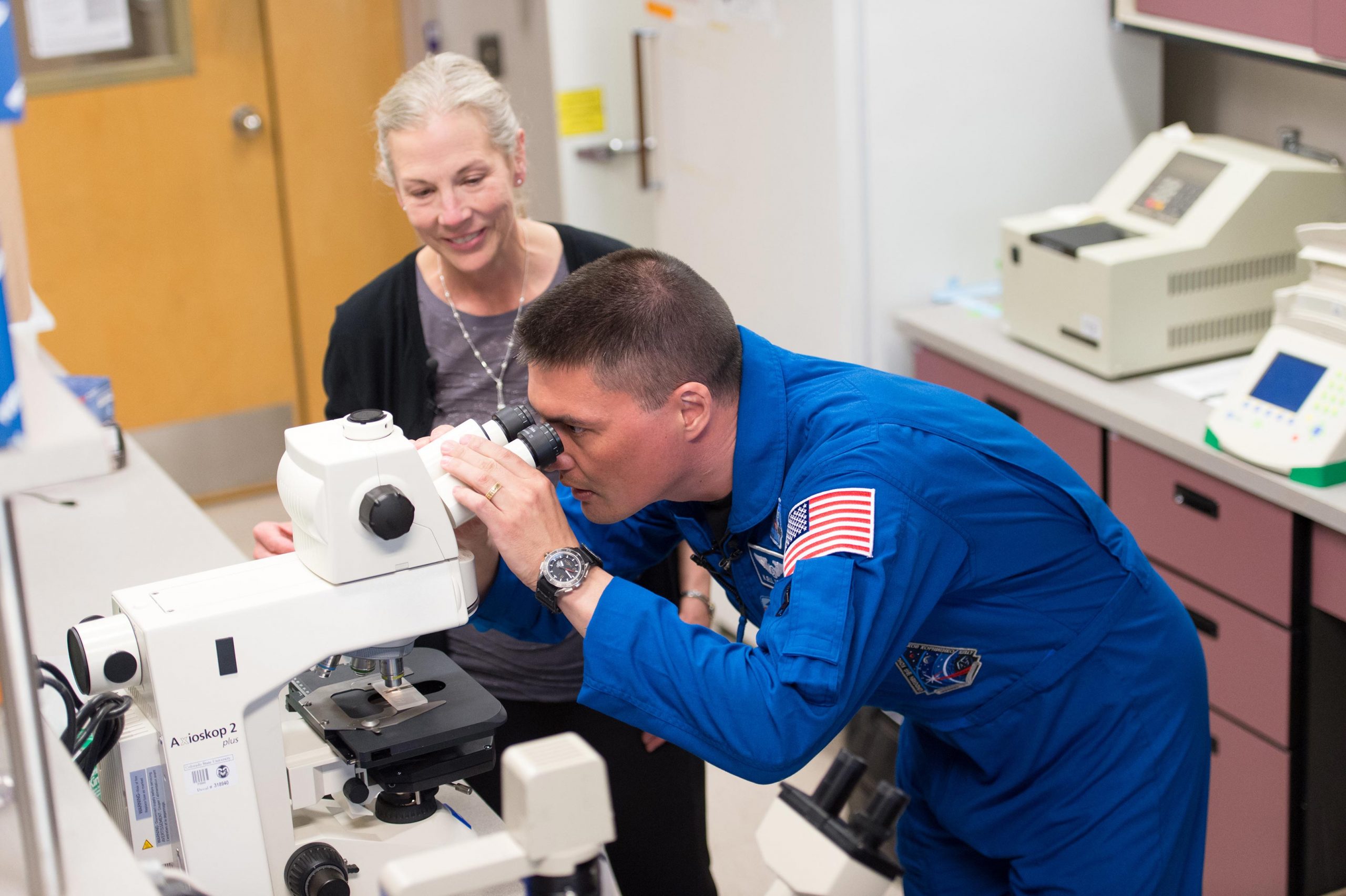
The historic NASA Twins Study investigated identical twin astronauts Scott and Mark Kelly and provided new information on the health effects of spending time in space.
Colorado State University Professor Susan Bailey was one of more than 80 scientists across 12 universities who conducted research on the textbook experiment; Mark remained on Earth while Scott orbited high above for nearly one year. The massive effort was coordinated by NASA’s Human Research Program.
Bailey has continued her NASA research and now joins more than 200 investigators from dozens of academic, government, aerospace, and industry groups to publish a package of 30 scientific papers in five Cell Press journals on November 25, 2020.
Jared Luxton, who recently received his doctoral degree in cell and molecular biology at CSU, is the first author of two of the studies. He is now a data scientist with the United States Department of Agriculture in Fort Collins.
The research — including an over-arching paper that covers what the investigators have learned about the fundamental features of space flight — represents the largest set of space biology and astronaut health effects data ever produced.
For Bailey, it is also a milestone marking many years of working with NASA, which included her lead role on basic radiation studies and the honor of being selected as an investigator for the Twins Study and concurrent research projects involving astronauts. During this time, several graduate students in her lab earned doctoral degrees under her mentorship.
“We now have a foundation to build on — things we know to look for in future astronauts, including telomere length changes and DNA damage responses,” Bailey said. “Going forward, our goal is to get a better idea of underlying mechanisms, of what’s going on during long-duration space flight in the human body and how it varies between people. Not everybody responds the same way. That was one of the good things about having the larger cohort of astronauts in these studies.”
Studying the ends of chromosomes, with implications for aging
Bailey is an expert on telomeres and radiation-induced DNA damage, areas of research that were of keen interest around the world when the Twins Study was published. In that study, she and her team found that Scott’s telomeres in his white blood cells got longer while in space, and subsequently returned to near normal length after he was back on Earth.
Telomeres are protective “caps” on the ends of chromosomes that shorten as a person ages. Large changes in telomere length could mean a person is at risk for accelerated aging or the diseases that come along with getting older, cardiovascular disease, and cancer for example.
In the latest research, Bailey, Luxton, Senior Research Associate Lynn Taylor and team studied a group of 10 unrelated astronauts, including CSU alum Dr. Kjell Lindgren, comparing the results with findings from the Kelly twins. The researchers did not have access to in-flight blood and other samples for all of the crewmembers, but Bailey said they did have blood samples before and after space flight for everyone.
The investigations involved astronauts who spent approximately six months on the International Space Station in low-Earth orbit, which is protected from some space radiation. Despite the protection, scientists found evidence of DNA damage that could be warning signs of potential health effects.
New discovery of oxidative stress
Among the new findings, the research team found that chronic oxidative stress during spaceflight contributed to the telomere elongation they observed. They also found that astronauts in general had shorter telomeres after spaceflight than they did before. The team also observed individual differences in responses.
To gain more insight on these findings, Bailey’s team also studied twin mountain climbers who scaled Mt. Everest, an extreme environment on Earth. The non-climbing twins remained at lower altitude, including in Boulder, Colorado. Remarkably, the team found similar evidence of oxidative stress and changes in telomere length in the climbers.
Christopher Mason, associate professor at Weill Cornell Medicine and a co-author with Bailey, performed gene expression analyses on the Mt. Everest climbers. He found evidence of a telomerase-independent, recombination-based pathway of telomere length maintenance known to result in longer telomeres.
Bailey said that when chronic oxidative stress occurs, it damages telomeres.
“Normal blood cells are dying and trying to survive,” she said. “They’re adapting to their new environment. Some cells will activate an alternative pathway to keep their telomeres going. It’s similar to what happens with some tumors. Some of the cells emerge from that process. That’s what we think we’re seeing during spaceflight as well.”
Luxton said the mechanism described above — known as alternative lengthening of telomeres, or ALT — was an unexpected finding.
“You usually see that in cancer or in developing embryos,” he said.
Take care of your telomeres
Similar to conclusions from the Twins Study, Bailey said the new findings have implications for future space travelers establishing a base on the Moon or traveling to Mars, or even as a space tourist. Long-duration exploration missions will involve increased time and distance outside of the protection of the Earth.
Although longer telomeres in space might seem like a good thing, perhaps even a “fountain of youth,” the scientist said she suspects a somewhat different ending to the story.
“Extended lifespan, or immortality, of cells that have suffered space radiation-induced DNA damage, such as chromosomal inversions, is a recipe for increased cancer risk,” she said.
Bailey said she and the team observed increased frequencies of inversions in all crewmembers, during and after spaceflight.
“Telomeres really are reflective of our lifestyles — whether on or off the planet,” said Bailey. “Our choices do make a difference in how quickly or how well we are aging. It’s important to take care of your telomeres.”
Bailey is a senior author of:
- “Fundamental Biological Features of Spaceflight: Advancing the Field to Enable Deep Space Exploration” to be published in Cell.
- “Temporal Telomere and DNA Damage Responses in the Space Radiation Environment,” to be published in Cell Reports.
- “Telomere Length Dynamics and DNA Damage Responses Associated with Long-Duration Spaceflight, which will also be published in Cell Reports.
Bailey and Luxton are also co-authors of “Haplotype Diversity and Sequence Heterogeneity of Human Telomeres,” to be published in Genome Research.
Never miss a breakthrough: Join the SciTechDaily newsletter.
Follow us on Google and Google News.
1 Comment
Sounds like this study is seeing the same thing as the Israeli “hyperbaric oxygen can reverse aging” study, but interpreting it in the opposite way.
http://www.sci-news.com/medicine/hyperbaric-oxygen-treatments-aging-09086.html
Interesting that the astronauts’ telomeres lengthened – but only temporarily. I wonder whether the Israeli study did long-term followups?