
Close Menu
    Facebook X (Twitter) Instagram
    SciTechDaily
    • Biology
    • Chemistry
    • Earth
    • Health
    • Physics
    • Science
    • Space
    • Technology
    Facebook X (Twitter) Pinterest YouTube RSS
    SciTechDaily
    Home»Science»Carbon Nanotubes Grown on Old Newspapers
    Science

    Carbon Nanotubes Grown on Old Newspapers

    By Swansea UniversityNovember 22, 2019No Comments3 Mins Read
    Facebook Twitter Pinterest Telegram LinkedIn WhatsApp Email Reddit
    Share
    Facebook Twitter LinkedIn Pinterest Telegram Email Reddit
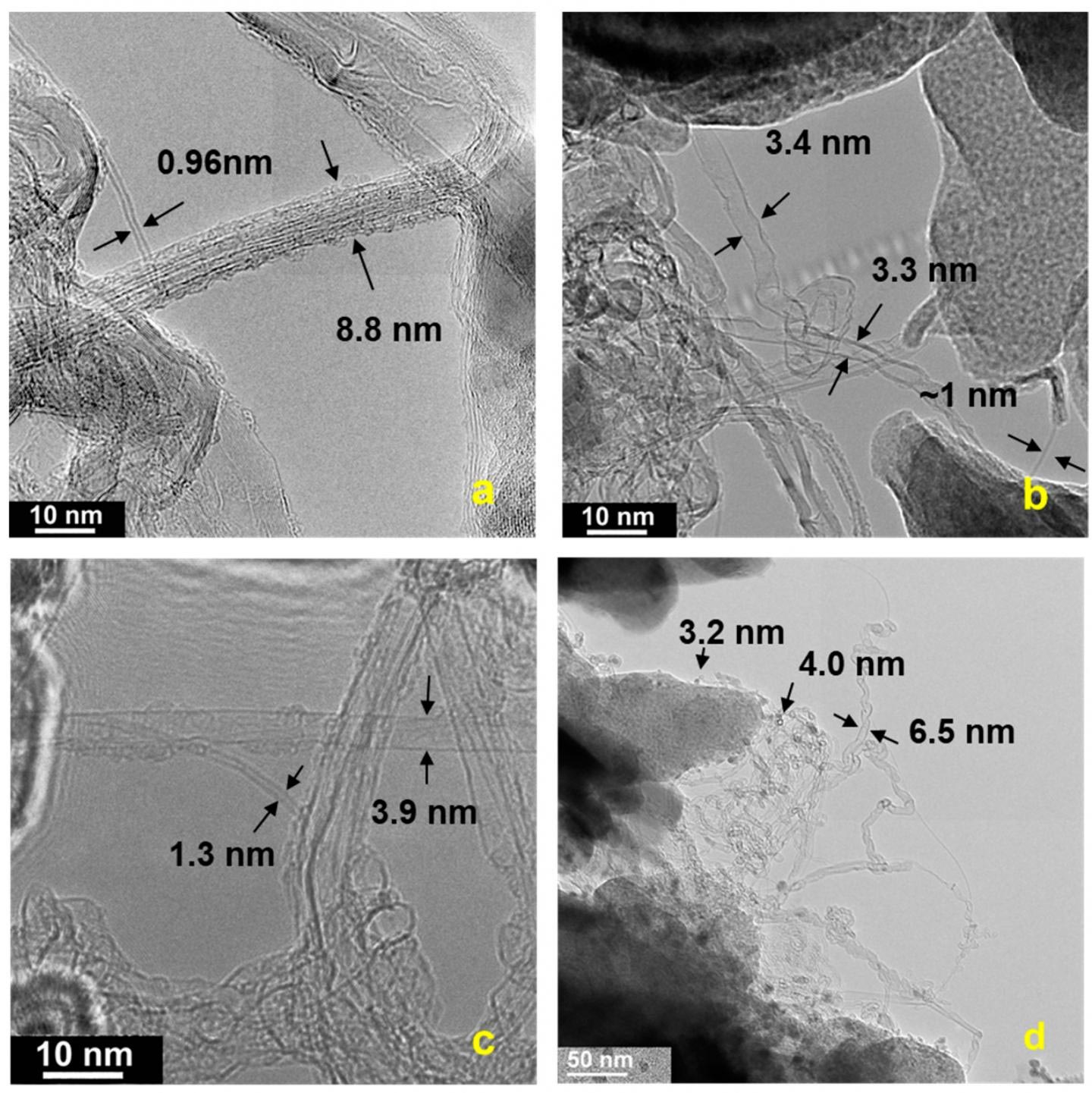
    Single Walled Carbon Nanotubes Grown on Kaolin Sized Paper
    TEM images of raw carbon soot grown on kaolin sized paper showing (a) roped single-walled carbon nanotubes (SWCNTs) helically wrapped by a SWCNT, and large SWCNTs, (b) collapsed, (c) folded, and (d) twisted nanotubes. Scale bar = 10 nm (a-c) and 50 nm (d). Credit: Rice University

    Newspapers provide a green, economical way to produce carbon nanotubes.

    Carbon nanotubes are tiny molecules with incredible physical properties that can be used in a huge range of things, such as conductive films for touchscreen displays, flexible electronics, fabrics that create energy and antennas for 5G networks.

    The new study, published in the MDPI Journal C, details the research experiments carried out in producing carbon nanotubes which could have the potential to solve some of the problems associated with their large-scale production such as:

    • The high cost of preparing a suitable surface for chemical growth.
    • The difficulties in scaling up the process, as only single surface growth processes have been previously available.

    The research team discovered that the large surface area of newspapers provided an unlikely but ideal way to chemically grow carbon nanotubes.

    Lead researcher Bruce Brinson said: “Newspapers have the benefit of being used in a roll-to-roll process in a stacked form making it an ideal candidate as a low-cost stackable 2D surface to grow carbon nanotubes.”

    However, not all newspaper is equally good – only newspaper produced with sizing made from kaolin, which is china clay, resulted in carbon nanotube growth.

    Co-author Varun Shenoy Gangoli said: “Many substances including talc, calcium carbonate, and titanium dioxide can be used in sizing in papers which act as a filler to help with their levels of absorption and wear. However, it was our observation that kaolin sizing, and not calcium carbonate sizing, showed us how the growth catalyst, which in our case was iron, is affected by the chemical nature of the substrate.”  

    ESRI Director Andrew Barron, also a professor at Rice University in the USA, said: “While there has been previous research that shows that graphene, carbon nanotubes and carbon dots can be been synthesized on a variety of materials, such as food waste, vegetation waste, animal, bird or insect waste and chemically grown on natural materials, to date, this research has been limited.

    “With our new research, we have found a continuous flow system that dramatically reduces the cost of both substrate and post-synthesis process which could impact on the future mass manufacture of single-walled carbon nanotubes.”

    Reference: ” From Newspaper Substrate to Nanotubes—Analysis of Carbonized Soot Grown on Kaolin Sized Newsprint” by Bruce E. Brinson, Varun Shenoy Gangoli, Anjli Kumar, Robert H. Hauge, W. Wade Adams and Andrew R. Barron, 29 October 2019, MDPI Journal C.
    DOI: 10.3390/c5040066

    Never miss a breakthrough: Join the SciTechDaily newsletter.
    Follow us on Google and Google News.

    Carbon Nanotubes Nanotechnology Rice University Swansea University
    Share. Facebook Twitter Pinterest LinkedIn Email Reddit

    Related Articles

    Contact Effects Could Limit How Small a Nano Device Can Be

    Double-Walled Carbon Nanotubes Display Singular Qualities

    Fine-Tuning the Chemistry of Materials

    Microbullets Demonstrate Graphene’s Energy Absorbing Strength

    Scientists Create Dual-Purpose Film for Energy Storage

    Graphene Quantum Dots Outperform Platinum in Fuel Cells

    Graphene Nanoribbon Film Keeps Glass Ice-Free

    Atom-Thick Carbyne Nanorods May Be The Strongest Material Ever

    PGClear Uses a Palladium-Gold Catalyst to Break Down Hazardous Compounds

    Leave A Reply Cancel Reply

    • Facebook
    • Twitter
    • Pinterest
    • YouTube

    Don't Miss a Discovery

    Subscribe for the Latest in Science & Tech!

    Trending News

    Scientists Uncover Potential Brain Risks of Popular Fish Oil Supplements

    Scientists Discover a Surprising Way To Make Bread Healthier and More Nutritious

    After 60 Years, Scientists Uncover Unexpected Brain Effects of Popular Diabetes Drug Metformin

    New Research Uncovers Hidden Side Effects of Popular Weight-Loss Drugs

    Scientists Rethink Extreme Warming After Surprising Ocean Discovery

    Landmark Study Links Never Marrying to Significantly Higher Cancer Risk

    Researchers Discover Unknown Beetle Species Just Steps From Their Lab

    Largest-Ever Study Finds Medicinal Cannabis Ineffective for Anxiety, Depression, PTSD

    Follow SciTechDaily
    • Facebook
    • Twitter
    • YouTube
    • Pinterest
    • Newsletter
    • RSS
    SciTech News
    • Biology News
    • Chemistry News
    • Earth News
    • Health News
    • Physics News
    • Science News
    • Space News
    • Technology News
    Recent Posts
    • Early Warning Signals of Esophageal Cancer May Be Hiding in Plain Sight
    • Researchers Have Discovered a THC-Free Cannabis Compound That May Replace Opioids
    • Common Blood Pressure Drug Shows Surprising Power Against Deadly Antibiotic-Resistant Superbug
    • Students Build Dark Matter Detector and Set New Experimental Limits
    • Scientists Discover Caffeine Can Repair Key Memory Circuits After Sleep Loss
    Copyright © 1998 - 2026 SciTechDaily. All Rights Reserved.
    • Science News
    • About
    • Contact
    • Editorial Board
    • Privacy Policy
    • Terms of Use

    Type above and press Enter to search. Press Esc to cancel.