
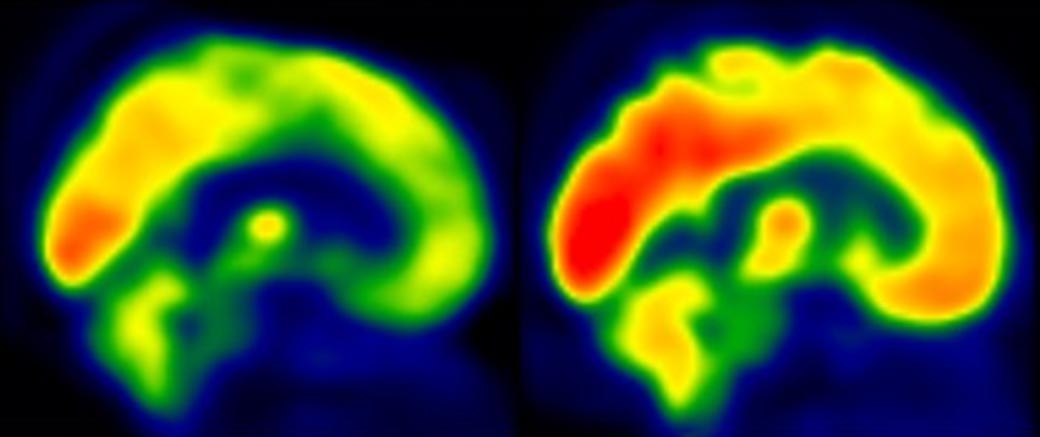
Regular aerobic workouts may decrease the likelihood of developing Alzheimer’s disease.
Individuals at risk for Alzheimer’s disease (AD) because of family history or genetic predisposition who engaged in six months of aerobic exercise training improved their brain glucose metabolism and higher-order thinking abilities (e.g., planning and mental flexibility) called executive function; these improvements occurred in conjunction with increased cardiorespiratory fitness. The results of this study are published in a special issue of Brain Plasticity devoted to Exercise and Cognition.
Drugs currently available to treat AD have limited therapeutic capacity. At a time when both the human and monetary costs of the disease are projected to rise dramatically in the coming decades, there is a critical need to provide individuals with readily-deployable strategies that can decrease the likelihood of acquiring the disease or slow its progression. Researchers, therefore, investigated whether exercise training in asymptomatic individuals harboring risk for AD improves markers associated with AD.
“This study is a significant step toward developing an exercise prescription that protects the brain against AD, even among people who were previously sedentary,” explained lead investigator Ozioma C. Okonkwo, Ph.D., of the Wisconsin Alzheimer’s Disease Research Center, University of Wisconsin School of Medicine and Public Health.
The study investigated 23 cognitively normal, relatively young older adults with a family history or genetic risk for AD. All patients had a sedentary lifestyle. They underwent a battery of assessments, including cardiorespiratory fitness testing, measurement of daily physical activity, brain glucose metabolism imaging (a measure of neuronal health), and cognitive function tests.
Half of the participants were randomly assigned to receive information about maintaining an active lifestyle but no further intervention. The other half participated in a moderate-intensity treadmill training program with a personal trainer, three times per week for 26 weeks.
Compared to the participants maintaining their usual level of physical activity, individuals assigned to the active training program improved their cardiorespiratory fitness, spent less time sedentary after the training program ended, and performed better on cognitive tests of executive functioning (but not episodic memory). Executive function, an aspect of cognition that is known to decline with the progression of AD, comprises the mental processes enabling individuals to plan, focus attention, remember instructions, and juggle multiple tasks successfully. The participants’ improved cardiorespiratory fitness was associated with increased brain glucose metabolism in the posterior cingulate cortex, an area of the brain linked to AD.
“This research shows that a lifestyle behavior — regular aerobic exercise — can potentially enhance brain and cognitive functions that are particularly sensitive to the disease. The findings are especially relevant to individuals who are at a higher risk due to family history or genetic predisposition,” noted Dr. Okonkwo. The lead author on the study, Max Gaitán, MEd, of the Wisconsin Alzheimer’s Disease Research Center, University of Wisconsin School of Medicine and Public Health, remarked that “an important next step would be to conduct a larger, more definitive, study. If these findings are replicated, they would have a tremendous impact on quality of later life, providing individuals with more years of independent living, active engagement with loved ones, and building memories.”
Reference: ” Brain Glucose Metabolism, Cognition, and Cardiorespiratory Fitness Following Exercise Training in Adults at Risk for Alzheimer’s Disease ” by Julian M. Gaitán, Elizabeth A. Boots, Ryan J. Dougherty, Jennifer M. Oh, Yue Ma, Dorothy F. Edwards, Bradley T. Christian, Dane B. Cook and Ozioma C. Okonkwo, 26 December 2019, Brain Plasticity.
DOI: 10.3233/BPL-190093
Never miss a breakthrough: Join the SciTechDaily newsletter.
Follow us on Google and Google News.