
Close Menu
    Facebook X (Twitter) Instagram
    SciTechDaily
    • Biology
    • Chemistry
    • Earth
    • Health
    • Physics
    • Science
    • Space
    • Technology
    Facebook X (Twitter) Pinterest YouTube RSS
    SciTechDaily
    Home»Science»Carnivorous Neighbors Were Able to Coexist During the Miocene
    Science

    Carnivorous Neighbors Were Able to Coexist During the Miocene

    By SciTechDailyJanuary 2, 2013No Comments2 Mins Read
    Facebook Twitter Pinterest Telegram LinkedIn WhatsApp Email Reddit
    Share
    Facebook Twitter LinkedIn Pinterest Telegram Email Reddit
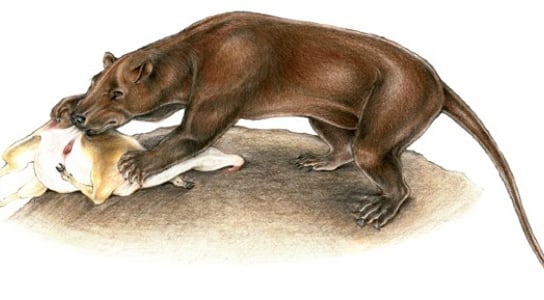
    A restoration of the large bear dog Amphicyon at a kill. Spain’s Magericyon anceps was a relative of this imposing carnivore. Credit: Charlene Letenneur, from Argot, 2010
    A restoration of the large bear dog Amphicyon at a kill. Spain’s Magericyon anceps was a relative of this imposing carnivore. Credit: Charlene Letenneur, from Argot, 2010

    Entombed within the 9- to 10-million-year-old rocks at Cerro de los Batallones in Spain’s Madrid Basin are at least nine different assemblages of large fossil mammals. Two of these deposits are rich in carnivore bones, and provide an interesting snapshot at how these apex predators coexisted.

    The scientists published their findings in the journal Proceedings of the Royal Society B¹. Out of the 1,800 large mammal fossils recovered at one of these sites, 92% belong to 10 different species of carnivores. Small cats, skunks, civet-sized hyenas, and red panda relatives were found in large numbers. A pair of sabercats, the leopard-sized Promegantereon ogygia and the tiger-sized Machairodus aphanistus were found next to a bear dog (Magericyon anceps).

    None of these Miocene carnivores have living descendants or even modern analogs, even though sabercats are often mistaken for tiger ancestors. The scientists drew upon geochemical clues drilled out from the teeth of the carnivores and their prey to see how these predators managed to coexist.

    The researchers were after the stable isotope δ13C, which becomes incorporated into the teeth and bones of herbivores. Paleontologists use these values to estimate what kind of habitat a creature lived in. Carnivores preserve these traces as well. By comparing the trace isotopes in the three carnivores, alongside the herbivores they lived with, the scientists estimated which prey species were suitable candidates for each of the carnivores.

    The sabercats seemed to prey on medium to small-sized herbivores, which frequented closed, wooded areas. The cats often dined on prehistoric pigs. The bear dog prowled more open spaces, and ate antelope and musk deer, which is known from partially digested remains supposedly left by a bear dog. Being of similar size, M. anceps and M. aphanistus probably avoided each other.

    Sheer size shielded the mega-sized herbivores from direct predation by these predators, although the same species would have been vulnerable when young, elderly, or infirm.

    Reference: “Resource partitioning among top predators in a Miocene food web” by M. Soledad Domingo, Laura Domingo, Catherine Badgley, Oscar Sanisidro and Jorge Morales, 7 January 2013, Proceedings of the Royal Society B.
    DOI: 10.1098/rspb.2012.2138

    Never miss a breakthrough: Join the SciTechDaily newsletter.
    Follow us on Google and Google News.

    Fossils Paleontology
    Share. Facebook Twitter Pinterest LinkedIn Email Reddit

    Related Articles

    Prehistoric Fossilized Eocene Epoch Turtles Died Locked In Coitus

    27-Foot Long Crocodylus Thorbjarnarsoni Roamed Kenya

    Carbonemys Was a Giant Turtle From Late Paleocene

    Mysterious “Godzillus” Fossil Discovered by Amateur Paleontologist

    Cretaceous Period Sankofa Pyrenaica Fossilized Eggs Are Unusually Shaped

    Burtele Foot Points to Other Past Hominins

    Microraptor Feathers Were Black With Iridescent Sheen

    Jurassic Period Super-Sized Fleas Had Armored Mouthparts to Attack the Thick Hide of Dinosaurs

    Hundreds of Lost Fossils From the Darwin Collection Rediscovered by the British Geological Survey

    Leave A Reply Cancel Reply

    • Facebook
    • Twitter
    • Pinterest
    • YouTube

    Don't Miss a Discovery

    Subscribe for the Latest in Science & Tech!

    Trending News

    Bone-Strengthening Discovery Could Reverse Osteoporosis

    Scientists Uncover Hidden Trigger Behind Stem Cell Aging

    Scientists Find Way to Reverse Fatty Liver Disease Without Changing Diet

    Could Humans Regrow Limbs? New Study Reveals Promising Genetic Pathway

    Scientists Reveal Eating Fruits and Vegetables May Increase Your Risk of Lung Cancer

    Scientists Reverse Brain Aging With Simple Nasal Spray

    Scientists Uncover Potential Brain Risks of Popular Fish Oil Supplements

    Scientists Discover a Surprising Way To Make Bread Healthier and More Nutritious

    Follow SciTechDaily
    • Facebook
    • Twitter
    • YouTube
    • Pinterest
    • Newsletter
    • RSS
    SciTech News
    • Biology News
    • Chemistry News
    • Earth News
    • Health News
    • Physics News
    • Science News
    • Space News
    • Technology News
    Recent Posts
    • 5 Common Myths About Learning a New Language, Debunked
    • The Neanderthal “Love Story” Isn’t What It Seems
    • Scientists Unlock Hidden Secrets of 2,300-Year-Old Mummies Using Cutting-Edge CT Scanner
    • Men vs. Women: Scientists Uncover Dramatic Differences in How the Immune System Ages
    • Eating Chili Peppers Linked to Longer Life
    Copyright © 1998 - 2026 SciTechDaily. All Rights Reserved.
    • Science News
    • About
    • Contact
    • Editorial Board
    • Privacy Policy
    • Terms of Use

    Type above and press Enter to search. Press Esc to cancel.