
Joint pain is common among older adults and osteoarthritis is something many active people will face as they age. Scientists at Washington University School of Medicine hope to put an ease to that pain and have discovered that the same genes that promote healing after cartilage damage also appear to protect against osteoarthritis in mice.
The same genes that promote healing after cartilage damage also appear to protect against osteoarthritis, a condition caused by years of wear-and-tear on the cartilage between joints, new research at Washington University School of Medicine in St. Louis shows.
Although the research was conducted in mice, the genes also are likely to be important in people.
“Our goal is to see whether we can protect cartilage in people by detecting the early biological changes that occur in osteoarthritis and prevent it from progressing to the stage where joint replacement becomes necessary,” says principal investigator Linda J. Sandell, PhD, the Mildred B. Simon Professor of Orthopaedic Surgery. “The main problem with biological treatments is that currently, we can’t detect osteoarthritis in its early stages. Better understanding of the genes that influence the disorder may help us do that.”
The researchers reported their findings in a pair of studies, published online in the journals Arthritis & Rheumatism and Osteoarthritis and Cartilage.
Osteoarthritis is the most common form of arthritis, affecting 25 million people in the United States. It is linked to the breakdown of cartilage, which acts as a shock absorber to cushion the joints. Osteoarthritis causes pain, swelling, and reduced motion and is most common in the hands, knees, hips, or spine.
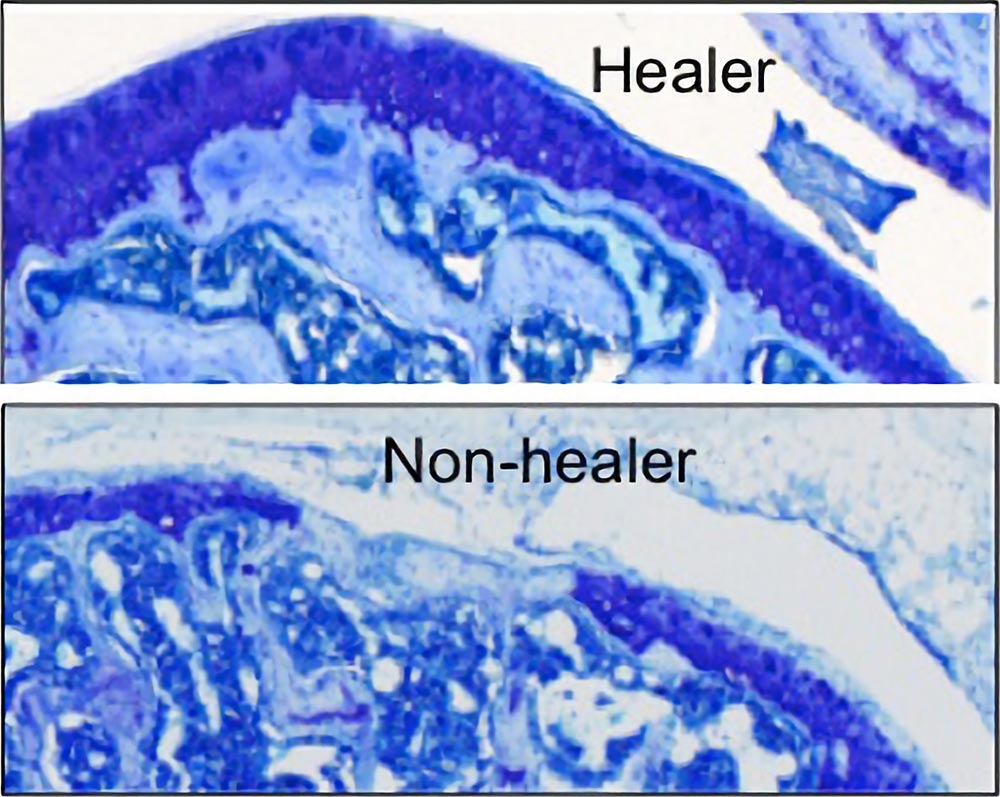
Scientists first discovered cartilage-healing properties in some strains of laboratory mice when they pierced their ears as a means to tag and identify them. But in some mice, the holes in their ears closed and quickly healed. Because so much of the ear is made from cartilage and healing occurred so rapidly in the mice ears, the researchers suspected that these mice also may be able to regenerate cartilage in their joints.
Sandell and her team bred the mice that healed rapidly with other mice that healed more slowly, and they found that the mice that could quickly heal and regenerate cartilage in the knee also were less susceptible to osteoarthritis.
In people, a breakdown of cartilage causes the bones to rub together and damage the joint. If the damage becomes too extensive, joint replacement surgery may be necessary.
Injury to a joint is a major risk factor for osteoarthritis, but not everyone is equally susceptible.
“Some people – and these mouse studies suggest that someday we may be able to predict which people – fare much better after an injury,” Sandell says. “We want to find a way to identify the genes that protect them.”
Sandell, director of the university’s Core Center for Musculoskeletal Biology and Medicine, and co-investigator James M. Cheverud, PhD, professor of anatomy and neurobiology, now are studying several other strains of mice on the spectrum between the good healers and those that heal poorly. They looked at the cartilage tissue under the microscope to determine the extent of osteoarthritis following an injury and analyzed the DNA in the cartilage.
“We’ve identified genes that correlate with healing and with protection from osteoarthritis,” Sandell says. “The work is in its beginning stages, but now that we’ve found a correlation, we want to look at even more strains of mice so that we can actually map the location of the genes that cause osteoarthritis and help to repair cartilage.”
She says osteoarthritis, like several other disorders, will ultimately involve many genes that each contribute in a small way to the disease process. By looking at more strains of mice, the research team believes it will become easier to identify the subtle genetic influences on osteoarthritis risk. As they clarify which genes are protecting the mice, it will be possible to look for similar genes in humans.
References:
“Heritability of articular cartilage regeneration and its association with ear-wound healing” by Muhammad Farooq Rai, Shingo Hashimoto, Eric E. Johnson, Kara L. Janiszak, Jamie Fitzgerald, Ellen Heber-Katz, James M. Cheverud and Linda J. Sandell, July 2012, Arthritis & Rheumatism.
DOI 10.1002/art.34396
“Cartilage and bone changes during development of post-traumatic osteoarthritis in selected LGXSM recombinant inbred mice” by S. Hashimoto, M.F. Rai, K.L. Janiszak, J.M. Cheverud and L.J. Sandell, 22 March 2012, Osteoarthritis and Cartilage.
DOI: 10.1016/j.joca.2012.01.022
Funding for this research comes from an ARRA Grand Opportunity Grant and from the National Institute of Arthritis, Musculoskeletal and Skin Diseases of the National Institutes of Health (NIH).
Never miss a breakthrough: Join the SciTechDaily newsletter.
Follow us on Google and Google News.