
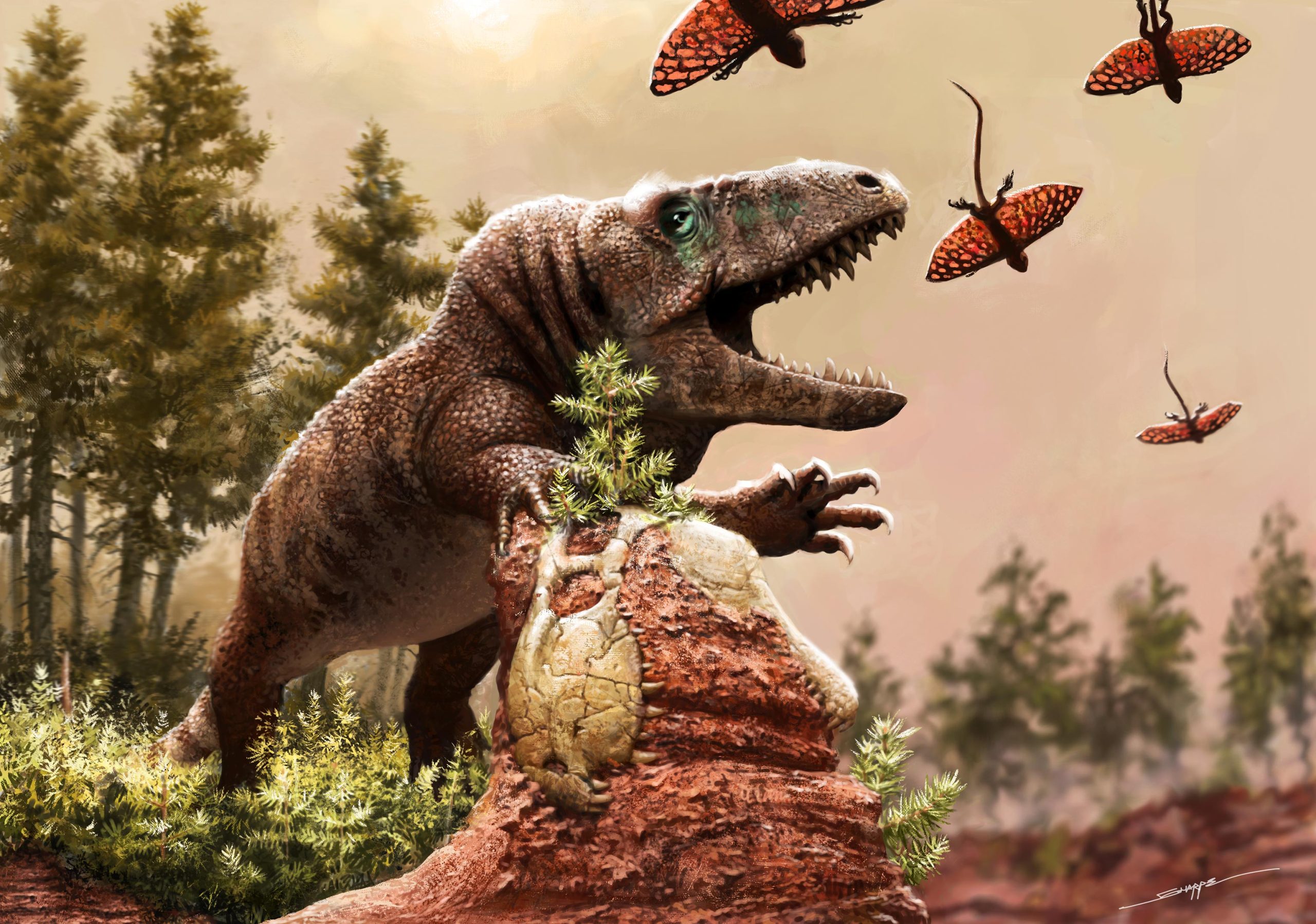
Climate change drove reptile evolution during the Permian-Triassic era, with rising temperatures prompting rapid diversification.
Reptiles had one heck of a coming-out party just over 250 million years ago during the end of the Permian period and the start of the Triassic.
Their rates of evolution and diversity began exploding, leading to a dizzying variety of abilities, body plans, and traits. This helped to firmly establish both their extinct lineages and those that still exist today as one of the most successful and diverse animal groups the world has ever seen. For the longest time, scientists explained this flourish by reptile competition being wiped out by two of the biggest mass extinction events in the history of the planet. These occurred around 261 and 252 million years ago.
This explanation has been rewritten by a new Harvard-led study that reconstructed how the bodies of ancient reptiles changed and compared it to the effects of millions of years of climate change.
Harvard paleontologist Stephanie Pierce’s lab shows that the morphological evolution and diversification seen in early reptiles started years before these mass extinction events. Moreover, they were directly driven by what caused the mass extinction events in the first place — rising global temperatures due to climate change.
Rising Global Temperatures Triggered Reptile Diversification
“We are suggesting that we have two major factors at play — not just this open ecological opportunity that has always been thought by several scientists — but also something that nobody had previously come up with, which is that climate change actually directly triggered the adaptive response of reptiles to help build this vast array of new body plans and the explosion of groups that we see in the Triassic,” said Tiago R. Simões, lead author on the study and a postdoctoral fellow in the Pierce lab.
“Basically, [rising global temperatures] triggered all these different morphological experiments — some that worked quite well and survived for millions of years up to this day, and some others that basically vanished a few million years later,” Simões added.
Impact of Climate Shifts on Reptile Morphological Changes
In the paper, which was published recently in the journal Science Advances, the researchers lay out the vast anatomical changes that took place in many reptile groups, including the forerunners of crocodiles and dinosaurs, in direct response to major climate shifts concentrated between 260 to 230 million years ago.
The study provides a close look at how a large group of organisms evolve because of climate change, which is especially pertinent today as global temperatures continually rise. In fact, the rate of carbon dioxide released into the atmosphere today is about nine times what it was during the timeframe that culminated in the biggest climate change-driven mass extinction of all time 252 million years ago: the Permian-Triassic mass extinction.
“Major shifts in global temperature can have dramatic and varying impacts on biodiversity,” said Stephanie E. Pierce. She is the Thomas D. Cabot Associate Professor of Organismic and Evolutionary Biology and curator of vertebrate paleontology in the Museum of Comparative Zoology. “Here we show that rising temperatures during the Permian-Triassic led to the extinction of many animals, including many of the ancestors of mammals, but also sparked the explosive evolution of others, especially the reptiles that went on to dominate the Triassic period.”
The study involved nearly eight years of data collection and took a heavy dose of camerawork, CT scanning, and loads of passport stamps as Simões traveled to more than 20 countries and more than 50 different museums to take scans and snapshots of more than 1,000 reptilian fossils.
With all the information, the scientists created an expansive dataset that was analyzed with state-of-the-art statistical methods to construct a diagram called an evolutionary time tree. Time trees reveal how early reptiles were related to each other, when their lineages first originated, and how fast they were evolving. Then they combined it with global temperature data from millions of years ago.
Diversification of reptile body plans began about 30 million years before the Permian-Triassic extinction, making it obvious that these changes weren’t triggered by the event as previously thought. Although the extinction events did help put them in high gear.
Temperature Rises and Reptile Body Changes
The dataset also showed that rises in global temperatures, which began at about 270 million years ago and lasted until at least 240 million years ago, were followed by rapid body changes in most reptile lineages. For example, some of the larger cold-blooded animals evolved to become smaller so they could cool down easier; others evolved to live in water for that same effect. The latter group included some of the most bizarre forms of reptiles that would go on to become extinct including a tiny chameleon-like creature with a bird-like skull and beak, a giant, long-necked marine reptile once thought to be the Loch Ness monster, and a gliding reptile resembling a gecko with wings. It also includes the ancestors of reptiles that still exist today such as turtles and crocodiles.
Smaller reptiles, which gave rise to the first lizards and tuataras, went on a different path than their larger reptile brethren. Their evolutionary rates slowed down and stabilized in response to the rising temperatures. The investigators believe it was because the small-bodied reptiles were already better adapted to the rising heat since they can more easily release heat from their bodies compared to larger reptiles when temperatures got hot very quickly all-around Earth.
The scientists say they are planning to expand on this work by investigating the impact of environmental catastrophes on the evolution of organisms with abundant modern diversity, such as the major groups of lizards and snakes.
For more on this research, see Researchers Discover That Global Warming Spawned the Age of Reptiles.
Reference: “Successive climate crises in the deep past drove the early evolution and radiation of reptiles” by Tiago R. Simões, Christian F. Kammerer, Michael W. Caldwell and Stephanie E. Pierce, 19 August 2022, Science Advances.
DOI: 10.1126/sciadv.abq1898
Never miss a breakthrough: Join the SciTechDaily newsletter.
Follow us on Google and Google News.