
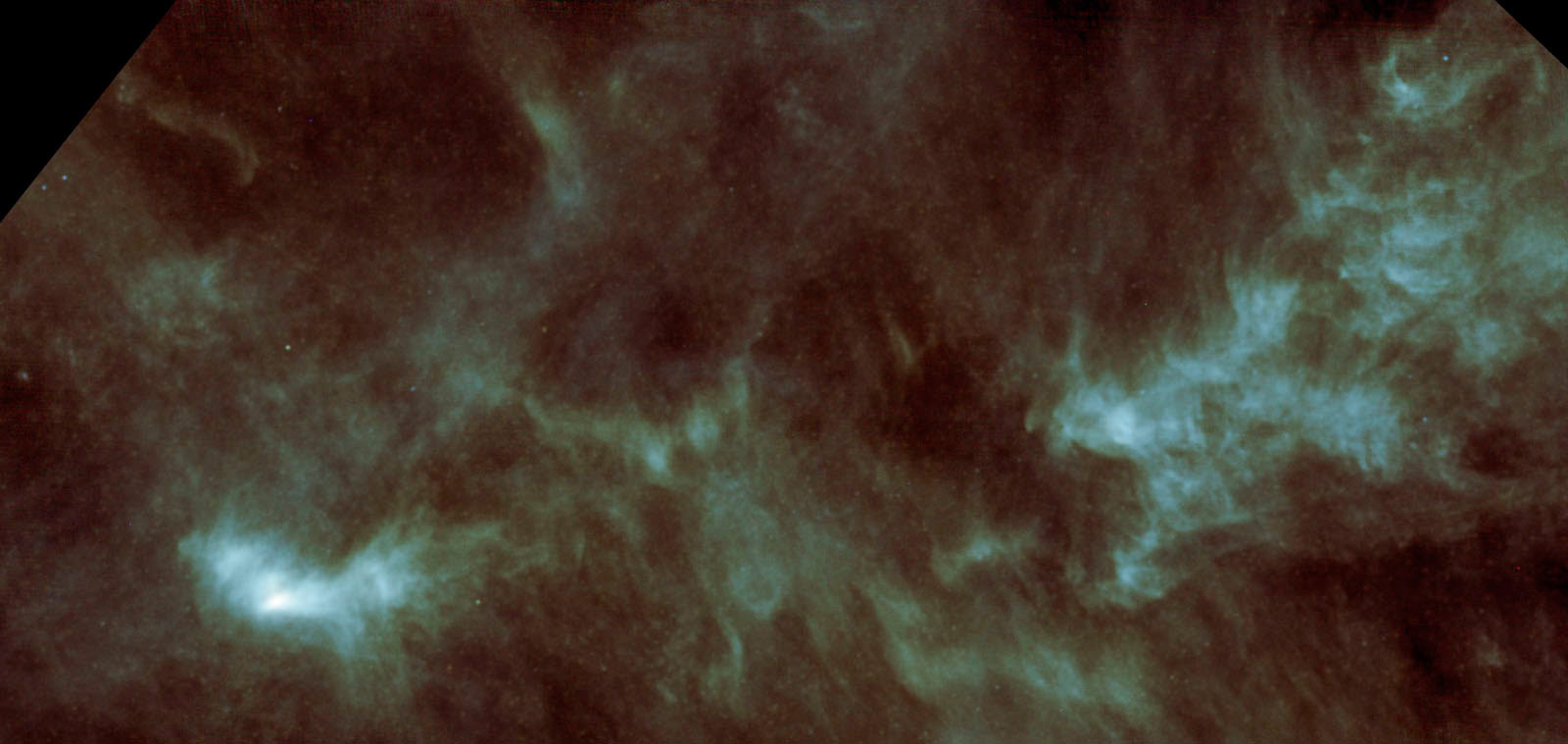
New research from the Harvard-Smithsonian Center for Astrophysics measures the velocity distribution of the gas in a pre-stellar core, revealing the dynamics of collapsing cores and star formation.
Stars like the Sun begin their lives as cold, dense cores of dust and gas that gradually collapse under the influence of gravity until nuclear fusion is ignited. Exactly how the critical collapse process occurs in these embryos, however, is poorly understood, with several competing ideas having been advanced. Material might just freely fall to the center, although in more likely scenarios the infall is inhibited by pressure from warm gas, turbulent motions, magnetic fields, or even perhaps by some combination of them. It might be possible to distinguish between these alternative collapse hypotheses by examining how the core’s density varies with radius, but it turns out that (at least for spherical clouds) the predicted density distributions all look about the same. The predicted distributions of velocity for the infalling gas, however, are quite different.
The dust in these cores makes them completely opaque in the optical, and so studying their behaviors requires techniques at other wavelengths. One of the most exciting developments in astronomy over the past decade has been the development of far-infrared and millimeter wavelength tools for the tasks of identifying pre-stellar cores as such, and determining their properties. CfA astronomer Eric Keto and two colleagues used observations of emission lines from water and carbon monoxide at both wavelength regimes to measure the velocity distribution of the gas in a pre-stellar, dense core. Each of these gas molecules traces a slightly different density of gas (the typical value in these clouds is about one hundred thousand particles per cubic centimeter).
The data clearly prefer the scenario in which the gas temperature is nearly constant throughout the cloud with just enough total mass present for gravity to drive slow contraction. Actually, the paper’s authors were the first to advocate and describe just such a possibility, and these observations of this particular core bring a satisfying confirmation that no magnetic fields or turbulence is present or needed. The new results highlight the dramatic modern successes in unraveling the earliest stages of stellar birth, and the power of new technology. More cores now need to be measured in order to determine if these particular conclusions have general validity.
Reference: “The Dynamics of Collapsing Cores and Star Formation” by Eric Keto, Paola Caselli and Jonathan Rawlings, 8 December 2014, MNRAS.
DOI: 10.1093/mnras/stu2247
arXiv: 1410.5889
Never miss a breakthrough: Join the SciTechDaily newsletter.
Follow us on Google and Google News.
2 Comments
I
This is an astrophysical-geological alternative theoretical model which reveals the formation and the evolution of the celestial bodies into a hypothetical multidimensional interconnected Universe, and what could be the actual reason for which molecular clouds would collapse.
Two metaphysical ingredients are borrowed and adapted here to my recipe-model:
1. All celestial bodies form with inner black holes at their center;
2. These inner black holes produce water.
The model says that when the gas and the dust in the early Universe, or in general when molecular clouds within the supernova remnants of today collapse within this physical dimensional layer, this collapse produces initially many what I would call small-mass black holes (the size of inner stellar or planetary cores). These small-mass black holes would become next the movers and the shakers of the protoplanetary disks, dictating the formation, the structure, and the evolution of these disks. They would organise the material within the molecular nebula in disk shape structures, leading in this way at the formation of solar systems, with stars, planets, and even satellites having inner black holes at their centers. Actually, these types of black holes would also be responsible for the strong magnetic fields connected with the formation of stars. In this way, there are different black holes with different dynamics inside the Universe, the differentiation of their dynamics being made most probably by their size and mass. Nothing in the physical Universe would exist by itself but in concordance, in interconnection, in organic interrelation with the still hypothetical higher subtle dimensions. (Although it doesn’t mention how these black holes formed initially, as I said, metaphysics comes here in the support of my astrophysical model and says that black holes stand at the basis of the formation of stars and planets.) Therefore, the formation and the evolution of all celestial bodies in a multidimensional interconnected Universe would have to be done through these types of black holes. If the Universe is multidimensional, then these black holes would have to play a key vital role in the formation and the evolution of the celestial bodies within this physical dimensional layer as well. In other words, in such a multidimensional interconnected macrocosmic system, in which everything manifested on a certain layer would have correspondence on the other layers, the existence of these inner core stellar and planetary black holes – true energetic bridges between the layers – would be inevitable. (In order to test this theory, we would need very powerful telescopes which would be able to detect such small-mass black holes within molecular nebulae and protoplanetary disks. Unfortunately still, such telescopes do not exist at the current time.)
Consequently, seen from the multidimensional perspective, the vortex of the black hole in the middle would represent the nucleus of the future planet around which would be formed the belt of matter at the beginning of the solar system. When the planet is formed, the small-mass black hole would attract the cosmic dust, the chemical ingredients (hydrogen, oxygen, nitrogen, sulfur, carbon, methane, ammonia, etc), and the ice particles which exist within the protoplanetary disk, forming a belt of matter. This belt of matter would then be organised by the black hole and would surround it on all sides, forming a thick cemented layer, all around it. In this way, the interior of the planet would remain hollow, with its own habitat and evolutionary process, being constantly governed and balanced by the conscious activity of the central black hole which would release and absorb matter as a convertor of energy in this dimensional layer. (In support of this statement that the planet may be hollow comes an experiment made by NASA with the drop of water in the sidereal space. When it was released from a tube, this drop of water organized in space having a hollow interior.) From here, the planet would continue its road of evolution with the inner central black hole which would regulate its entire manifestation, multidimensionally interconnecting the physical interior of the planet with the higher subtle realities of the Macrocosm.
II
I suspect that the gravity produced by the central black hole and the planets’ presence in this physical dimension would bend the very fabric of spacetime to the point of interconnecting it inside with the higher dimensions. In other words, the deeper you’d go inside the planet, the greater the bending of spacetime would be, to the point where somewhere deep within the mantle there would be a transition zone between the physical and the higher dimensional layers. If we would remain strictly in this physical dimension and go deeper, matter would become more rarefied, less dense, to the point where there would be no matter anymore but only the black hole at the center, the heart and the engine of the planet.
Just like humans, the planet would have also its own subtle structures connected with these extradimensional layers of the Macrocosm. The planet could be seen in this way like a living being, multidimensionally layered, with the subtle planes manifested inside it. The black hole nucleus of the planet would be the center of its subtle structure.
According to the model, the inner black hole would be also responsible for producing the magnetic field of the planet. As we know, black holes also generate magnetic fields. The magnetic field would be in this case the wave, the “echo” produced by the inner black hole within this physical dimensional layer of the Macrocosm. The intensity of the magnetic field would increase with the depth inside the structure of the planet.
I also suspect that the central black hole would dictate the rotation of the planet around its axis and also its revolution around the Sun. Actually, from my perspective, the central black holes of all celestial bodies in the Universe would have a direct connection with their rotation and revolution movements from one point to another within spacetime. As we also know, black holes rotate as well.
From this perspective, if we would section the planet in two, below the surface we would find the material layer of the crust and the upper and the lower mantle. The deeper you’d descend, gradually, the structure of the physical layer would become like cheese, with bigger and bigger cavities and tunnels, with lakes, oceans, tectonic plates, rivers of water and chambers of lava, oil, different types of minerals, precious stones, metals, and rocks, granite, basalt, etc. The thickness of the physical layer would be somewhere around 2,000 – 2,500 kilometers. Still, the deeper you’d go inside this layer, the bigger and more abundant would be the holes until the point of transition towards the subtle planes. In other words, the closer you get to the center of the planet, the higher the vibration, the states of matter changing in line with the frequencies connected with the higher macrocosmic layers, the gravity, the influence generated by the inner black hole being essential here. Beyond the 2,000 – 2,500 kilometers depth there would be only the interior atmosphere in the physical plane with the black hole in the center which would absorb and release matter in the same time. We could even associate the planet with a plant whose roots would be found in the higher dimensions, dimensions interconnected by the central black hole.
At its beginnings, the planet would form having already stored within its structure all the building blocks of life. In this case, the panspermia scenario in which an asteroid would come and seed the planet with germs is a complete nonsense. Therefore, the planets would contain already those germs in their structure ever since their inception in the protoplanetary disk, and that’s exactly what scientists observed. Life would be a very common element in the evolution of the Universe. Later, if the planet would be rocky and would be formed at the right distance from the sun, in the habitable zone of its solar system, these germs would evolve into more and more complex organisms, and biological life will thrive on that planet with the black hole at its core. After the formation of the physical layer around the black hole, the water coming from it would fuel the interior ocean, and after that, through holes, cracks, and crevices (the physical layer of the planet being honeycombed) the water would reach the surface, fueling the oceans and the seas. In this way, the water would be expelled from the black hole in different periods of the planet and in different quantities.