

A study led by the UAB has revealed a practice that history has overlooked for millennia.
An interdisciplinary study led by the Universitat Autònoma de Barcelona (UAB) has uncovered that women living in ancient Nubia, a region corresponding to modern-day Sudan, developed distinct skeletal adaptations for carrying heavy loads on their heads as early as the Bronze Age, more than 3,500 years ago. Published in the Journal of Anthropological Archaeology, the research highlights a long-standing yet largely invisible practice that has been overlooked in historical records and predominantly undertaken by women for millennia.
Traditionally, depictions of physical labor in prehistoric times have focused on men. However, this new study challenges that narrative. It reveals that women from the Kerma culture (2500–1500 BCE) regularly transported heavy objects, and occasionally children, atop their heads, using techniques refined across generations, including the use of head straps known as tumplines.
The project was led by Jared Carballo from UAB’s Department of Antiquity and Middle Ages Studies, in collaboration with Leiden University (Netherlands), and Uroš Matić from the University of Essen (Germany). The team combined anthropological analysis of skeletal remains with ethnographic and iconographic studies from various African and Mediterranean cultures. Their research also examined depictions of Nubian women in Egyptian tomb art. Together, these findings offer valuable insights into how habitual labor shaped the human body and reveal the gendered division of load-carrying tasks in ancient societies.
Skeletal Evidence of Gendered Labor
The study of 30 human skeletons (14 women and 16 men) buried at the Bronze Age site of Abu Fatima, located near Kerma, the capital of the kingdom of Nubia – also called Kush and a rival of ancient Egypt –revealed significant sex-based differences, thanks to the material provided by the excavations by the Sudanese-American Mission led by Sarah A. Schrader and Stuart T. Smith, co-authors of the research. While men showed signs of strain in the shoulders and arms, especially on the right side — likely from shoulder-carrying — women exhibited specific skeletal changes in the cervical vertebrae and areas of the skull associated with the prolonged use of head straps that transferred weight from the forehead to the back.
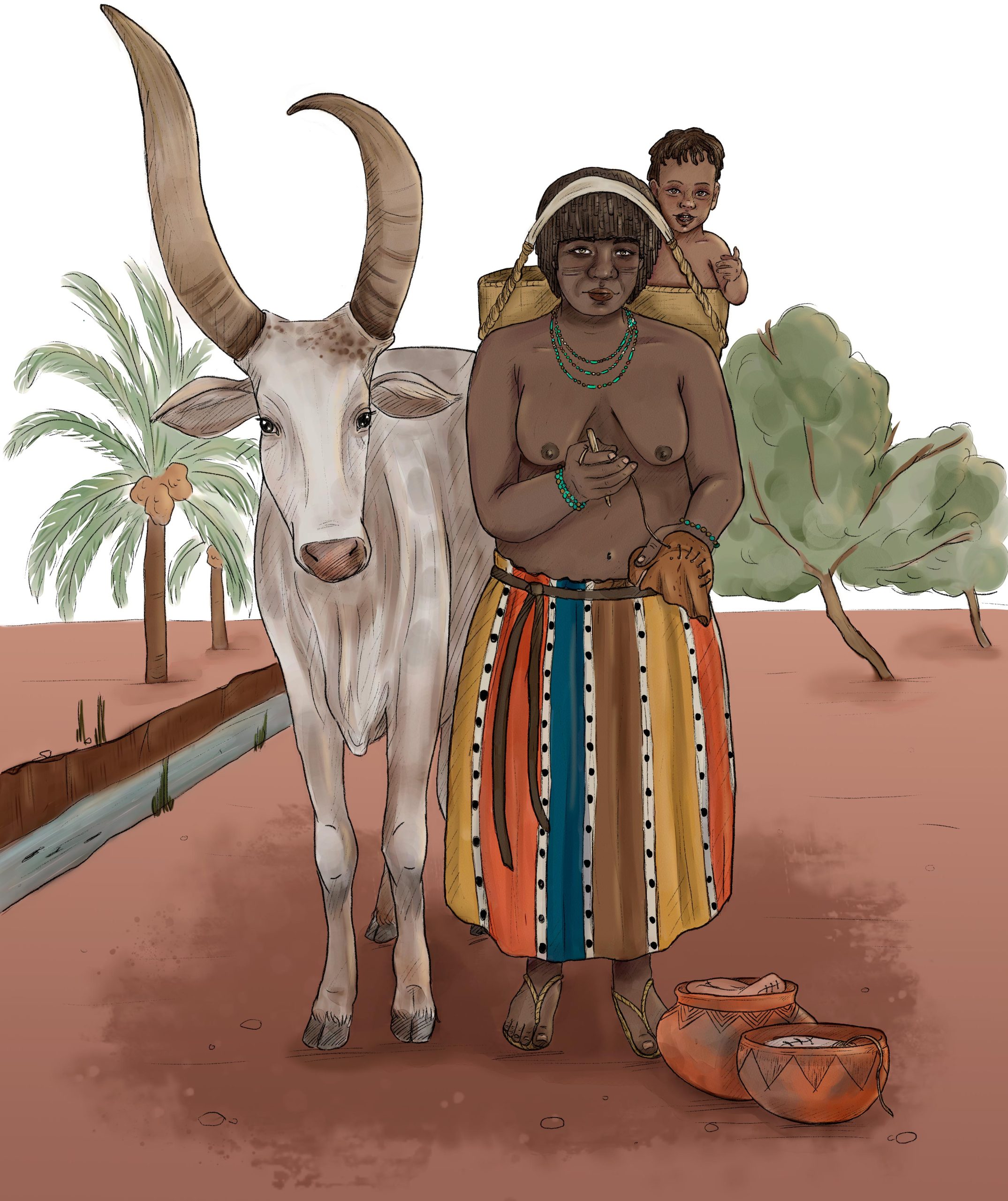
One of the clearest examples was the woman classified as “individual 8A2”: a woman who died over the age of 50 and was buried with luxury items such as an ostrich feather fan and a leather cushion. Biochemical analysis of her dental enamel indicates she was born elsewhere, suggesting she was a migrant. Her skull displays a significant depression behind the coronal suture and severe cervical osteoarthritis, consistent with a prolonged use of tumplines. It is likely that, in addition to migrating from her homeland, she spent much of her life transporting heavy loads in the rural Nile environment — perhaps even carrying children from her family or community. A way of life as common as it is overlooked by written history.
“This way of life is as common as it is overlooked by written history,” explains Jared Carballo. “In some way, the study reveals how women literally have carried the weight of society on their heads for millennia.”
The Human Body as a Living Archive
This study supports a growing perspective that sees the human body as a biological archive of lived experiences. In this sense, bone modifications are not simply the result of ageing; they also reflect social patterns, such as the division of labor and gender roles. Therefore, anthropological concepts like “body techniques” (ways in which people use their bodies in different societies in everyday activities such as walking, running, or using tools) or “gender performativity” (differences in movements dues to imitation or social conventions) offer a framework for interpreting how repeated tasks shape bones and configure bodies according to identity.
Such practices, also observed in representations of Nubian women in later Egyptian tombs and still documented today in rural communities across Africa, Asia, and Latin America, have long been invisible in historical narratives. However, as this research shows, their impact was so profound that they literally reshaped the anatomy of those who performed them. Head-loading was not only a physical effort but also a material expression of inequality and resilience.
As a result, the study opens new avenues of research into women’s mobility, the physical implications of motherhood, and the economic and logistical roles of women in rural societies. “Abu Fatima thus offers a new window into the deep past of the fascinating Nile Valley and a powerful reminder of how heavy the silences around women in history still are”, Jared Carballo concludes.
Reference: “Tumplines, baskets, and heavy burden? Interdisciplinary approach to load carrying in Bronze Age Abu Fatima, Sudan” by Jared Carballo-Pérez, Uroš Matić, Rachael Hall, Stuart T. Smith and Sarah A. Schrader, 17 December 2024, Journal of Anthropological Archaeology.
DOI: 10.1016/j.jaa.2024.101652
The research included the participation of archaeologists from the Universitat Autònoma de Barcelona, Leiden University, the University of Essen, and the University of California Santa Barbara.
Never miss a breakthrough: Join the SciTechDaily newsletter.
Follow us on Google and Google News.
5 Comments
How can you uncover something thats been ignored? To ignore it, you have to know it in the first place right?
The bottom line is that life was difficult before the invention of the internal combustion engine, and these authors are not interested in what caused the “signs of strain in the shoulders and arms, especially on the right side” of the men. As a penance for supposedly ignoring how heavy loads were transported by people in the past, and what was probably a personal decision by those doing so, the authors willfully ignore the men. Which is worse, a willful bias or an unconscious bias? They are both biases, meaning that the supposed scientists are not being objective.
Willful bias as they are looking at it through the perspective of not only modern, but western lenses.
PNG; women living in the bush regularly carry a baby, a load of firewood and a very heavy weight of sweet potato in three separate string bags hung from their head. Girls start doing it at about five yeas of age when they accompany mum up the mountain to the garden; and that leads to formation of that groove in the head. Men; the right arm is used for carrying the bush knife (presumably its predecessor was a stone axe and a spear) which is used for all manner of business including warfare. Fighting would certainly put a strain on the right arm, as would tree-felling, chopping and splitting planks from extremely large felled trees building fences, houses etc etc.
Odd to think that that sort stuff was normal for tens of thousands of years. And is now being discovered by academia.
And STILL normal in places like PNG.