
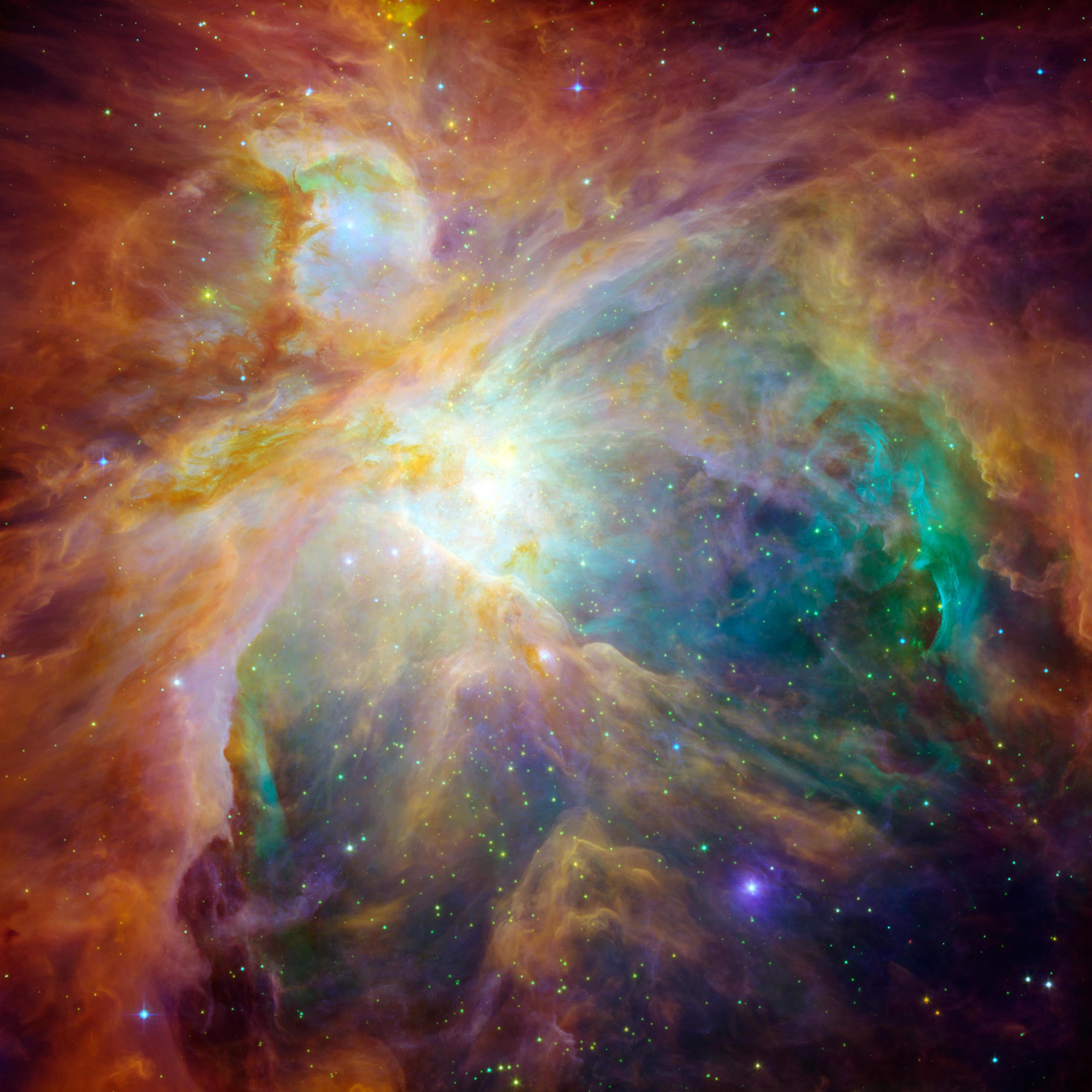
A composite image from Hubble and Spitzer captures the Orion Nebula, revealing ionized gases and carbon-rich molecules in this star-forming region 1,500 light-years away. Young stars appear as colorful dots sprinkled throughout the cosmic cloud.
Gaseous swirls of hydrogen, sulfur, and hydrocarbons cradle a collection of infant stars in this composite image of the Orion Nebula, as seen by the Hubble Space Telescope and the Spitzer Space Telescope. Together, the two telescopes expose carbon-rich molecules in the cosmic cloud of this star-formation factory located 1,500 light-years away.
Hubble’s ultraviolet and visible-light view reveal hydrogen and sulfur gas that have been heated and ionized by intense ultraviolet radiation from the massive stars, collectively known as the “Trapezium.” Meanwhile, Spitzer’s infrared view exposes carbon-rich molecules in the cloud. Together, the telescopes expose the stars in Orion as a rainbow of dots sprinkled throughout the image.
Never miss a breakthrough: Join the SciTechDaily newsletter.
Follow us on Google and Google News.
2 Comments
… it does swirls, but if you don’t understand something, it just doesn’t mean that it is a chaos…
… and define chaos, …
… by the way, what happens to the entropy it the Sun is born, or a planet…