
A new electrical power converter design developed by Kobe University offers significantly improved efficiency at a reduced cost and lower maintenance. This direct current voltage boost converter is set to make a substantial impact on the development of electric and electronic components in various sectors, including power generation, healthcare, mobility, and information technology.
Devices that harvest energy from sunlight or vibrations, or power medical devices or hydrogen-fueled cars have one key component in common. This so-called “boost converter” converts low-voltage direct current input into high-voltage direct current output. Because it is such a ubiquitous and key component, it is desirable that it uses as few parts as possible for reduced maintenance and cost and at the same time that it operates at the highest possible efficiency without generating electromagnetic noise or heat. The main working principle of boost converters is to quickly change between two states in a circuit, one that stores energy and another that releases it. The faster the switching is, the smaller the components can be and therefore the whole device can be downsized. However, this also increases the electromagnetic noise and heat production, which deteriorates the performance of the power converter.
The team of Kobe University power electronics researcher Mishima Tomokazu made significant progress in developing a new direct current power conversion circuit. They managed to combine high-frequency switching (about 10 times higher than before) with a technique that reduces electromagnetic noise and power losses due to heat dissipation, called “soft switching,” while also reducing the number of components and, therefore, keeping cost and complexity low.
“When the circuit changes between two states, there is a brief period when the switch is not completely closed, and at that point there is both a voltage and a current across the switch. This means that during this time the switch acts like a resistor and thus dissipates heat. The more often a switch state changes, the more this dissipation occurs. Soft switching is a technique that guarantees that the switch transitions happen at zero voltage, thus minimizing the heat loss,” explains Dr. Mishima. Traditionally, this has been achieved by “snubbers,” components that offer alternative energy sinks during the transition period, which subsequently leads to energy losses.
Publication and Prototype Development
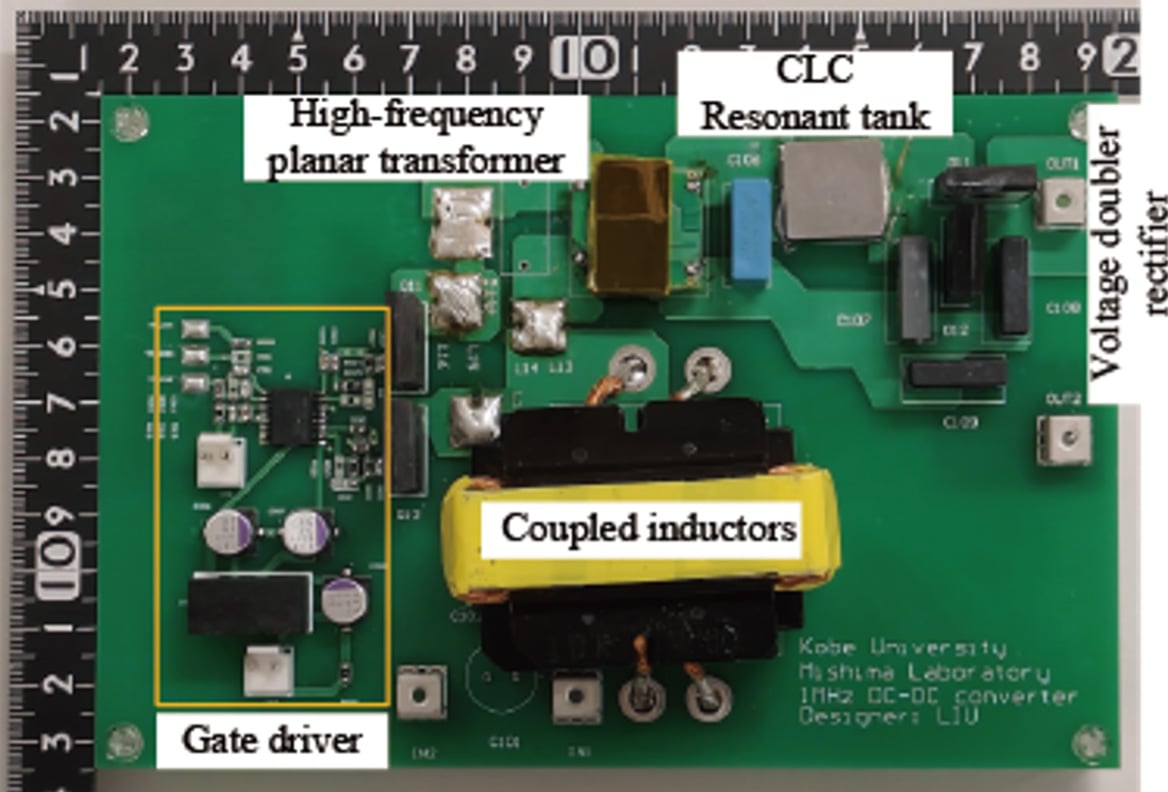
The Kobe University team presented their new circuit design and its evaluation in the journal IEEE Transactions on Power Electronics. The key to their achievement is the use of “resonant tank” circuits that can store energy during the switching period and therefore have much lower losses. In addition, they use a component-saving design with flat components printed onto a circuit board, called a “planar transformer,” which is very compact and has both good efficiency and thermal performance.
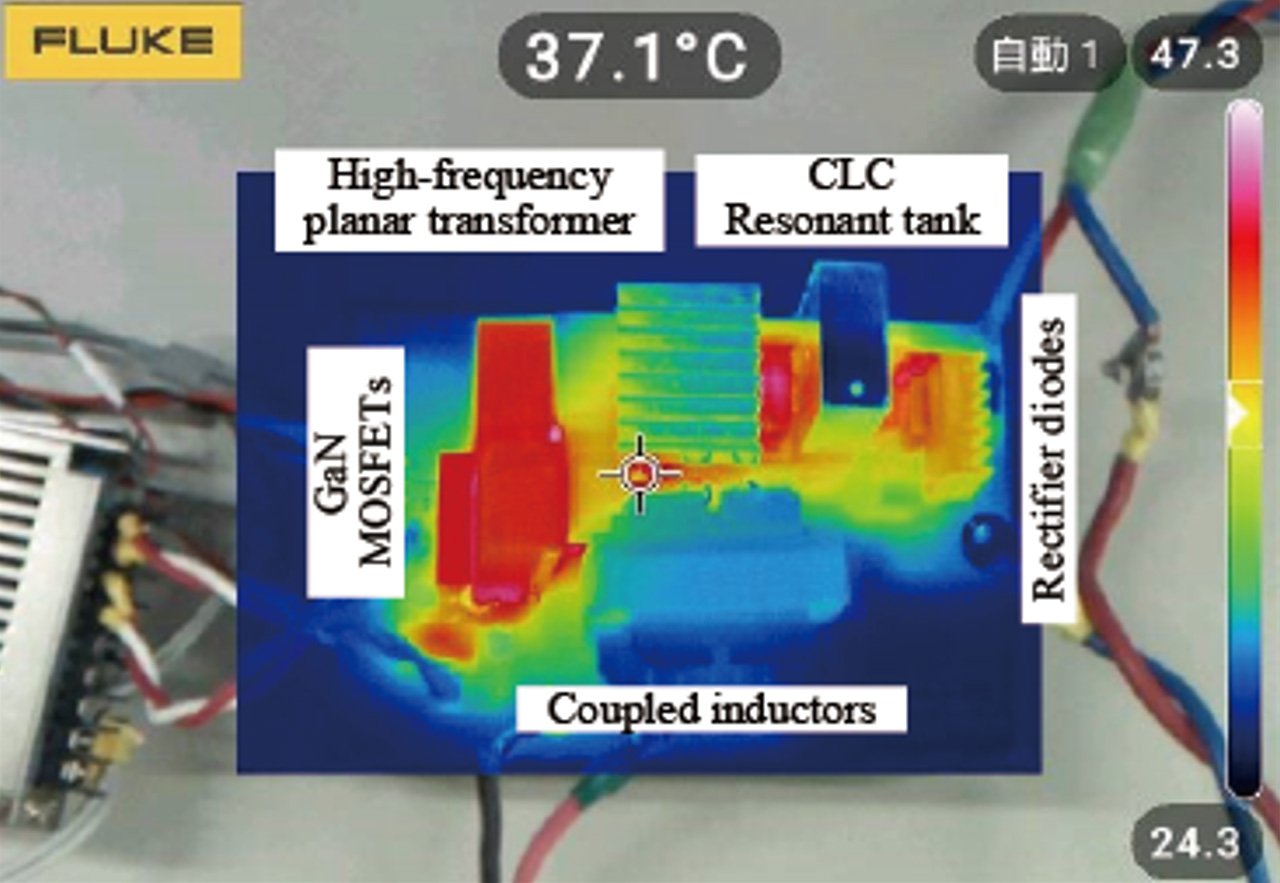
Mishima and his colleagues also built a prototype of the circuit and measured its performance. “We confirmed that our snubberless design has much reduced electromagnetic noise and a high energy efficiency of up to 91.3 percent, which is unprecedented for a MHz drive with high voltage conversion ratio. This ratio is also more than 1.5 times higher than existing designs.” However, they want to further increase the efficiency by reducing the power dissipation of the magnetic components used.
Considering how ubiquitous electrical devices are in our society, the high-efficiency and low-noise operation of direct current power supplies with a high voltage multiplier ratio is extremely important. This Kobe University development will be of great relevance to applications in electric power, renewable energy, transportation, information and telecommunications and medical care. Mishima explains their plans going forward, saying “The current development is a 100W-class small-capacity prototype, but we aim to expand the power capacity to a larger kW-class capacity in the future by improving the electronic circuit board and other components.”
Reference: “MHz-Driven Snubberless Soft-Switching Current-Fed Multiresonant DC-DC Converter” by Tomokazu Mishima, Shiqiang Liu, Ryotaro Taguchi and Ching-Ming Lai, 21 March 2024, IEEE Transactions on Power Electronics.
DOI: 10.1109/TPEL.2024.3380069
This research was conducted in collaboration with researchers from the National Chung Hsing University.
Never miss a breakthrough: Join the SciTechDaily newsletter.
Follow us on Google and Google News.
1 Comment
I would like to express my appreciation to the author for this insightful article. It’s always exciting to read about advancements in battery technology.
Did you know that programming languages like MATLAB play a significant role in battery science? MATLAB is often used for modeling and simulation in battery technology. It helps implement algorithms for battery management systems, enabling precise measurements and predictions of parameters such as State of Charge (SoC) and State of Health (SoH). This is a great example of how programming and computational models are driving innovation in this field. Looking forward to more such informative articles!