
Argonne National Laboratory scientists have used anomaly detection in the ATLAS collaboration to search for new particles, identifying a promising anomaly that could indicate new physics beyond the Standard Model.
Scientists used a neural network, a type of brain-inspired machine learning algorithm, to sift through large volumes of particle collision data in a study that marks the first use of a neural network to analyze data from a collider experiment.
Particle physicists are tasked with mining this massive and growing store of collision data for evidence of undiscovered particles. In particular, they’re searching for particles not included in the Standard Model of particle physics, our current understanding of the universe’s makeup that scientists suspect is incomplete.
Utilizing Machine Learning in ATLAS Collaboration
As part of the ATLAS collaboration, scientists at the U.S. Department of Energy’s (DOE) Argonne National Laboratory and their colleagues recently used a machine learning approach called anomaly detection to analyze large volumes of ATLAS data. The method has never before been applied to data from a collider experiment. It has the potential to improve the efficiency of the collaboration’s search for something new. The collaboration involves scientists from 172 research organizations.
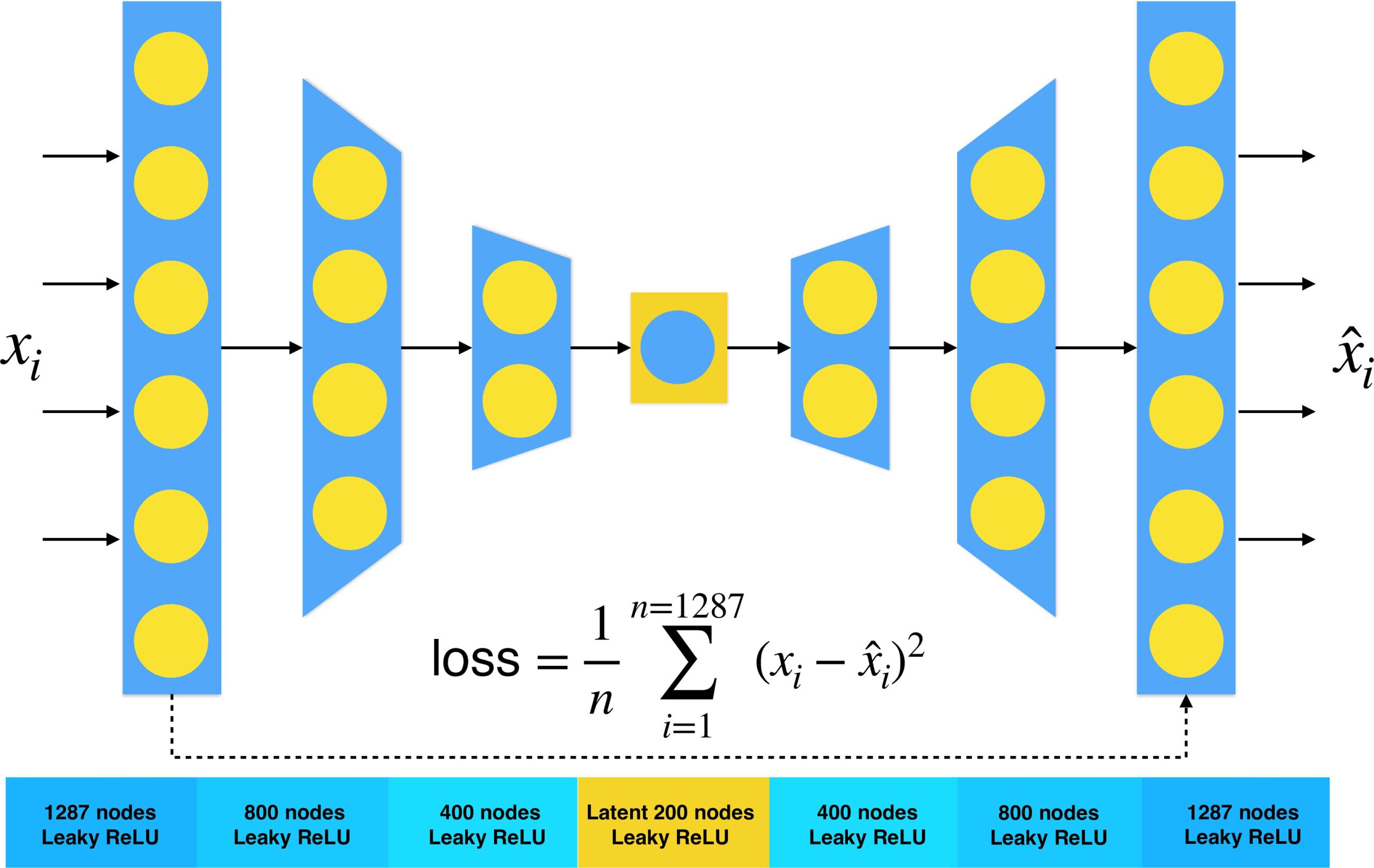
The team leveraged a brain-inspired type of machine learning algorithm called a neural network to search the data for abnormal features, or anomalies. The technique breaks from more traditional methods of searching for new physics. It is independent of — and therefore unconstrained by — the preconceptions of scientists.
“Rather than looking for very specific deviations, the goal is to find unusual signatures in the data that are completely unexplored, and that may look different from what our theories predict.”
Physicist Sergei Chekanov
Traditionally, ATLAS scientists have relied on theoretical models to help guide their experiment and analysis in the directions most promising for discovery. This often involves performing complex computer simulations to determine how certain aspects of collision data would look according to the Standard Model. Scientists compare these Standard Model predictions to real data from ATLAS. They also compare them to predictions made by new physics models, like those attempting to explain dark matter and other phenomena unaccounted for by the Standard Model.
But so far, no deviations from the Standard Model have been observed in the billions of billions of collisions recorded at ATLAS. And since the discovery of the Higgs boson in 2012, the ATLAS experiment has yet to find any new particles.
Innovative Techniques and Goals
“Anomaly detection is a very different way of approaching this search,” said Sergei Chekanov, a physicist in Argonne’s High Energy Physics division and a lead author on the study. “Rather than looking for very specific deviations, the goal is to find unusual signatures in the data that are completely unexplored and that may look different from what our theories predict.”
To perform this type of analysis, the scientists represented each particle interaction in the data as an image that resembles a QR code. Then, the team trained their neural network by exposing it to 1% of the images.
The network consists of around 2 million interconnected nodes, which are analogous to neurons in the brain. Without human guidance or intervention, it identified and remembered correlations between pixels in the images that characterize Standard Model interactions. In other words, it learned to recognize typical events that fit within Standard Model predictions.

After training, the scientists fed the other 99% of the images through the neural network to detect any anomalies. When given an image as input, the neural network is tasked with recreating the image using its understanding of the data as a whole.
“If the neural network encounters something new or unusual, it gets confused and has a hard time reconstructing the image,” said Chekanov. “If there is a large difference between the input image and the output it produces, it lets us know that there might be something interesting to explore in that direction.”
Using computational resources at Argonne’s Laboratory Computing Resource Center, the neural network analyzed around 160 million events within LHC Run-2 data collected from 2015 to 2018.
Discoveries and Future Research
Although the neural network didn’t find any glaring signs of new physics in this data set, it did spot one anomaly that the scientists think is worth further study. An exotic particle decay at an energy of around 4.8 teraelectronvolts results in a muon (a type of fundamental particle) and a jet of other particles in a way that does not fit with the neural network’s understanding of Standard Model interactions.
“We’ll have to do more investigation,” said Chekanov. “It is likely a statistical fluctuation, but there’s a chance this decay could indicate the existence of an undiscovered particle.”
The team plans to apply this technique to data collected during the LHC Run-3 period, which began in 2022. ATLAS scientists will continue to explore the potential of machine learning and anomaly detection as tools for charting unknown territory in particle physics.
The results of the study were published in Physical Review Letters.
Reference: “Search for New Phenomena in Two-Body Invariant Mass Distributions Using Unsupervised Machine Learning for Anomaly Detection at √s=13 TeV with the ATLAS Detector” by G. Aad et al. (ATLAS Collaboration)m 20 February 2024, Physical Review Letters.
DOI: 10.1103/PhysRevLett.132.081801
This work was funded in part by the DOE Office of Science’s Office of High Energy Physics and the National Science Foundation.
Never miss a breakthrough: Join the SciTechDaily newsletter.
Follow us on Google and Google News.