
Close Menu
    Facebook X (Twitter) Instagram
    SciTechDaily
    • Biology
    • Chemistry
    • Earth
    • Health
    • Physics
    • Science
    • Space
    • Technology
    Facebook X (Twitter) Pinterest YouTube RSS
    SciTechDaily
    Home»Physics»Chromatic Intensity Interferometer: High-Spatial-Resolution Interferometry Enters the Multi-Wavelength Era
    Physics

    Chromatic Intensity Interferometer: High-Spatial-Resolution Interferometry Enters the Multi-Wavelength Era

    By University of Science and Technology of ChinaSeptember 17, 2021No Comments3 Mins Read
    Facebook Twitter Pinterest Telegram LinkedIn WhatsApp Email Reddit
    Share
    Facebook Twitter LinkedIn Pinterest Telegram Email Reddit
    Improved Spatial Resolution Achieved by Chromatic Intensity Interferometry
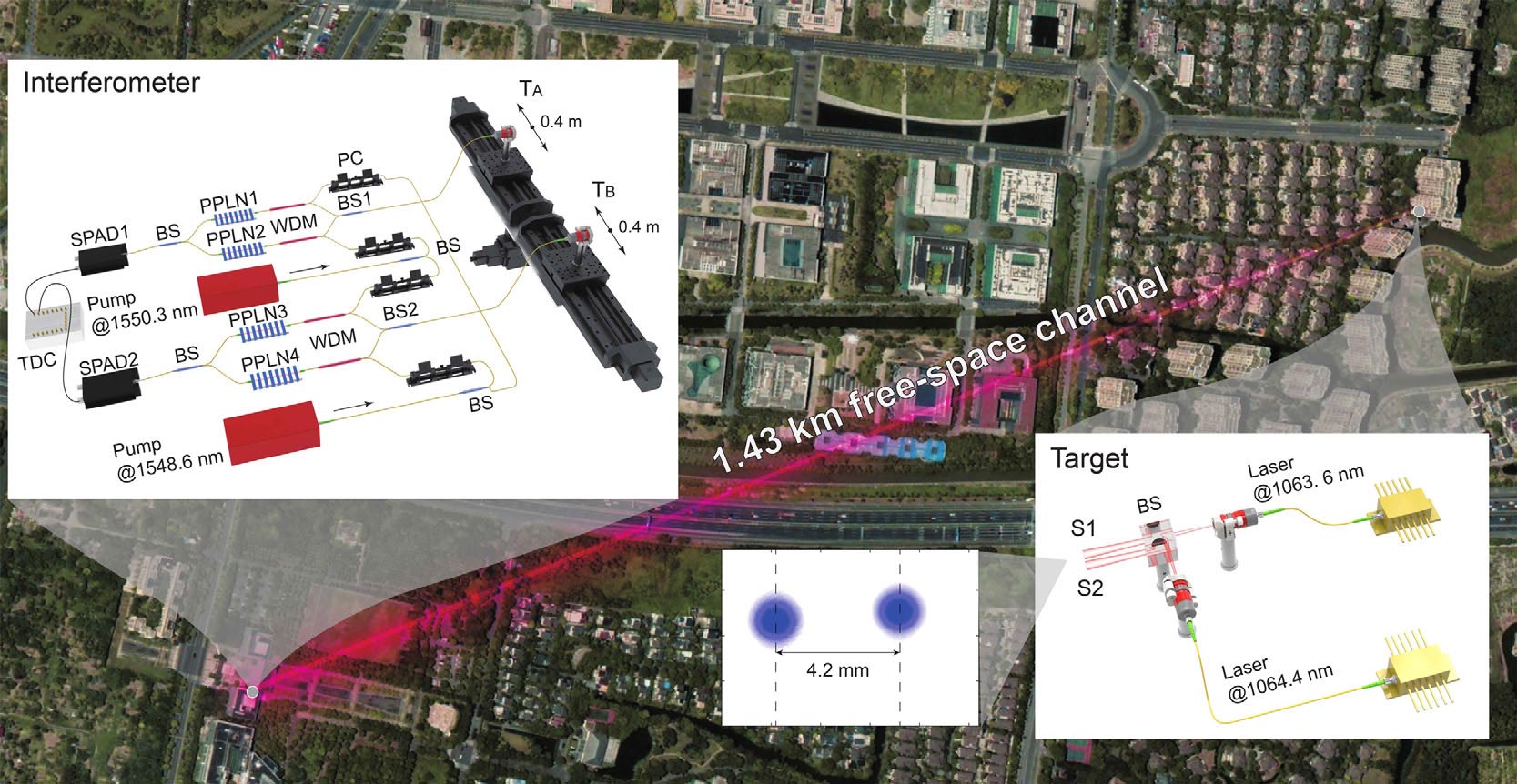
    Scheme of the chromatic intensity interferometer. Credit: LIU Luchuan et al

    Chromatic interferometry, once theoretical, has now been proven to surpass conventional resolution limits using detectors that erase color differences between photons.

    Interferometers are widely used in various high spatial resolution imaging techniques to extend the diffraction limit. However, the conventional interferometric methods only work when the photons have the same wavelength.

    Researchers from the University of Science and Technology of China (USTC) of the Chinese Academy of Sciences built a chromatic intensity interferometer with a periodically poled lithium niobate waveguide (PPLN) and successfully measured two very close laser sources of different wavelengths. This work was published in Physical Review Letters.

    In 2016, Frank Wilczek, a Nobel Prize winner, and his colleagues theoretically proposed that photons of different wavelengths could enter the detector to interfere and extract the phase information through introducing a color erasure detector, which was based on the frequency conversion into an intensity interferometer. This new technique was then named chromatic intensity interferometry.

    Subsequently, Prof. Jian-Wei Pan’s group built single-photon detectors with the PPLN waveguide created by Jinan Institute of Quantum Technology. Based on that, they demonstrated the intensity interference technique in the laboratory (Physical Review Letters 123, 243601 (2019), Optics Express 28, 32294 (2020)).

    To verify the high spatial resolution imaging of the chromatic intensity interferometry, researchers carried out a series of field experiments. By using two pump lasers of different wavelengths (1063.6 nm and 1064.4 nm respectively) to pump a pair of parallel PPLN waveguides, they realized color erasure detectors that could not distinguish between photons of 1063.6 nm and 1064.4 nm.

    Surpassing the Diffraction Limit with Dual Telescopes

    With the two detectors, they installed two telescopes to build an intensity interferometer with a baseline length of 80 cm. After measuring the distance between two laser sources separated by 4.2 mm at a distance of 1.43 km by telescopes, they proposed a phase-fitting method to obtain the angular distance between the two laser sources. Surprisingly, the results surpassed the diffraction limit of a single telescope by about 40 times, proving that the chromatic intensity interferometry had a higher spatial resolution.

    With the multi-wavelength setting, this technique expands the application of intensity interferometry to diverse fields such as the astronomical observation, space remote sensing, and space debris detection.

    Reference: “Improved Spatial Resolution Achieved by Chromatic Intensity Interferometry” by Lu-Chuan Liu, Luo-Yuan Qu, Cheng Wu, Jordan Cotler, Fei Ma, Ming-Yang Zheng, Xiu-Ping Xie, Yu-Ao Chen, Qiang Zhang, Frank Wilczek and Jian-Wei Pan, 31 August 2021, Physical Review Letters.
    DOI: 10.1103/PhysRevLett.127.103601

    Never miss a breakthrough: Join the SciTechDaily newsletter.
    Follow us on Google and Google News.

    Optics University of Science and Technology of China
    Share. Facebook Twitter Pinterest LinkedIn Email Reddit

    Related Articles

    Super-Resolution Imaging of a Single Cold Atom on a Nanosecond Timescale

    Scientists Realize Noiseless Photon-Echo Protocol – Key to Long-Distance Quantum Communication

    Coherent Storage of Light Over One-Hour Achieved – Great Stride Towards the Application of Quantum Memories

    Ultimate Precision: Scientists Reach Limit of Multi-Parameter Quantum Measurement With Zero Trade-Off

    Physicists Develop a New Method to Accelerate Charged Particles

    Cathodoluminescence Used to Probe Metamaterials

    Fastest Laser Blast – 67 Quintillionths of a Second

    Gamma Ray Lens Created Using Amplifying Effect of Virtual Electron-Positron Pairs

    First Universal Quantum Network Prototype Operational

    Leave A Reply Cancel Reply

    • Facebook
    • Twitter
    • Pinterest
    • YouTube

    Don't Miss a Discovery

    Subscribe for the Latest in Science & Tech!

    Trending News

    Scientists Recreate a Nuclear Fireball and Uncover Fallout’s Hidden Chemistry

    These Tiny Gut Particles Could Be Accelerating Aging Throughout the Body

    Doctors Changed One Thing and Weight Gain Stopped

    Magnetic Fields May Solve a Longstanding Binary Star Mystery

    The Probiotic Breakthrough for Natural Anxiety Relief and Better Mental Health

    Animal vs. Plant Protein: Scientists Found a Surprising Nutritional Difference

    According to Scientists, This Simple Dietary Change Is Linked to Lower Depression Scores

    Researchers Discover a Hidden Vitamin D Problem That Persists Year-Round

    Follow SciTechDaily
    • Facebook
    • Twitter
    • YouTube
    • Pinterest
    • Newsletter
    • RSS
    SciTech News
    • Biology News
    • Chemistry News
    • Earth News
    • Health News
    • Physics News
    • Science News
    • Space News
    • Technology News
    Recent Posts
    • Scientists Tracked 4,500 Animals During COVID – What They Discovered Was Surprising
    • Hidden Phase of Matter Finally Captured After Decades of Predictions
    • The Strange “Spacetime Crystal” That Can Suddenly Turn Into a Black Hole
    • A Hidden Gut Signal May Be Driving Sleep Apnea’s Deadly Heart Risks
    • This AI-Designed “Universal Vaccine” Could Stop Future Pandemics Before They Start
    Copyright © 1998 - 2026 SciTechDaily. All Rights Reserved.
    • Science News
    • About
    • Contact
    • Editorial Board
    • Privacy Policy
    • Terms of Use

    Type above and press Enter to search. Press Esc to cancel.