
Research Looks at Warming, Browning Effects on Freshwater Systems
Organisms at the base of the aquatic food web may be hidden from sight, but they are just as sensitive to climate change as other plant and animal life, according to a study published in Scientific Reports.
“Climate change causes food quality to deteriorate at the lowest level of the food web,” says Pianpian Wu, a postdoctoral fellow at Dartmouth and lead author of the study. “That spells trouble for the entire food chain from phytoplankton to humans.”
The study looked at two effects of climate change on water that researchers expect to increase in coming years: warming and “browning,” the discoloration caused by high loads of dissolved organic matter.

According to the study, a combination of warmer, browner water results in greater transfer of toxic methylmercury from water to phytoplankton. The research also documented lower concentrations of essential polyunsaturated fatty acids in the organisms.
“The reduction of polyunsaturated acids is concerning,” says Wu, who began the research as a PhD candidate at the Swedish University of Agricultural Sciences.
Fatty acids such as omega-3 and omega-6 provide energy and regulate the immune systems in animal and plant life. Methylmercury is an easily absorbed form of mercury that acts as a potent neurotoxin.
“Understanding how mercury and fatty acids in aquatic food webs respond to climate change will tell us about the embedded risks at the top of the food web.”
Celia Chen, research professor of biological sciences
According to the study, fish and humans can be exposed to increased levels of methylmercury as organisms that are lower on the food chain consume more phytoplankton to gain fatty acids in their diets.
The Embedded Risks of Climate Change
“Humans eat fish,” says Celia Chen, research professor of biological sciences and a co-author of the study. “Understanding how mercury and fatty acids in aquatic food webs respond to climate change will tell us about the embedded risks at the top of the food web.”
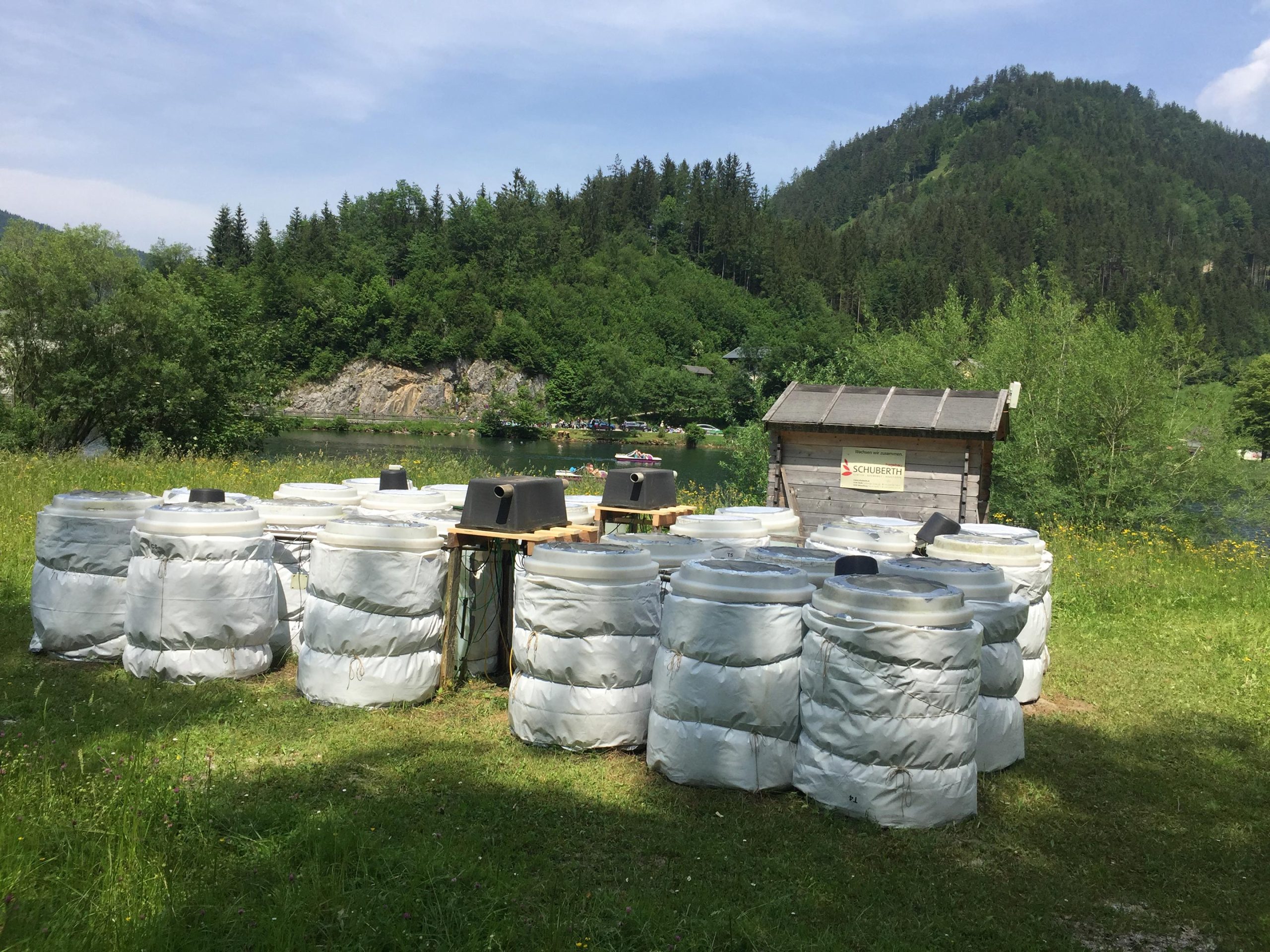
While previous research on browning and warming has been conducted in natural environments, this is the first study to rely entirely on controlled outdoor environments known as mesocosms.

The researchers used 24 insulated cylinders to test the effects of various levels of warming and browning under four different scenarios at subalpine conditions.
“Mesocosms are really cool to work with,” says Wu. “We can test for a variety of climate effects without needing to travel long distances to the field.”
The study was conducted at the WasserCluster Lunz research facility outside of Vienna, Austria. Kevin Bishop, a professor at the Swedish University of Agricultural Sciences, served as the senior researcher.
Closer to home, Wu and Chen continue their research on aquatic food webs with a team that has also included undergraduate students. Past research has studied how freshwater organic matter may influence mercury uptake in blackfly larvae.
“Dartmouth students are engaged and hard working. Having undergraduates involved in our research gives them direct experience studying environmental challenges that will confront society for generations to come,” says Chen.
Reference: “Elevated temperature and browning increase dietary methylmercury, but decrease essential fatty acids at the base of lake food webs” by Pianpian Wu, Martin J. Kainz, Fernando Valdés, Siwen Zheng, Katharina Winter, Rui Wang, Brian Branfireun, Celia Y. Chen and Kevin Bishop, 19 August 2021, Scientific Reports.
DOI: 10.1038/s41598-021-95742-9
Never miss a breakthrough: Join the SciTechDaily newsletter.
Follow us on Google and Google News.
1 Comment
“… in another treatment we increased the temperature by 3°C above ambient…”
The annual increase in atmospheric global mean temperature is estimated to be less than 0.2 deg C per decade. In another 25 years that may amount to about 0.5 deg C for the increase in AIR temperature. However, because the specific heat capacity of water is about 4200 J⋅kg−1⋅K−1, and the specific heat capacity of air is about 1000 J⋅kg−1⋅K−1, that average increase in AIR temperature of 0.5 deg C would be equivalent to an increase in the average WATER surface temperature of about 0.1 deg C. Heating the barrels to +3 deg is not a realistic simulation of future conditions.
“… fish and humans can be exposed to increased levels of methylmercury as organisms that are lower on the food chain consume more phytoplankton …”
Neither phytoplankton or fish are known for their mental gymnastics. To the best of my knowledge, there are no studies that demonstrate deleterious effects on animals or plants near the bottom of the food chain from exposure to natural MeHg. With the exception of the debacle at Minamata in the 1950s, there are no well-documented incidences of people suffering the consequences of eating contaminated fish. That is probably for two reasons: 1) the mercury load in the fish in Minamata Bay was exceptionally high because of the proximate industrial pollution, and 2) the Japanese are accustomed to eating raw fish. MeHg has a boiling point the same as water, and is readily driven off by cooking. Thus, those eating freshwater fish, invariably cooked to avoid being infected by tape worms, are exposed to very little natural MeHg.
Anyone who has had the opportunity to visit New Zealand may have been surprised at the color of the water in streams on the North Island. It is quite unlike the alpine lakes and streams of North America. It is commonly the color of strong tea — the epitome of “browning.” They don’t seem to have any problems associated with it.
It is good to stay on top of environmental changes. However, I don’t put much stock in the validity of experiments that are poorly designed.