
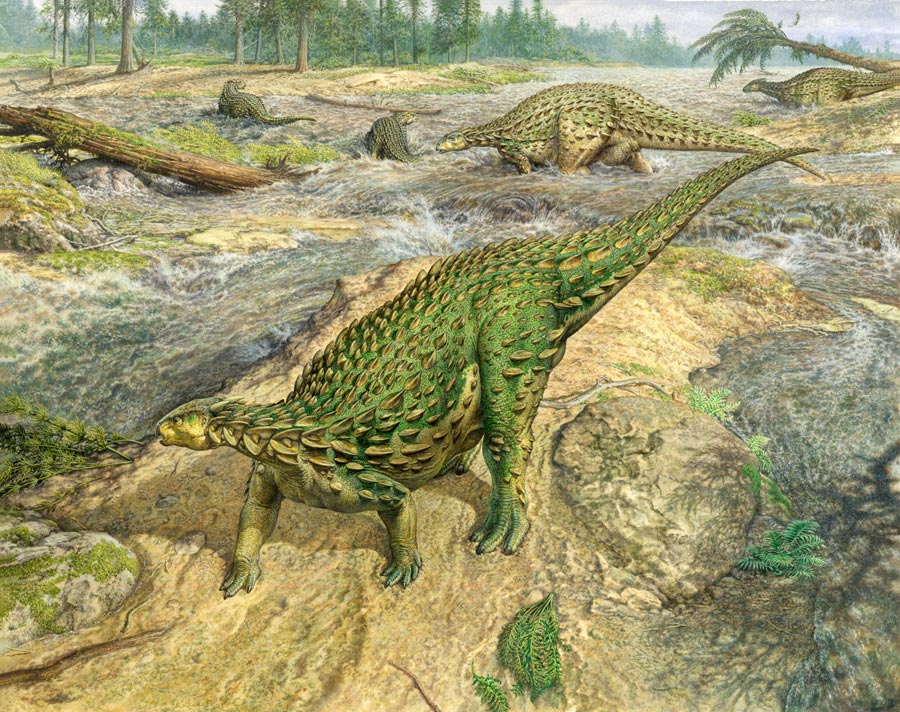
The first complete dinosaur skeleton ever identified has finally been studied in detail and found its place in the dinosaur family tree, completing a project that began more than a century and a half ago.
The skeleton of this dinosaur, called Scelidosaurus, was collected more than 160 years ago on west Dorset’s Jurassic Coast. The rocks in which it was fossilized are around 193 million years old, close to the dawn of the Age of Dinosaurs.
This remarkable specimen — the first complete dinosaur skeleton ever recovered — was sent to Richard Owen at the British Museum, the man who invented the word dinosaur.
So, what did Owen do with this find? He published two short papers on its anatomy, but many details were left unrecorded. Owen did not reconstruct the animal as it might have appeared in life and made no attempt to understand its relationship to other known dinosaurs of the time. In short, he ‘re-buried’ it in the literature of the time, and so it has remained ever since: known, yet obscure and misunderstood.
Over the past three years, Dr David Norman from Cambridge’s Department of Earth Sciences has been working to finish the work which Owen started, preparing a detailed description and biological analysis of the skeleton of Scelidosaurus, the original of which is stored at the Natural History Museum in London, with other specimens at Bristol City Museum and the Sedgwick Museum, Cambridge.
The results of Norman’s work, published as four separate studies in the Zoological Journal of the Linnean Society of London, not only reconstruct what Scelidosaurus looked like in life, but reveal that it was an early ancestor of ankylosaurs, the armor-plated ‘tanks’ of the Late Cretaceous Period.
For more than a century, dinosaurs were primarily classified according to the shape of their hip bones: they were either saurischians (‘lizard-hipped’) or ornithischians (‘bird-hipped’).
However, in 2017, Norman and his former Ph.D. students Matthew Baron and Paul Barrett argued that these dinosaur family groupings needed to be rearranged, re-defined, and re-named. In a study published in Nature, the researchers suggested that bird-hipped dinosaurs and lizard-hipped dinosaurs such as Tyrannosaurus evolved from a common ancestor, potentially overturning more than a century of theory about the evolutionary history of dinosaurs.
Another fact that emerged from their work on dinosaur relationships was that the earliest known ornithischians first appeared in the Early Jurassic Period. “Scelidosaurus is just such a dinosaur and represents a species that appeared at, or close to, the evolutionary ‘birth’ of the Ornithischia,” said Norman, who is a Fellow of Christ’s College, Cambridge. “Given that context, what was actually known of Scelidosaurus? The answer is remarkably little!”
Norman has now completed a study of all known material attributable to Scelidosaurus and his research has revealed many firsts.
“Nobody knew that the skull had horns on its back edge,” said Norman. “It had several bones that have never been recognized in any other dinosaur. It’s also clear from the rough texturing of the skull bones that it was, in life, covered by hardened horny scutes, a little bit like the scutes on the surface of the skulls of living turtles. In fact, its entire body was protected by skin that anchored an array of stud-like bony spikes and plates.”
Now that its anatomy is understood, it is possible to examine where Scelidosaurus sits in the dinosaur family tree. It had been regarded for many decades as an early member of the group that included the stegosaurs, including Stegosaurus with its huge bony plates along its spine and a spiky tail, and ankylosaurs, the armor-plated ‘tanks’ of the dinosaur era, but that was based on a poor understanding of the anatomy of Scelidosaurus. Now it seems that Scelidosaurus is an ancestor of the ankylosaurs alone.
“It is unfortunate that such an important dinosaur, discovered at such a critical time in the early study of dinosaurs, was never properly described,” said Norman. “It has now — at last! — been described in detail and provides many new and unexpected insights concerning the biology of early dinosaurs and their underlying relationships. It seems a shame that the work was not done earlier but, as they say, better late than never.”
Reference: “Scelidosaurus harrisonii (Dinosauria: Ornithischia) from the Early Jurassic of Dorset, England: biology and phylogenetic relationships” by David B Norman, FLS, 18 August 2020, Zoological Journal of the Linnean Society.
DOI: 10.1093/zoolinnean/zlaa061
Never miss a breakthrough: Join the SciTechDaily newsletter.
Follow us on Google and Google News.
20 Comments
Pictures?!!!!!!!!
Pics
Pics?????????????
“Closeup at Last: First Complete Dinosaur Skeleton Ever Found Is Ready”
That caption absolutely guarantees photos.
You are a stinking liar and I resent being lied to. This is past click bait you dirty liar.
No wonder there is no name listed, you are right to be ashamed.
You’re garbage.
I’ll never click this pos page again. Nothing but worthless liars.
Well, artistic impression is nice but why not show the final, completed skeleton ?
A little over the top everyone! It doesn’t say that an articulated skeleton has been assembled and put on display. In summary, it says that the first complete dinosaur fossil ever found (perhaps still in the enclosing rock) has finally been studied completely, as it should have been when first found. Your expectations are obviously driven by your ignorance of how modern paleontologic research is conducted. The articulated skeletons in museums are largely something for children and child-like adults.
As to pictures, which several so desperately feel a need for, the camera hadn’t yet been invented 190 million years ago!
It was, however, recently ‘studied completely’. That would be shortly after the camera was invented (in geologic terms). No pics – didn’t happen Poindexter.
Clyde Spencer is a wanker!
Good GRIEF, people!! You are all getting SO miffed, SO worked up, that you had to actually READ the article, with ALL of the DESCRIPTIONS of what the Dinosaur DID look like, INSTEAD of just having a “PICTURE BOOK” like “show & tell” time in pre-school??
So many of us already have been guessing how “dumbed down” so many Adults are becoming these days, but the majority of you folks that are posting here just GREATLY ILLUSTRATED that we no longer HAVE to guess! You have proven it!! Can’t ANY of you, with the exception of Clyde Spencer, use your imaginations from the given description and formulate a picture, either in your mind, or on paper, to even GUESS what this Dinosaur looks like? Use your minds, use your brains, people!! Don’t go childishly whine, and call the author a liar because you refuse to use your own imaginations!!
Sheesh!!
IKR?
The internet, and social media, has spawned a multi generational age of wannabe smart arsed “edge lords” who argue for the sake of views. There is no real reason to be as upset as they are, except for … pop culture has made them that way.
It does indeed say that it has only been studied,but , let’s be real for a damn second…..u have to admit, it would be nice to have a few pics to associate the study with, after all, it just helps with the learning aspect of it, just my humble opinion.
I’m afraid that the Hall of Dinosaur Skeletons is currently closed for renovations. However, if you lie on the floor and kick and scream, perhaps you will be allowed to play in the sandbox — where you belong. You and the other whiners are good examples proving that our educational system is failing society.
I really like your info on the dinasours and dome of the other archeology finds, however, can u leave the rodent commercials out? I am disgusted by them & so sto reading ur articles because I don’t want to see another rodrmt!
Well, there was NO CHEESE at the end of That reading maze…
No it’s not possible to see where it sits in the family tree. Similarities in structure is not a reliable means of determining one kind of lifeform to another. It has never been proven that comparing different kinds of organisms by their physiology is evidence of common relations.
Gerald: “It has never been proven that comparing different kinds of organisms by their physiology is evidence of common relations.”
How absurd. The tree of life was initially constructed based on an organisms features, specifically the derived synopomophies that indicate commonality. That is, the key divisions start with speciation as key features develop that are passed on in large populations that become increasingly distinct. That is a known and observed fact.
Then as genetics became a method to look at organisms from the top down, it was confirmed that the vast majority of relationships presumed by the analysis of forms was absolutely correct. Only a few corrections had to be made, well within the range of human error.
The genetics confirms common ancestry with humans and the other apes, for example, which is why we share so many physical characteristics with them.
DNA dictates the features an organisms CAN have such that the features found indicate the DNA present. Obviously you can’t get DNA samples from everything, but because we know features of organisms are dictates by their genes, it is not a mere assumption that shared features indicate shared genetics. This is simply how life works.
So when they find fully articulated skeletons that have very specific features, they know what genes had to be involved and thus stick it in the tree where it makes sense. Computers help with this analysis too to ensure statistically probable transitions are placed properly. The only assumption is that certain very specific features is unlikely to develop on independent lines. Feathers are highly derived which is why they emerged in Dinosaurs alone. This article explains the various specific features that severly limits where this organism can go in the tree.
When I was little I loved dinosaurs now I’m starting to think their sham. I’m a physician and I asked any other doctor if they thought dinosaurs were real I was surprised that 30% of them thought it was probably apart hoax for money. I can’t find a single real skeleton of Tyrannosaurus Rex in the excavation site. It’s all made up these things are all replicas and then they build an entire dinosaur from a tooth. I think it’s a fake. I don’t believe anything until I could see the head of Tyrannosaurus Rex in the ground. Why is it so hard to find a picture? Maybe because there are no such picture@
I don’t believe in dinosaurs unless I get bit by one