
Close Menu
    Facebook X (Twitter) Instagram
    SciTechDaily
    • Biology
    • Chemistry
    • Earth
    • Health
    • Physics
    • Science
    • Space
    • Technology
    Facebook X (Twitter) Pinterest YouTube RSS
    SciTechDaily
    Home»Science»Clues to Origin of Mysterious Tanystropheid Reptiles From New Brazilian Fossil
    Science

    Clues to Origin of Mysterious Tanystropheid Reptiles From New Brazilian Fossil

    By PLOSApril 9, 2020No Comments3 Mins Read
    Facebook Twitter Pinterest Telegram LinkedIn WhatsApp Email Reddit
    Share
    Facebook Twitter LinkedIn Pinterest Telegram Email Reddit
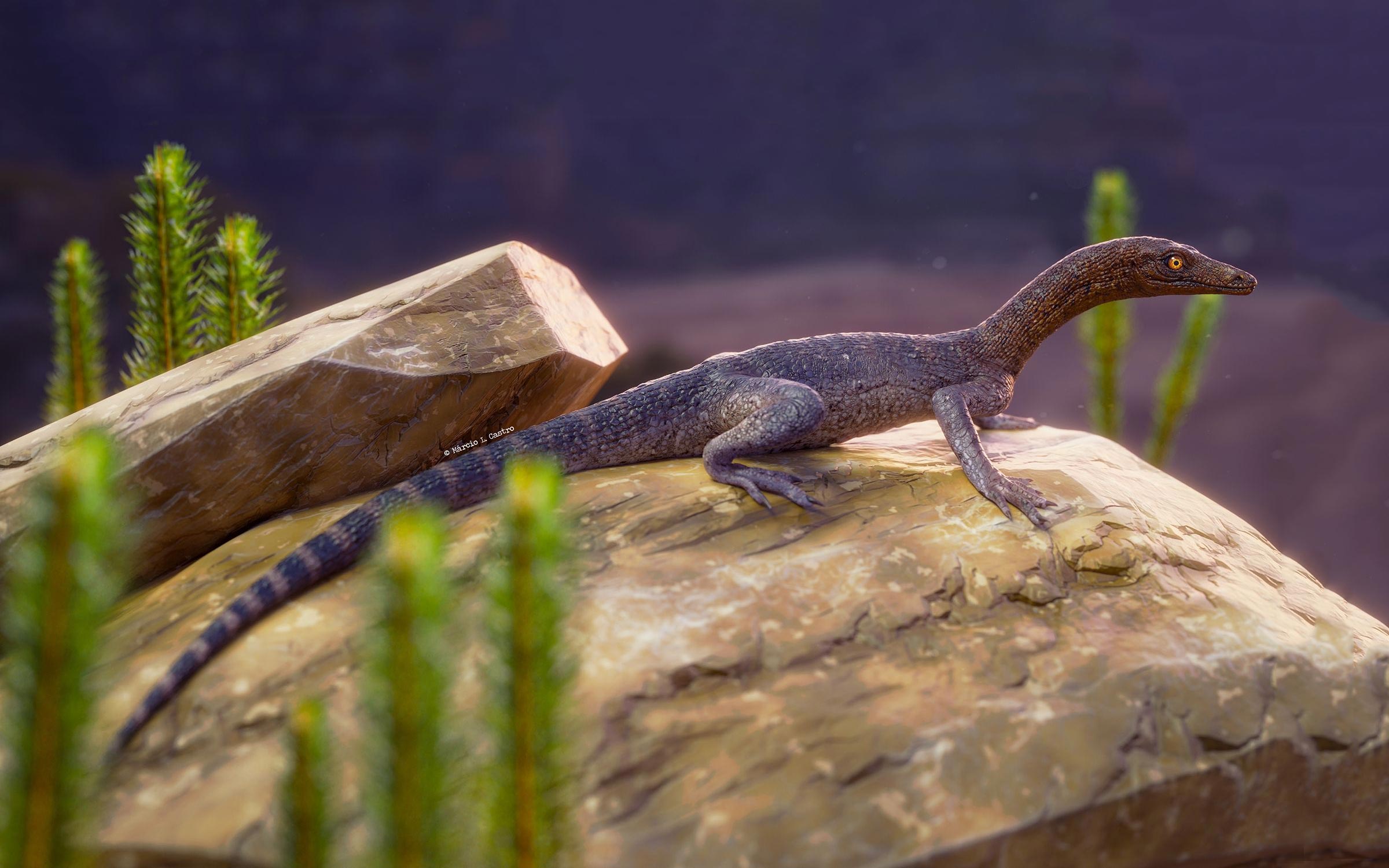
    Elessaurus gondwanoccidens
    Life restoration of Elessaurus gondwanoccidens, from the Sanga do Cabral Formation (Lower Triassic), Brazil. Credit: Márcio L. Castro

    New species named after Tolkien’s Aragorn hints at early southern evolution for these reptiles.

    A new species of Triassic reptile from Brazil is a close cousin of a mysterious group called tanystropheids, according to a study published April 8, 2020 in the open-access journal PLOS ONE by Tiane De-Oliviera of the Federal University of Santa Maria, Brazil, and colleagues.

    After the Permian mass extinction, 250 million years ago, reptiles took over global ecosystems. Among the early groups to appear after this extinction event were the tanystropheids, a group of long-necked animals whose lifestyles are still mysterious, but who were nonetheless successful in the Triassic Period. However, the early evolution of this group is poorly understood, as their remains are very rare from the Early Triassic.

    In this study, De-Oliviera and colleagues describe a new specimen of reptile from Early Triassic rocks of the Sanga do Cabral Formation in southern Brazil. Skeletal comparison indicates this specimen, known from remains of the hind leg, pelvis, and tail, is the closest known relative of tanystropheids. The researchers identified these remains as belonging to a new species, which they named Elessaurus gondwanoccidens. The name derives in part from the Elvish name (Elessar) of a character from Lord of the Rings also known as Aragorn or Strider, chosen as a reference to the fossil animal’s long legs.

    Most tanystropheid fossils are found in Middle to Late Triassic rocks of Europe, Asia, and North America, and often in marine sediments. The presence of Elessaurus in continental deposits of Early Triassic South America suggests that the origins of this group may lie in the southern continents, and that their ancestors may have lived on land before later species adapted to aquatic life. A clearer view of the group’s origins will rely on more rare fossils from this early time in their evolution.

    Reference: “A new archosauromorph from South America provides insights on the early diversification of tanystropheids” by Tiane M. De-Oliveira, Felipe L. Pinheiro, Átila Augusto Stock Da-Rosa, Sérgio Dias-Da-Silva and Leonardo Kerber, 8 April 2020, PLoS ONE.
    DOI: 10.1371/journal.pone.0230890

    Funding: This study was financed by the Coordenação de Aperfeiçoamento de Pessoal de Nível Superior – Brasil (CAPES) – Finance Code 001. Fundação de Amparo à Pesquisa do Estado do Rio Grande do Sul (FAPERGS 16/2551-0000271-1 to FLP; 17/2551-0000816-2 to LK) and Conselho Nacional de Desenvolvimento Científico e Tecnológico (CNPq 407969/2016-0; 305758/2017-9 to FLP; 313494/2018-5 to AASR; 306352/2016-8 to SDS; 422568/2018-0; 309414/2019-9 to LK).

    Competing Interests: The authors have declared that no competing interests exist.

    Never miss a breakthrough: Join the SciTechDaily newsletter.
    Follow us on Google and Google News.

    Archaeology PLOS Reptiles
    Share. Facebook Twitter Pinterest LinkedIn Email Reddit

    Related Articles

    Surprising Diversity of Cretaceous Reptiles at Argentina Fossil Site – Revealed by Discovery of Ancient Teeth

    Indiscriminate Killing Revealed in Genetic Analysis of Ancient Massacre

    Rare “Mud Carapace” Mortuary Treatment of Egyptian Mummy Uncovered – And a Case of Mistaken Identity

    Ancient European Money: Hoards Full of Standardized Bronze Rings, Ribs and Axe Blades

    Paleontologist Trackers Discover Giant Crocodile That Walked on Two Legs

    Jurassic Dinosaurs Turned to Scavenging – Maybe Even Cannibalism – In Stressed Ecosystems

    Deformed Skulls Discovered in an Ancient Cemetery Reveal a Remarkably Diverse Community

    Neandertals Dove Underwater to Collect Clam Shells to Use as Tools

    Paleontologists Identify a New Species of Prehistoric Reptile, Colobops Noviportensis

    Leave A Reply Cancel Reply

    • Facebook
    • Twitter
    • Pinterest
    • YouTube

    Don't Miss a Discovery

    Subscribe for the Latest in Science & Tech!

    Trending News

    The Universe Is Expanding Too Fast and Scientists Can’t Explain Why

    “Like Liquid Metal”: Scientists Create Strange Shape-Shifting Material

    Early Warning Signals of Esophageal Cancer May Be Hiding in Plain Sight

    Common Blood Pressure Drug Shows Surprising Power Against Deadly Antibiotic-Resistant Superbug

    Scientists Uncover Dangerous Connection Between Serotonin and Heart Valve Disease

    Scientists Discover a “Protector” Protein That Could Help Reverse Hair Loss

    Bone-Strengthening Discovery Could Reverse Osteoporosis

    Scientists Uncover Hidden Trigger Behind Stem Cell Aging

    Follow SciTechDaily
    • Facebook
    • Twitter
    • YouTube
    • Pinterest
    • Newsletter
    • RSS
    SciTech News
    • Biology News
    • Chemistry News
    • Earth News
    • Health News
    • Physics News
    • Science News
    • Space News
    • Technology News
    Recent Posts
    • Scientists Create Improved Insulin Cells That Reverse Diabetes in Mice
    • Scientists Stunned After Finding Plant Thought Extinct for 60 Years
    • A Common Diabetes Drug May Hold the Key to Stopping HIV From Coming Back
    • Ancient “Syphilis-Like” Disease in Vietnam Challenges Key Scientific Assumptions
    • Drinking Alcohol To Cope in Your 20s Could Damage Your Brain for Life
    Copyright © 1998 - 2026 SciTechDaily. All Rights Reserved.
    • Science News
    • About
    • Contact
    • Editorial Board
    • Privacy Policy
    • Terms of Use

    Type above and press Enter to search. Press Esc to cancel.