
Referred to as “China’s Venice of the Stone Age,” the Liangzhu excavation site in eastern China is considered one of the most significant testimonies of early Chinese advanced civilization. More than 5000 years ago, the city already had an elaborate water management system. Until now, it has been controversial what led to the sudden collapse. Massive flooding triggered by anomalously intense monsoon rains caused the collapse, as an international team with Innsbruck geologist and climate researcher Christoph Spötl has now shown in the journal Science Advances.
In the Yangtze Delta, about 160 kilometers (100 miles) southwest of Shanghai, the archeological ruins of Liangzhu City are located. There, a highly advanced culture blossomed about 5300 years ago, which is considered to be one of the earliest proofs of monumental water culture.
The oldest evidence of large hydraulic engineering structures in China originates from this late Neolithic cultural site. The walled city had a complex system of navigable canals, dams, and water reservoirs. This system made it possible to cultivate very large agricultural areas throughout the year.
In the history of human civilization, this is one of the first examples of highly developed communities based on a water infrastructure. Metals, however, were still unknown in this culture. Thousands of elaborately crafted jade burial objects were found during excavations.
Long undiscovered and underestimated in its historical significance, the archaeological site is now considered a well-preserved record of Chinese civilization dating back more than 5000 years. Liangzhu was declared a UNESCO World Heritage Site in 2019. However, the advanced civilization of this city, which was inhabited for almost 1000 years, came to an abrupt end. Until today, it remains controversial what caused it.
“A thin layer of clay was found on the preserved ruins, which points to a possible connection between the demise of the advanced civilization and floods of the Yangtze River or floods from the East China Sea. No evidence could be found for human causes such as warlike conflicts,” explains Christoph Spötl, head of the Quaternary Research Group at the Department of Geology. “However, no clear conclusions on the cause were possible from the mud layer itself.”
Dripstones Store the Answer
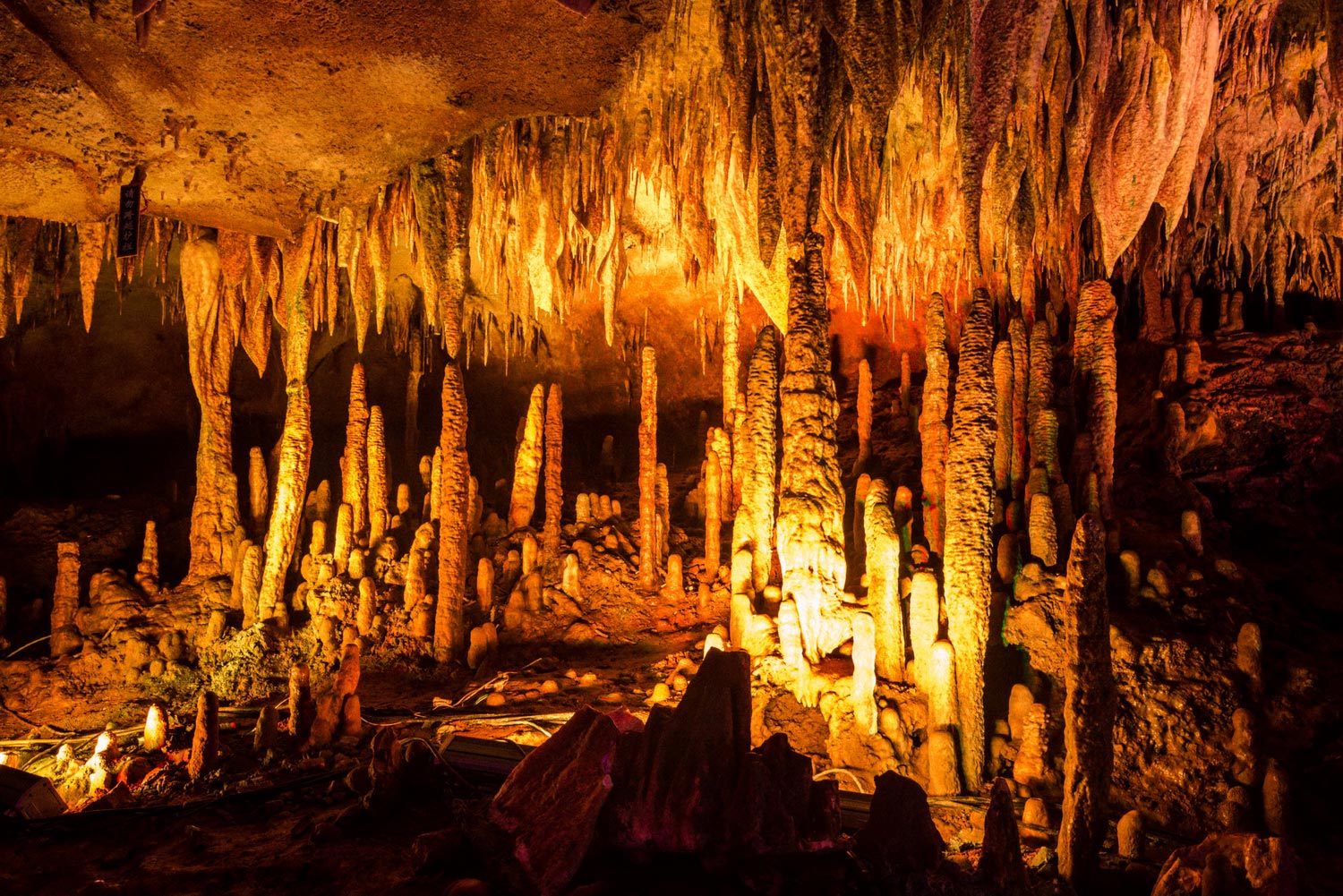
Caves and their deposits, such as dripstones, are among the most important climate archives that exist. They allow the reconstruction of climatic conditions above the caves up to several 100,000 years into the past. Since it is still not clear what caused the sudden collapse of the Liangzhu culture, the research team searched for suitable archives in order to investigate a possible climatic cause of this collapse.
Geologist Haiwei Zhang from Xi’an Jiaotong University in Xi’an, who spent a year at the University of Innsbruck as a visiting researcher in 2017, took samples of stalagmites from the two caves Shennong and Jiulong, which are located southwest of the excavation site.
“These caves have been well explored for years. They are located in the same area affected by the Southeast Asian monsoon as the Yangtze delta and their stalagmites provide a precise insight into the time of the collapse of the Liangzhu culture, which, according to archaeological findings, happened about 4300 years ago,” Spötl explains.
Data from the stalagmites show that between 4345 and 4324 years ago there was a period of extremely high precipitation. Evidence for this was provided by the isotope records of carbon, which were measured at the University of Innsbruck. The precise dating was done by uranium-thorium analyses at Xi’an Jiaotong University, whose measurement accuracy is ± 30 years.
“This is amazingly precise in light of the temporal dimension,” says the geologist. “The massive monsoon rains probably led to such severe flooding of the Yangtze and its branches that even the sophisticated dams and canals could no longer withstand these masses of water, destroying Liangzhu City and forcing people to flee.” The very humid climatic conditions continued intermittently for another 300 years, as the geologists show from the cave data.
Reference: “Collapse of the Liangzhu and other Neolithic cultures in the lower Yangtze region in response to climate change” by Haiwei Zhang, Hai Cheng, Ashish Sinha, Christoph Spötl, Yanjun Cai, Bin Liu, Gayatri Kathayat, Hanying Li, Ye Tian, Youwei Li, Jingyao Zhao, Lijuan Sha, Jiayu Lu, Binglin Meng, Xiaowen Niu, Xiyu Dong, Zeyuan Liang, Baoyun Zong, Youfeng Ning, Jianghu Lan and R. Lawrence Edwards, 24 November 2021, Science Advances.
DOI: 10.1126/sciadv.abi9275
Never miss a breakthrough: Join the SciTechDaily newsletter.
Follow us on Google and Google News.