

Colliding neutron stars were touted as the main source of some of the heaviest elements in the Periodic Table. Now, not so much …
Neutron star collisions do not create the quantity of chemical elements previously assumed, a new analysis of galaxy evolution finds.
The research also reveals that current models can’t explain the amount of gold in the cosmos — creating an astronomical mystery.
The work has produced a new-look Periodic Table, showing the stellar origins of naturally occurring elements from carbon to uranium.
All the hydrogen in the Universe — including every molecule of it on Earth — was created by the Big Bang, which also produced a lot of helium and lithium, but not much else.
The rest of the naturally occurring elements are made by different nuclear processes happening inside stars. Mass governs exactly which elements are forged, but they are all released into galaxies in each star’s final moments — explosively in the case of really big ones, or as dense outflows, similar to solar wind, for ones in the same class as the Sun.
“We can think of stars as giant pressure cookers where new elements are created,” explained co-author Associate Professor Karakas, from Australia’s ARC Centre of Excellence for All Sky Astrophysics in 3 Dimensions (ASTRO 3D).
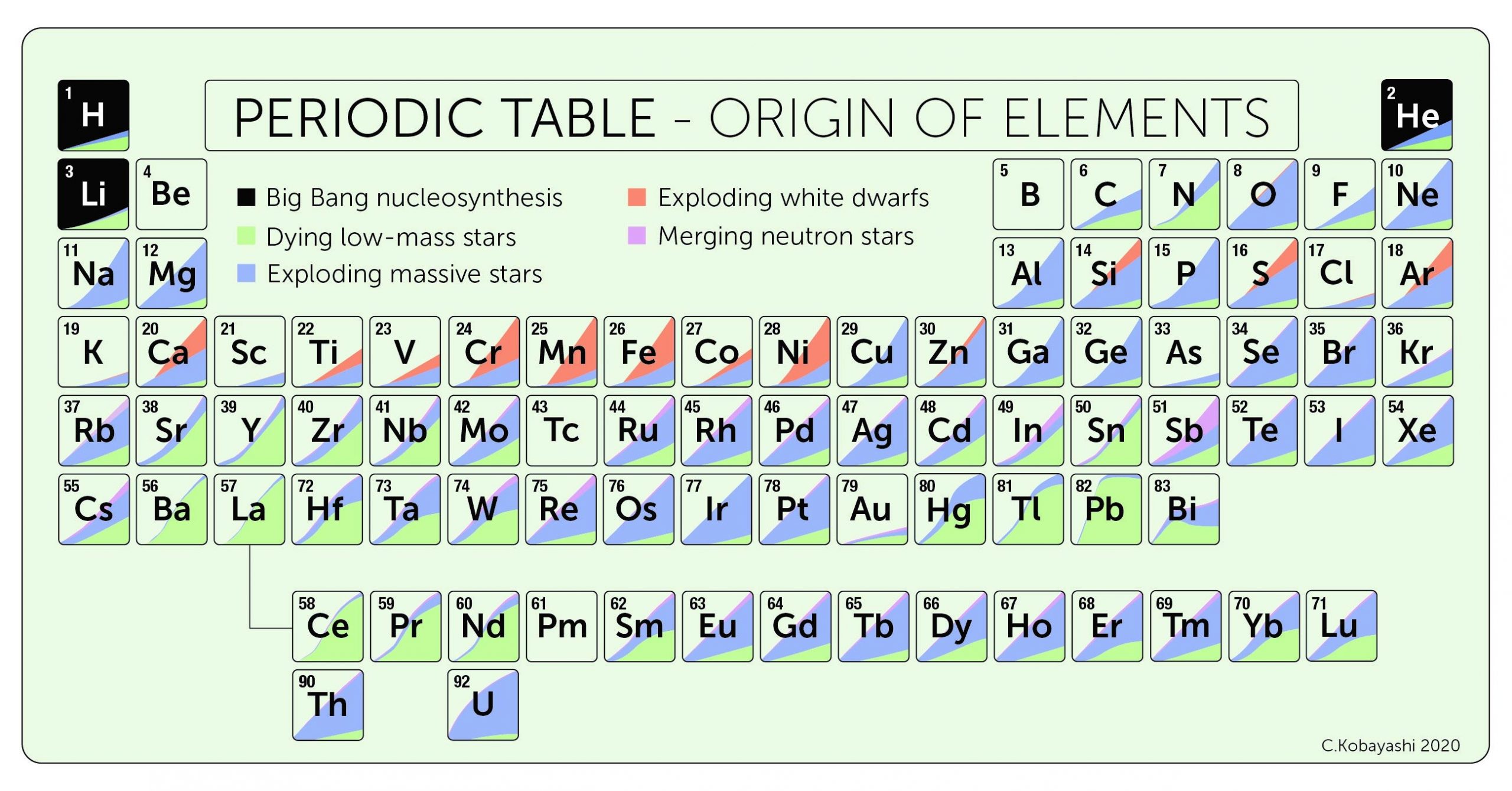
“The reactions that make these elements also provide the energy that keeps stars shining bright for billions of years. As stars age, they produce heavier and heavier elements as their insides heat up.”
Half of all the elements that are heavier than iron — such as thorium and uranium — were thought to be made when neutron stars, the superdense remains of burnt-out suns, crashed into one another. Long theorized, neutron star collisions were not confirmed until 2017.
Now, however, fresh analysis by Karakas and fellow astronomers Chiaki Kobayashi and Maria Lugaro reveals that the role of neutron stars may have been considerably overestimated — and that another stellar process altogether is responsible for making most of the heavy elements.
“Neutron star mergers did not produce enough heavy elements in the early life of the Universe, and they still don’t know, 14 billion years later,” said Karakas.
“The Universe didn’t make them fast enough to account for their presence in very ancient stars, and, overall, there are simply not enough collisions going on to account for the abundance of these elements around today.”
Instead, the researchers found that heavy elements needed to be created by an entirely different sort of stellar phenomenon — unusual supernovae that collapse while spinning very fast and generating strong magnetic fields.
The finding is one of several to emerge from their research, which has just been published in the Astrophysical Journal. Their study is the first time that the stellar origins of all naturally occurring elements from carbon to uranium have been calculated from first principles.
The new modeling, the researchers say, will substantially change the presently accepted model of how the universe evolved. “For example, we built this new model to explain all elements at once, and found enough silver but not enough gold,” said co-author Associate Professor Kobayashi, from the University of Hertfordshire in the UK.
“Silver is over-produced but gold is under-produced in the model compared with observations. This means that we might need to identify a new type of stellar explosion or nuclear reaction.”
The study refines previous studies that calculate the relative roles of star mass, age, and arrangement in the production of elements.
For instance, the researchers established that stars smaller than about eight times the mass of the Sun produce carbon, nitrogen, and fluorine, as well as half of all the elements heavier than iron.
Massive stars over about eight times the Sun’s mass that also explode as supernovae at the end of their lives, produce many of the elements from carbon through to iron, including most of the oxygen and calcium needed for life.
“Apart from hydrogen, there is no single element that can be formed only by one type of star,” explained Kobayashi.
“Half of the carbon is produced from dying low-mass stars, but the other half comes from supernovae.
“And half the iron comes from normal supernovae of massive stars, but the other half needs another form, known as Type Ia supernovae. These are produced in binary systems of low mass stars.”
Pairs of massive stars bound by gravity, in contrast, can transform into neutron stars. When these smash into each other, the impact produces some of the heaviest elements found in nature, including gold.
On the new modeling, however, the numbers simply don’t add up.
“Even the most optimistic estimates of neutron star collision frequency simply can’t account for the sheer abundance of these elements in the Universe,” said Karakas. “This was a surprise. It looks like spinning supernovae with strong magnetic fields are the real source of most of these elements.”
Co-author Dr. Maria Lugaro, who holds positions at Hungary’s Konkoly Observatory and Australia’s Monash University, thinks the mystery of the missing gold may be solved quite soon.
“New discoveries are to be expected from nuclear facilities around the world, including Europe, the USA, and Japan, currently targeting rare nuclei associated with neutron star mergers,” she said.
“The properties of these nuclei are unknown, but they heavily control the production of the heavy element abundances. The astrophysical problem of the missing gold may indeed be solved by a nuclear physics experiment.”
The researchers concede that future research might find that neutron star collisions are more frequent than the evidence so far suggests, in which case their contribution to the elements that make up everything from mobile phone screens to the fuel for nuclear reactors might be revised upwards again.
For the moment, however, they appear to deliver much less buck for their bangs.
Reference: “The Origin of Elements from Carbon to Uranium” by Chiaki Kobayashi, Amanda I. Karakas and Maria Lugaro, 15 September 2020, The Astrophysical Journal.
DOI: 10.3847/1538-4357/abae65
Never miss a breakthrough: Join the SciTechDaily newsletter.
Follow us on Google and Google News.
28 Comments
ha ha ha, they are so stupid, scientists say that atoms were born from collision or explosion of stars, what stupidity, it means that atoms fly in galactic space and new stars are born from them, there are no atoms in galactic space, there are only quarks from which stars are then born , let be scientists will try to catch at least one atom in outer space and then we’ll see.I know all secrets of space since its born.
and neutron stars do not happen this is impossible, a neutron star is a dying star, this is the core of star with the remnants of the atmosphere, then this neutron star will turn into a black hole and explode when it dies
Claiming experts are stupid is not credible.
This comment is a great example of Dunning Kruger effect in action
READ MY COMMENT BELOW…BECAUSE OMFG.
I think they are underestimating heavy element creation in planetary core, where a relative balance of endothermic and exothermic fusion results in a hot core, but no explosive result. Not enough mass & light hydrogen to be a star, but enough heat & compression to produce the small traces of heavy elements we find in our crust.
? Planets doesn’t make elements they don’t have fusion, they are not stars – apart from radioactive decay.
“Planets doesn’t make elements they don’t have fusion, they are not stars” = ? Planets don’t make elements – they don’t have fusion, they are not stars.
planet is born in the center of star, it flies out of it. The planet has a piece from the center of the star, it is powerful magnet. It attracts to itself simple atoms from the solar system, and from these simple atoms born another atoms.
Planets are observably born in protoplanetary disks [ https://astrobiology.nasa.gov/news/planets-still-forming-detected-in-a-protoplanetary-disk/ ].
And as for the rest you contradict the OP, as well as me, without any evidence [look up fusion in stars, if you haven’t heard of it].
These things are technical tours de force [tour de elements?] and the resolution of problems is encouraging – the table show neat fits albeit the paper describes many uncertainties and open questions. Paper here: https://arxiv.org/pdf/2008.04660.pdf .
Nice to see someone who’s nice and smart leaving comments
Thanks for the accolades!
One day science will prove that the production of is not extra terrestrial.
READ MY COMMENT BELOW…BECAUSE….OMFG
Omg…i was so appalled by the sheer colossal stupidity inherent in nearly every comment here that I felt compelled to leave a comment highlighting it. Please–leave science to experts. And maybe dont comment on something that’s clearly beyond your limited understanding. Unfortunately I know people will read these comments and some will go “omg yeah you are so right!”
No. You arent. Let me explain.
1. OF COURSE THERE ARE ATOMS IN SPACE. Atoms are comprised of various components–including quarks yes. But atoms put together make this stuff called MATTER, and guess what stars and planets and virtually every object in space is made of? YES, MATTER!! Therefore ATOMS INDEED exist in space. Otherwise you wouldn’t exist, and neither would Earth or the Sun or pretty much anything else.
2. PLANETS ARE NOT FUSION REACTORS. NOR ARE THEIR CORES. If they were you can bet your ass we wouldnt be here to debate it. It would be like living on the surface of the sun. The sheer amount of heat, pressure and gravity required for stellar fusion of elements is–quite literally–enormous. Something small like a planet–even at its core–doesnt quite cut it. In fact most stars can only fuse new elements up to a critical tipping point, at which point they begin to die, and that’s when a star begins to fuse iron. Iron is a star killer. You can read elsewhere as to why, but sufficed to say it is. Gold is much much heavier than iron–so are elements like silver and platinum, that’s why alternate explanations are needed to explain their existence.
3. NEUTRON STARS ARE STILL KINDA STARS, AND THEY DEFINITELY CAN COLLIDE IN SPACE. AND DONT CONFUSE THEM WITH WHITE DWARFS. White dwarfs are formed from the collapse of low-mass stars and are supported by something called “electron degeneracy pressure”. They also are larger than neutron stars–about 1.4 solar masses at their largest. Eventually they cool and become black dwarfs, because they shine with residual heat, not from fusion. NEUTRON stars, on the other hand, are formed from the cores of MASSIVE, dying stars that were just shy of being massive enough to form a black hole. So neutron stars are some of the most gravitationally dense objects in the universe–so dense that protons and electrons merge to form neutrons (hence neutron star!) They form a crystalline crust on their surface, and some are so magnetic that–if you were close enough–sheer magnetism could rip apart the bonds between the atoms in your body. They also no longer fuse, and shine with residual heat.They They are so dense, tho, that something the size of a little larger than the SUN is compacted down into something the size of NEW YORK CITY.
So yeah–toss two of these monsters together and the resulting explosion–provided they don’t end up somehow merging and collapsing into a black hole–you would think would be enough to generate some of the heaviest elements in the cosmos. And apparently as far as silver goes, they do!
Apparently just not gold lol.
Now please–end the stupidity here.
You covered so much – nicely done – that adding something isn’t meant to say that it was forgotten – there is always one detail more.
But I came in from a thread where they reminded me of the neutron degeneracy in neutron stars, which is why they don’t always collapse further (to black holes). It is a nice parallel to white dwarfs.
I also wanted to add the question why there is still a need to rehash basic astronomy on astronomy threads? Well, at least dark matter and dark energy stopped yesteryear’s rants about “dark” black holes (and now we have images …). I guess most of the non-trolls will catch up with Astronomy 101 in a few decades.
That question was rhetorical by the way. Typing too fast …
Append: I MISSED ONE:
4. EVERY SINGLE ELEMENT EVER MADE IS “EXTRA TERRESTRIAL”–Since elements dont FORM on or in planets, every element ever made IS BY DEFINITION EXTRA TERRESTRIAL. It simply ends up as part of that planet during its formation. That’s why we can find elements we know about on earth in things like meteorites and on the moon and everywhere else in the dolar system and elsewhere in the universe. Otherwise what you are saying is that Earth makes every element in the universe.
Then how did they get everywhere else? Did each planet “make” the same elements independently? I think you are confusing geology for stellar fusion. It’s ok. Easy mistake to make.
In my hurry, I didnt spell check. Dolar is meant to say Solar. That’s my stupidity lol.
This is a pretty interesting mystery, I wonder if it could be made in the accretion disk of a blackhole. Scientists have probably already proposed this, but maybe that is where all the extra gold is coming from. Don’t quote me on this, I’m in no way an astronomer.
Nitpicking some hydrogen atoms may reform in Earth’s atmosphere as heavy cosmic radiation hits it, and I guess you can say the same for daughters in radioactive decay chains (and helium – alpha decay). Rare exceptions proving the rule.
Nucleosynthesis in black hole accretion disks seems to be a research topic – good guess! I’m sure the results spread, but the first link was on a MSc thesis [2017].
“Black hole accretion disks also can contain material of high temperatures generated by high accretion rates, allowing nuclear fusion to take place. Nucleosynthesis products can be expelled in winds driven by a super-Eddington accretion, and enrich the interstellar medium.
I wrote a computer program integrating a nuclear burning network in a black hole accretion disk for various ranges of black hole mass and accretion rates.”
“Assuming a given fraction of the disk material is expelled in winds due to Super-Eddington accretion, and knowing the rate at which such events happen in the Galaxy allowed me to compute upper limits of the contribution of accretion disks to the interstellar medium enrichment.
Comparing this production to combined stellar yields from stars, I find that black hole–white dwarf accretion disks produce at most 10^−4 times the amount of the same elements that stars produce. This result shows that such a small contribution can be neglected to the overall content of the Galaxy.
But the nucleosynthesis involved in general may perhaps play a role in observing these systems, for example a light curve emitted by radioactive elements produced in these short-lived black hole accretion disks.”
[ https://lup.lub.lu.se/luur/download?func=downloadFile&recordOId=8912003&fileOId=8912097 ; obs: download link!]
So YMMV with the work at a guess, and it doesn’t look like much, but if we are talking about deficiencies maybe this is one of the sources.
But I should add this: If it is a generic source for heavier elements the “small contribution can be neglected” may be a fact since some elements are in theory at – or already above – the observed production rates. Those models, like these accretion disks models, are work in progress though.
ANOTHER ONE:
5. PLANETS ABSOLUTELY DO NOT FLY OUT OF STARS. Planets form AROUND a star, AFTER the star forms. Stars form in giant disks of dust and gas, and as they spin this gas and dust becomes gravitationally bound. According to the accretion model, this dust and gas begins to clump together, forming planetesimals and then eventually planets. Incidentally–NOT ALL PLANETS ARE MAGNETIC. For example, Mars is so small that it’s iron core solidified and went cold long, long ago, and so Mars doesnt support a magnetic field. Earth has a solid iron core, but a liquid outer core and its the flow around this core that generates our own magnetic field.
Earth did not fly out of the center of the sun. And neither did Mercury, Venus, Mars, Jupiter, Staurn, Uranus, Neptune, Pluto, Ceres, Vests, Comets, Asteroids, Or any other obejct in orbit around the sun. EVER.
Again, wrote too fast–Vesta, not Vests. Stupid SP.
Again, wrote too fast–Vesta, not Vests. Stupid SP.
Jenna M provided a very succinct and idiot proof explanation. Thank you
I agree heartily – another set of smart comments!
The moon is the reason why our iron core spins producing a magnetic shield. The moon’s purpose is completely underestimated. If it wasn’t for the moon the goldilock zone wouldn’t make difference for sustaining life. Every should give thanks to the moon and MoonPies.