
Close Menu
    Facebook X (Twitter) Instagram
    SciTechDaily
    • Biology
    • Chemistry
    • Earth
    • Health
    • Physics
    • Science
    • Space
    • Technology
    Facebook X (Twitter) Pinterest YouTube RSS
    SciTechDaily
    Home»Space»Cosmic Cloak & Dagger: Quasars Shrouded by Starburst Galaxies
    Space

    Cosmic Cloak & Dagger: Quasars Shrouded by Starburst Galaxies

    By Durham UniversityNovember 6, 2023No Comments4 Mins Read
    Facebook Twitter Pinterest Telegram LinkedIn WhatsApp Email Reddit
    Share
    Facebook Twitter LinkedIn Pinterest Telegram Email Reddit
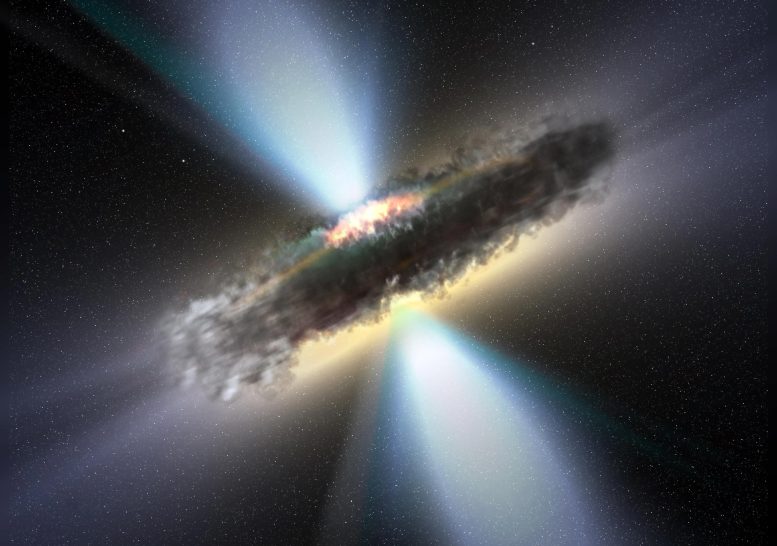
    Dust Torus Surrounding Supermassive Black Hole
    Artistic illustration of the thick dust torus thought to surround supermassive black holes and their accretion disks. Durham University researchers using ALMA have discovered that dense gas and dust in starburst galaxies can obscure quasars, challenging the idea that only nearby dust rings are responsible. Credit: ESA / V. Beckmann (NASA-GSFC)

    New reserarch has revealed that quasars, the bright centers of galaxies, can be hidden by the very galaxies they inhabit. This contradicts the old belief that a quasar’s glow is only dimmed by a surrounding dust ring, shedding new light on the evolution of galaxies and their central black holes.

    A new study reveals that supermassive black holes at the centers of galaxies, known as quasars, can sometimes be obscured by dense clouds of gas and dust in their host galaxies.

    This challenges the prevailing idea that quasars are only obscured by donut-shaped rings of dust in the close vicinity of the black hole.

    New Research Findings

    Quasars are extremely bright objects powered by black holes gorging on surrounding material. Their powerful radiation can be blocked if thick clouds come between us and the quasar.

    Astronomers have long thought this obscuring material only exists in the quasar’s immediate surroundings, in a “dusty torus” (or donut) encircling it.

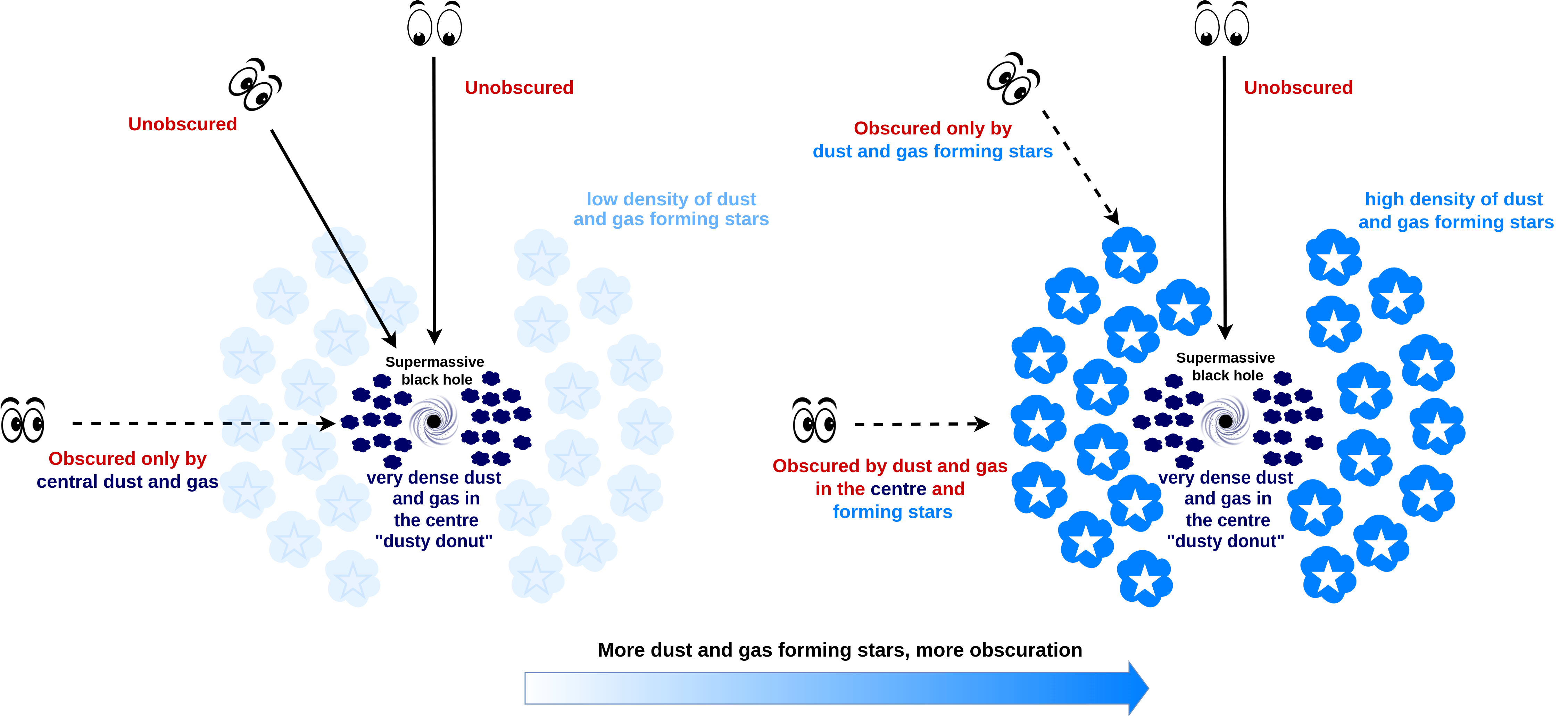
    Now, a team of scientists led by Durham University have found evidence that in some quasars, the obscuration is entirely caused by the host galaxy in which the quasar resides.
    Quasar Obscuration Sources
    Illustration of the sources of obscuration. Orange clouds represent the dust and gas close to the central black hole, and blue clouds with stars represent the dust and gas in the galaxy forming the stars. The gradient in the blue color represents the amount of gas and dust in the galaxy, from little (transparent) to large (opaque) amount of gas and dust. Credit: Durham University

    Using the Atacama Large Millimeter Array (ALMA) in Chile, they observed a sample of very dusty quasars with intense rates of star formation. They found that many of these quasars live in very compact galaxies, known as “starburst galaxies,” no more than 3000 light-years across.

    These starburst galaxies can form more than 1000 stars like the Sun per year. To form such a large number of stars, the galaxy needs a huge amount of gas and dust, which are essentially the building blocks of stars.

    In such galaxies, clouds of gas and dust stirred up by rapid star formation can pile up and completely hide the quasar.

    Implications of the Discovery

    The full study has been published in the journal Monthly Notices of the Royal Astronomical Society: Letters.

    Lead author of the study Carolina Andonie, PhD student in the Centre for Extragalactic Astronomy at Durham University, said: “It’s like the quasar is buried in its host galaxy.

    “In some cases, the surrounding galaxy is so stuffed with gas and dust, not even X-rays can escape.

    “We always thought the dusty donut around the black hole was the only thing hiding the quasar from view. Now we realize the entire galaxy can join in.

    “This phenomenon only seems to happen when the quasar is undergoing an intense growth spurt.”

    The team estimates that in about 10-30% of very rapidly star-forming quasars, the host galaxy is solely responsible for obscuring the quasar.

    The findings provide new insights into the link between galaxy growth and black hole activity.

    Obscured quasars may represent an early evolutionary stage, when young galaxies are rich with cold gas and dust, fuelling high rates of star formation and black hole growth.

    Study co-author Professor David Alexander of Durham University said: “It’s a turbulent, messy phase of evolution, when gas and stars collide and cluster in the galaxy’s center.

    “The cosmic food fight cloaks the baby quasar in its natal cocoon of dust.”

    Unveiling these buried quasars will help scientists understand the connection between galaxies and the supermassive black holes at their hearts.

    Reference: “Obscuration beyond the nucleus: infrared quasars can be buried in extreme compact starbursts” by Carolina Andonie, David M Alexander, Claire Greenwell, Annagrazia Puglisi, Brivael Laloux, Alba V Alonso-Tetilla, Gabriela Calistro Rivera, Chris Harrison, Ryan C Hickox, Melanie Kaasinen, Andrea Lapi, Iván E López, Grayson Petter, Cristina Ramos Almeida, David J Rosario, Francesco Shankar and Carolin Villforth, 6 October 2023, Monthly Notices of the Royal Astronomical Society: Letters.
    DOI: 10.1093/mnrasl/slad144

    Never miss a breakthrough: Join the SciTechDaily newsletter.
    Follow us on Google and Google News.

    ALMA Astronomy Astrophysics Durham University Popular Quasars
    Share. Facebook Twitter Pinterest LinkedIn Email Reddit

    Related Articles

    ALMA Uncovers How Ancient Quasars Silence Star Formation

    Extragalactic Surprise: First-Ever Circumstellar Disc Discovered Beyond the Milky Way

    Purported Phosphine – An Indicator of Life – On Venus More Likely to Be Ordinary Sulfur Dioxide

    Astronomers Discover Earliest Supermassive Black Hole and Quasar in the Universe – 1000x More Luminous Than the Milky Way

    Most Distant Quasar Discovered Sheds Light on How Supermassive Black Holes Grow

    “This Galaxy Is Witnessing a Truly Extreme Event” – Galaxy Mergers Could Limit Star Formation

    Research Shows NASA’s James Webb Space Telescope Will Reveal Hidden Galaxies

    NASA Discovers “Very Weird” Molecule in Titan’s Atmosphere

    Astronomers Find Extreme Galaxy With Intense Ultraviolet Luminosity Comparable to a Quasar

    Leave A Reply Cancel Reply

    • Facebook
    • Twitter
    • Pinterest
    • YouTube

    Don't Miss a Discovery

    Subscribe for the Latest in Science & Tech!

    Trending News

    Largest-Ever Study Finds Medicinal Cannabis Ineffective for Anxiety, Depression, PTSD

    250-Million-Year-Old Egg Solves One of Evolution’s Biggest Mysteries

    Living With Roommates Might Be Changing Your Gut Microbiome Without You Knowing

    Century-Old Cleaning Chemical Linked to 500% Increased Risk of Parkinson’s Disease

    What if Your Memories Never Happened? Physicists Take a New Look at the Boltzmann Brain Paradox

    One of the Universe’s Largest Stars May Be Getting Ready To Explode

    Scientists Discover Enzyme That Could Supercharge Ozempic-Like Weight Loss Drugs

    Popular Sweetener Linked to DNA Damage – “It’s Something You Should Not Be Eating”

    Follow SciTechDaily
    • Facebook
    • Twitter
    • YouTube
    • Pinterest
    • Newsletter
    • RSS
    SciTech News
    • Biology News
    • Chemistry News
    • Earth News
    • Health News
    • Physics News
    • Science News
    • Space News
    • Technology News
    Recent Posts
    • A Simpler Path to Super-Resolution: Scientists Reinvent Microscopy
    • Scientists Uncover Hidden Genetic Cause of Diabetes in Babies
    • Amazonian Chocolate Could Become the Next Superfood, Scientists Say
    • Challenging the Narrative: New Study Shows U.S. Life Expectancy Is Rising Across All States
    • Mystery Illness Kills 5 in Burundi As Doctors Scramble for Answers
    Copyright © 1998 - 2026 SciTechDaily. All Rights Reserved.
    • Science News
    • About
    • Contact
    • Editorial Board
    • Privacy Policy
    • Terms of Use

    Type above and press Enter to search. Press Esc to cancel.