
A Dazzling Display of Star Birth Captured in Infrared
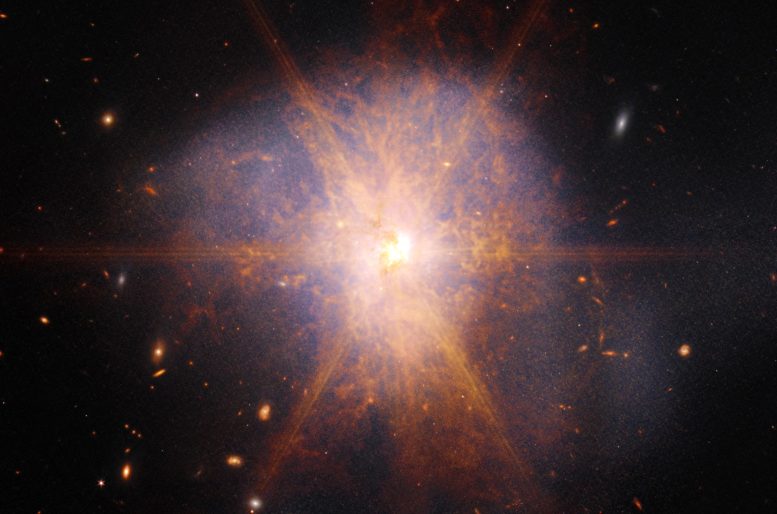
A stunning smash-up of two spiral galaxies shines in infrared with the light of more than a trillion suns. Collectively called Arp 220, the colliding galaxies ignited a tremendous burst of star birth. Each of the combining galactic cores is encircled by a rotating, star-forming ring blasting out the glaring light that Webb captured in infrared. This brilliant light creates a prominent, spiked, starburst feature.
Webb Space Telescope Captures the Spectacular Galactic Merger Arp 220
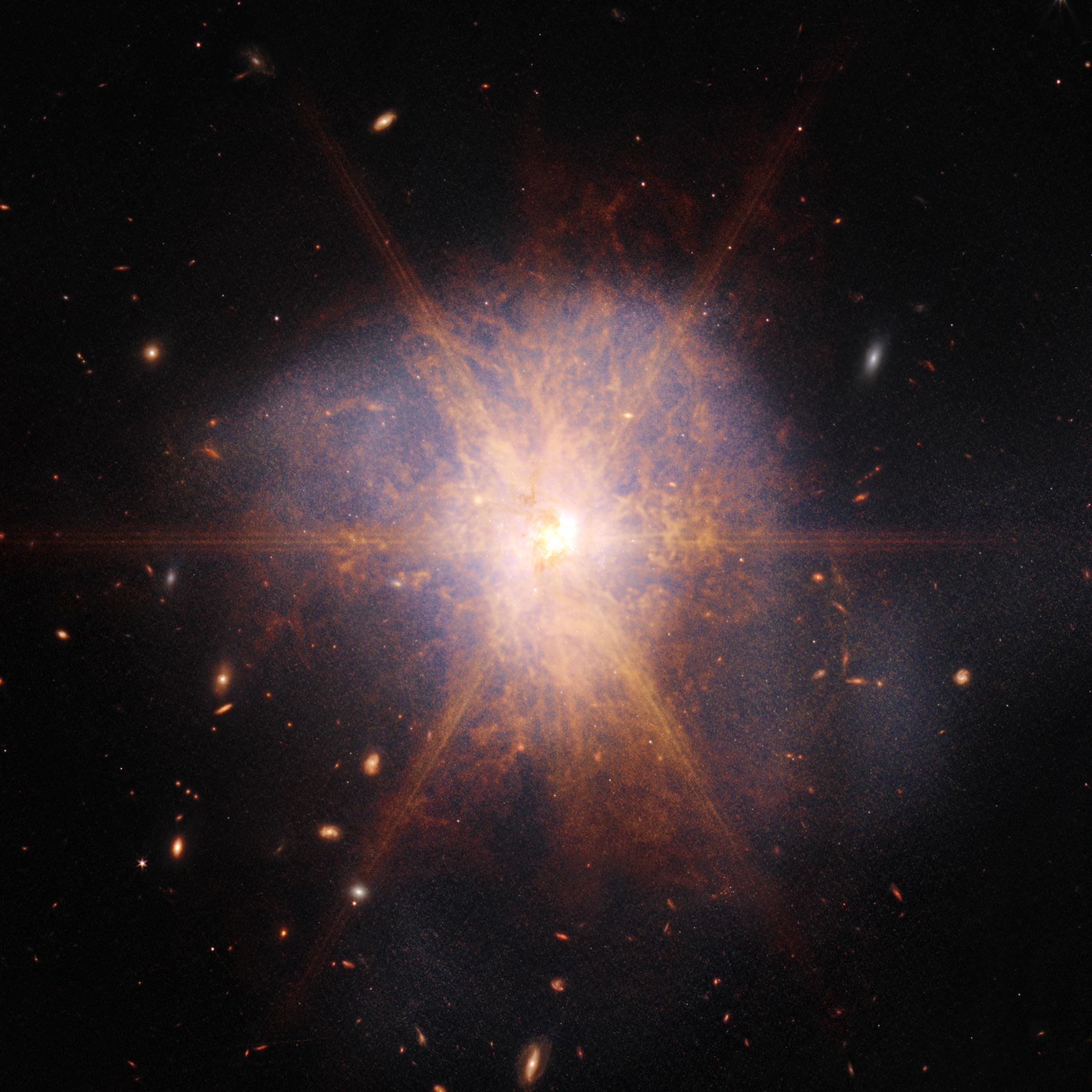
Shining like a brilliant beacon amidst a sea of galaxies, Arp 220 lights up the night sky in this view from NASA’s James Webb Space Telescope. Actually, two spiral galaxies in the process of merging, Arp 220 glows brightest in infrared light, making it an ideal target for Webb. It is an ultra-luminous infrared galaxy (ULIRG) with a luminosity of more than a trillion suns. In comparison, our Milky Way galaxy has a much more modest luminosity of about ten billion suns.
Located 250 million light-years away in the constellation of Serpens, the Serpent, Arp 220 is the 220th object in Halton Arp’s Atlas of Peculiar Galaxies. It is the nearest ULIRG and the brightest of the three galactic mergers closest to Earth.
The collision of the two spiral galaxies began about 700 million years ago. It sparked an enormous burst of star formation. About 200 huge star clusters reside in a packed, dusty region about 5,000 light-years across (about 5 percent of the Milky Way’s diameter). The amount of gas in this tiny region is equal to all of the gas in the entire Milky Way galaxy.
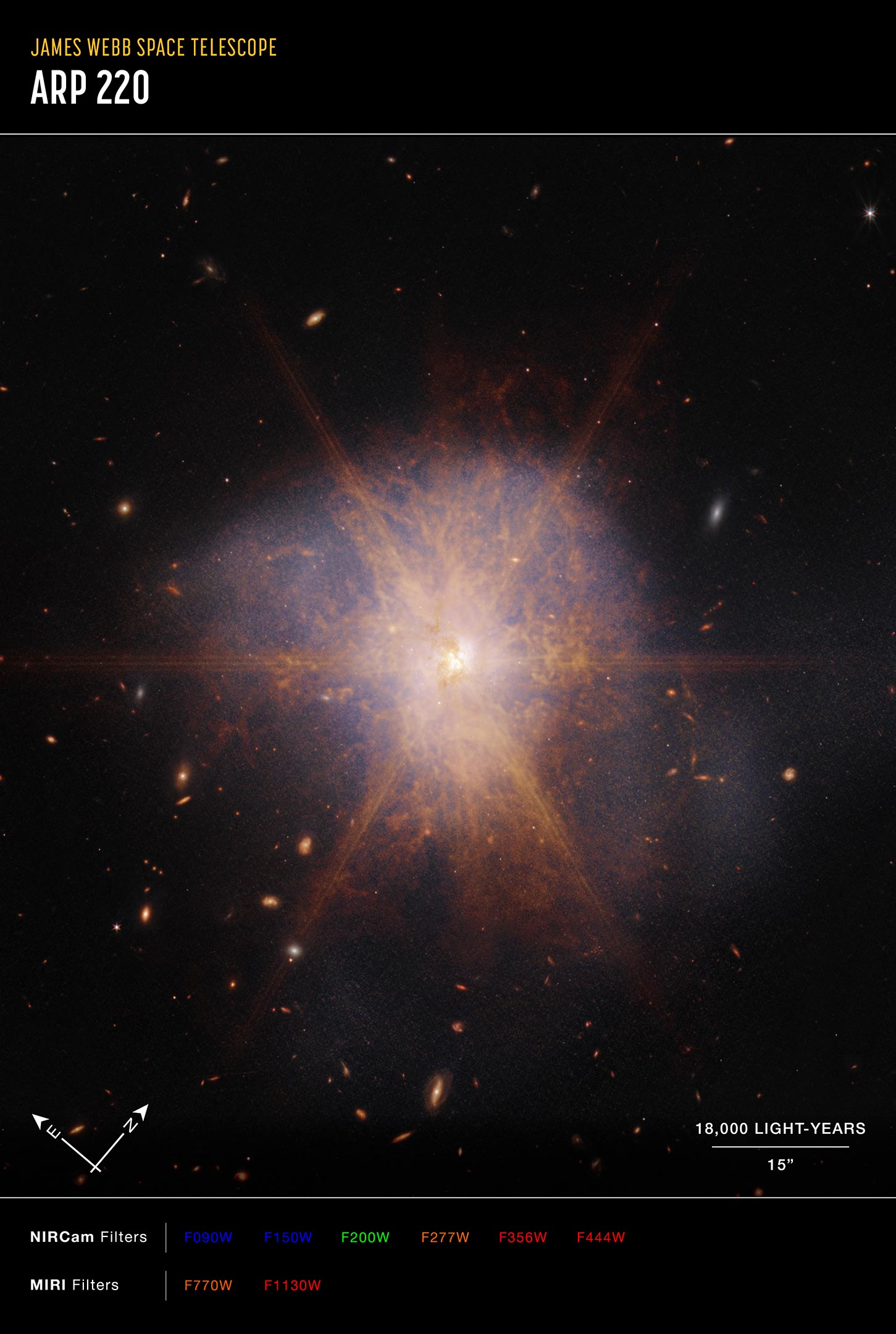
The north and east compass arrows show the orientation of the image on the sky. Note that the relationship between north and east on the sky (as seen from below) is flipped relative to direction arrows on a map of the ground (as seen from above).
The scale bar is labeled in light-years, which is the distance that light travels in one Earth-year. (It takes 18,000 years for light to travel a distance equal to the length of the bar.) One light-year is equal to about 5.88 trillion miles or 9.46 trillion kilometers. The field of view shown in this image is approximately 120,000 light-years across.
This image shows invisible infrared wavelengths of light that have been translated into visible-light colors. The color key shows which filters were used when collecting the light. The color of each filter name is the visible-light color used to represent the infrared light that passes through that filter.
Credit: NASA, ESA, CSA, STScI, Image Processing: Alyssa Pagan (STScI)
Previous radio telescope observations revealed about 100 supernova remnants in an area of less than 500 light-years. NASA’s Hubble Space Telescope uncovered the cores of the parent galaxies 1,200 light-years apart. Each of the cores has a rotating, star-forming ring blasting out the dazzling infrared light so apparent in this Webb view. This glaring light creates diffraction spikes — the starburst feature that dominates this image.
On the outskirts of this merger, Webb reveals faint tidal tails, or material drawn off the galaxies by gravity, represented in blue — evidence of the galactic dance that is occurring. Organic material represented in reddish-orange appears in streams and filaments across Arp 220.
Webb viewed Arp 220 with its Near-Infrared Camera (NIRCam) and Mid-Infrared Instrument (MIRI).
The James Webb Space Telescope is the world’s leading space science observatory is the James Webb Space Telescope, and was designed to unravel the mysteries of our solar system and explore distant worlds around other stars. Moreover, it aims to investigate the enigmatic structures and origins of our universe, and our position within it. This international program is spearheaded by NASA in collaboration with its partners, namely, the European Space Agency (ESA) and the Canadian Space Agency.
Never miss a breakthrough: Join the SciTechDaily newsletter.
Follow us on Google and Google News.
4 Comments
I’m biased to seeing in the surrounding of Arp 220 a kind of galaxy-sized repeated whispy honeycomb-like structure due to my concept of longitudinal roll in quantum gravity effects, where the comb size is simply related to a protonic adaptation of Dirac’s LNH.
If this is two spiral galaxies shown bright in the center, then it looks to me like the size scale given is apparently off by about a factor of 100, setting the reference distance at about 1.8 million light years. One million light-years would normally be around 10 typical spiral galaxies across.
I’ve got to take that size re-scale back. I was not focusing on the faint blue-white part.
The comb scale is much smaller than the two galaxies presumably because they are in the process of orbiting tightly around each other with an orbit radius evidently matching the comb scale of around 1,800 light-years, or about one tenth of the reference scale in other words.
The dangling participle and its incongruity are agregius in that my ruler says less than 12″ across the universe! Thoughts meander like a restless wind inside a letter box…big bang boom 💥 🎶 ♥️ Two Hearts are better than one!