
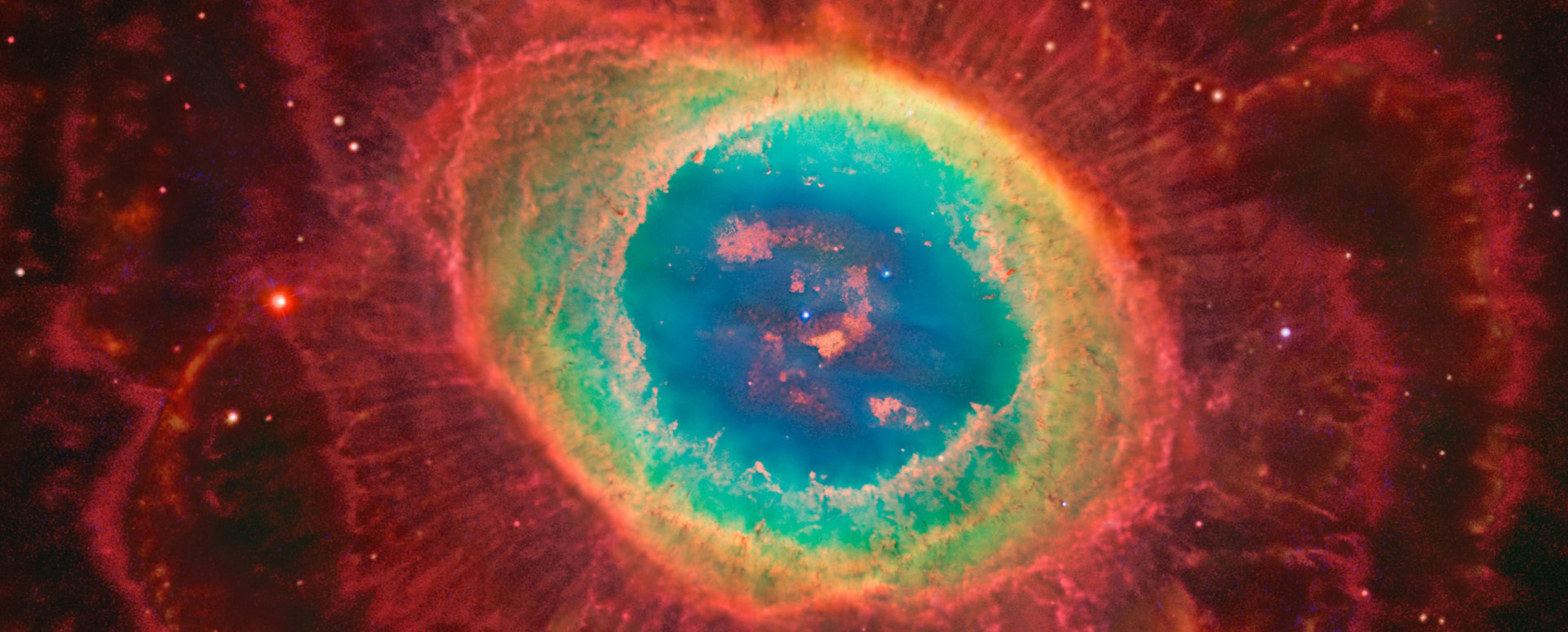
Fullerenes are large, complex carbon molecules known for their durability. Their atoms are arranged in three-dimensional spherical structures that feature a pattern of alternating hexagons and pentagons. This arrangement resembles a soccer ball in the case of C60 fullerenes and a rugby ball for C70 fullerenes.
These molecules were discovered in the laboratory in 1985, which procured the Nobel Prize for Chemistry for their three discoverers 11 years later. Since then there have been many instances of observational proof of their existence in space, especially within the gas clouds around old, dying stars the size of the Sun, called planetary nebulae, which have been expelled from the outer layers of the stars towards the end of their lives.
As these molecules are highly stable and difficult to destroy, it is thought that the fullerenes can act as cages for other molecules and atoms, so that they could have brought complex molecules to Earth, which gave an impulse to start life. So their study is important for the understanding of the basic physical processes that take part in the organization of organic material in the universe.
An unknown chemical footprint
Spectroscopy is essential for the search and identification of fullerenes in space. Spectroscopy allows us to study the material composing the universe by analyzing the chemical footprints made by atoms and molecules on the light that reaches us from them.
A recent study, led entirely from the IAC, has analyzed infrared spectroscopic data obtained previously from telescopes in space, from the planetary nebula Tc1. These spectra show spectral lines indicating the presence of fullerenes, but also show broader infrared bands, (UIR for their initials in English) which are detected widely in the universe, from the small bodies in the Solar System to distant galaxies.
“The identification of the chemical species which causes this infrared emission, widely present in the universe, was an astrochemical mystery, although it was always thought probable that it is rich in carbon, one of the basic elements of life” explains Marco A. Gómez Muñoz, an IAC researcher, who led this study.
A new origin for the fullerenes
In order to identify these mysterious bands, the research team reproduced the infrared emission of the planetary nebula Tc 1. Analysis of the emission bands showed the presence of grains of amorphous hydrogenated carbon (HAC). These compounds of carbon and hydrogen in a highly disordered state, very abundant in the envelopes of dying stars, can account for the infrared emission of this nebula.
“We have combined for the first time, the optical constants of HAC, obtained from laboratory experiments, with models of photoionization, and doing this we have reproduced the infrared emission of the planetary nebula Tc 1, which is very rich in fullerenes”, explains Domingo Anibal García Hernández, an IAC researcher who is a coauthor of the paper.
For the research team, the presence of the same object of HAC and fullerenes supports the theory that the fullerenes could have formed during the process of destruction of the dust grains, for example by interaction with ultraviolet radiation, which is much more energetic than visible light.
With this result, the scientists have opened the way for future research based on collaboration between laboratory chemistry and astrophysics. “Our work shows clearly the great potential of interdisciplinary science, and technology to make basic advances in astrophysics and astrochemistry,” concludes Gómez Muñoz.
Reference: “Hydrogenated amorphous carbon grains as an alternative carrier of the 9–13 μm plateau feature in the fullerene planetary nebula Tc 1” by M. A. Gómez-Muñoz, D. A. García-Hernández, R. Barzaga, A. Manchado and T. Huertas-Roldán, 21 February 2024, Astronomy & Astrophysics.
DOI: 10.1051/0004-6361/202349087
Never miss a breakthrough: Join the SciTechDaily newsletter.
Follow us on Google and Google News.