
Close Menu
    Facebook X (Twitter) Instagram
    SciTechDaily
    • Biology
    • Chemistry
    • Earth
    • Health
    • Physics
    • Science
    • Space
    • Technology
    Facebook X (Twitter) Pinterest YouTube RSS
    SciTechDaily
    Home»Earth»Romania’s Fields of Gold Captured From Space
    Earth

    Romania’s Fields of Gold Captured From Space

    By Lindsey Doermann, NASA Earth ObservatoryApril 30, 2024No Comments2 Mins Read
    Facebook Twitter Pinterest Telegram LinkedIn WhatsApp Email Reddit
    Share
    Facebook Twitter LinkedIn Pinterest Telegram Email Reddit
    Golden Fields in Romania Annotated
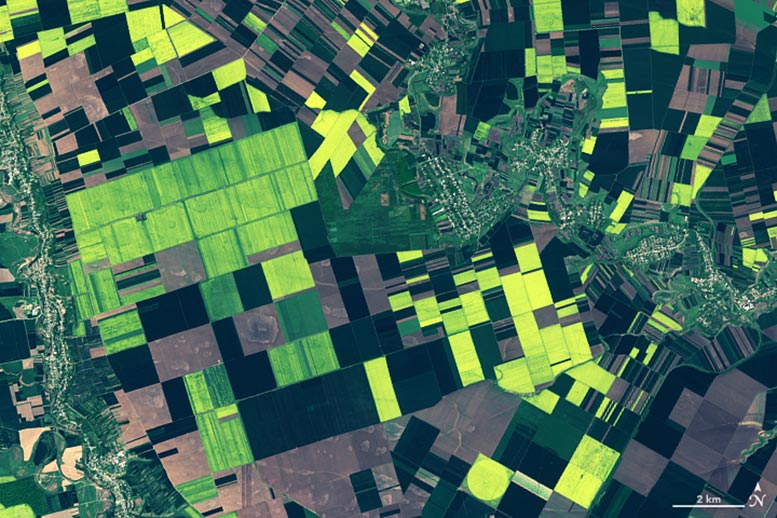
    Satellite image of agricultural fields in southern Romania captured on April 12, 2024, by the Operational Land Imager on Landsat 8.

    Agricultural plots are carpeted in yellow when rapeseed or canola plants bloom.

    Green agricultural fields in southern Romania became tinged with yellow as rows upon rows of what appear to be rapeseed or canola plants bloomed. The OLI (Operational Land Imager) on the Landsat 8 satellite captured these pops of color near the confluence of the Olt and Danube rivers on April 12, 2024.

    Rapeseed and canola plants are part of the Brassica family, which also includes cabbages and mustards. They produce clusters of small, brilliant yellow blooms that, en masse, blanket entire fields in gold.
    Golden Fields in Romania Detail
    Detailed zoomed-in view from the image above.

    The yellow flowers develop into slender pods resembling pea pods containing small, oil-rich seeds. When extracted, the oil is used in a variety of chemical, biofuel, food, and other industry applications. Canola oil, commonly used in cooking, is derived from a rapeseed cultivar bred to have a low acid content.

    In a typical year, Romania produces 10 percent of the European Union’s grain and oilseed, according to the International Trade Commission. In addition to rapeseeds, Romania’s main crops include sunflowers and soybeans, as well as corn, wheat, and barley. Its annual oilseed production is sensitive to drought and heat and has undergone significant swings in recent years.

    While the E.U. as a whole produced 23 percent of the world’s rapeseed in 2023, Canada and China top the list of the largest rapeseed and canola-producing countries, generating 21 and 17 percent, respectively, that year. Satellites have captured images of expansive flowering fields in both countries. Canada’s season of yellow blooms occurs later in the year than the E.U.’s, while China’s takes place earlier.

    NASA Earth Observatory images by Lauren Dauphin, using Landsat data from the U.S. Geological Survey.

    Never miss a breakthrough: Join the SciTechDaily newsletter.
    Follow us on Google and Google News.

    Agriculture Geography NASA NASA Earth Observatory
    Share. Facebook Twitter Pinterest LinkedIn Email Reddit

    Related Articles

    The Hidden Logic Behind Poland’s Stunningly Striped Fields

    From Space to Soil, Tracking the Explosive Rise of Greenhouses in China

    Satellite Reveals Larger Wheat Harvest in Ukraine Than Expected – And Barren Boundary of War

    Satellite Images Reveal a Rough Year for Rice in California

    Russia-Ukraine Conflict: Measuring War’s Effect on a Global Breadbasket

    Sea Ice in Denmark Strait – Drifted More Than 1,000 Km (600 Miles) From the Arctic Ocean

    Mars Terraforming: Cultivating Ideas for Mars on Earth

    Meandering Mississippi River: Photo Taken by Astronaut on Space Station Shows Divergence From State Boundaries

    Incredible Rare Peek at Patagonia in Winter

    Leave A Reply Cancel Reply

    • Facebook
    • Twitter
    • Pinterest
    • YouTube

    Don't Miss a Discovery

    Subscribe for the Latest in Science & Tech!

    Trending News

    Scientists Uncover Promising New Strategy To Stop Parkinson’s in Its Tracks

    Experts Reveal the Surprising Cancer Link Behind a Common Vitamin

    This Strange “Golden Orb” Found 2 Miles Deep Stumped Scientists for Years

    Giant “Last Titan” Dinosaur Discovered in Thailand Was Bigger Than 9 Elephants

    This “Longevity Gene” May Protect the Brain From Aging and Dementia

    Common Cleaning Chemical Could Triple Your Risk of a Dangerous Liver Disease

    Scientists Discover Bizarre 100-Million-Year-Old Insect With Giant Claws

    Scientists Discover “Good” Gut Microbes That Could Protect Against Autism and ADHD

    Follow SciTechDaily
    • Facebook
    • Twitter
    • YouTube
    • Pinterest
    • Newsletter
    • RSS
    SciTech News
    • Biology News
    • Chemistry News
    • Earth News
    • Health News
    • Physics News
    • Science News
    • Space News
    • Technology News
    Recent Posts
    • NASA’s Roman Space Telescope Nears Launch for Epic Hunt Across the Universe
    • Ancient Mega-Floods Once Ripped Across Mars and Left This Giant Scar
    • Scientists Just Used Sunlight To Pull Off a Quantum Physics Feat Once Thought Impossible
    • Scientists Discover “Immature” Brain Cells That May Defy Alzheimer’s
    • Children of Centenarians Share One Surprising Habit That May Boost Longevity
    Copyright © 1998 - 2026 SciTechDaily. All Rights Reserved.
    • Science News
    • About
    • Contact
    • Editorial Board
    • Privacy Policy
    • Terms of Use

    Type above and press Enter to search. Press Esc to cancel.