
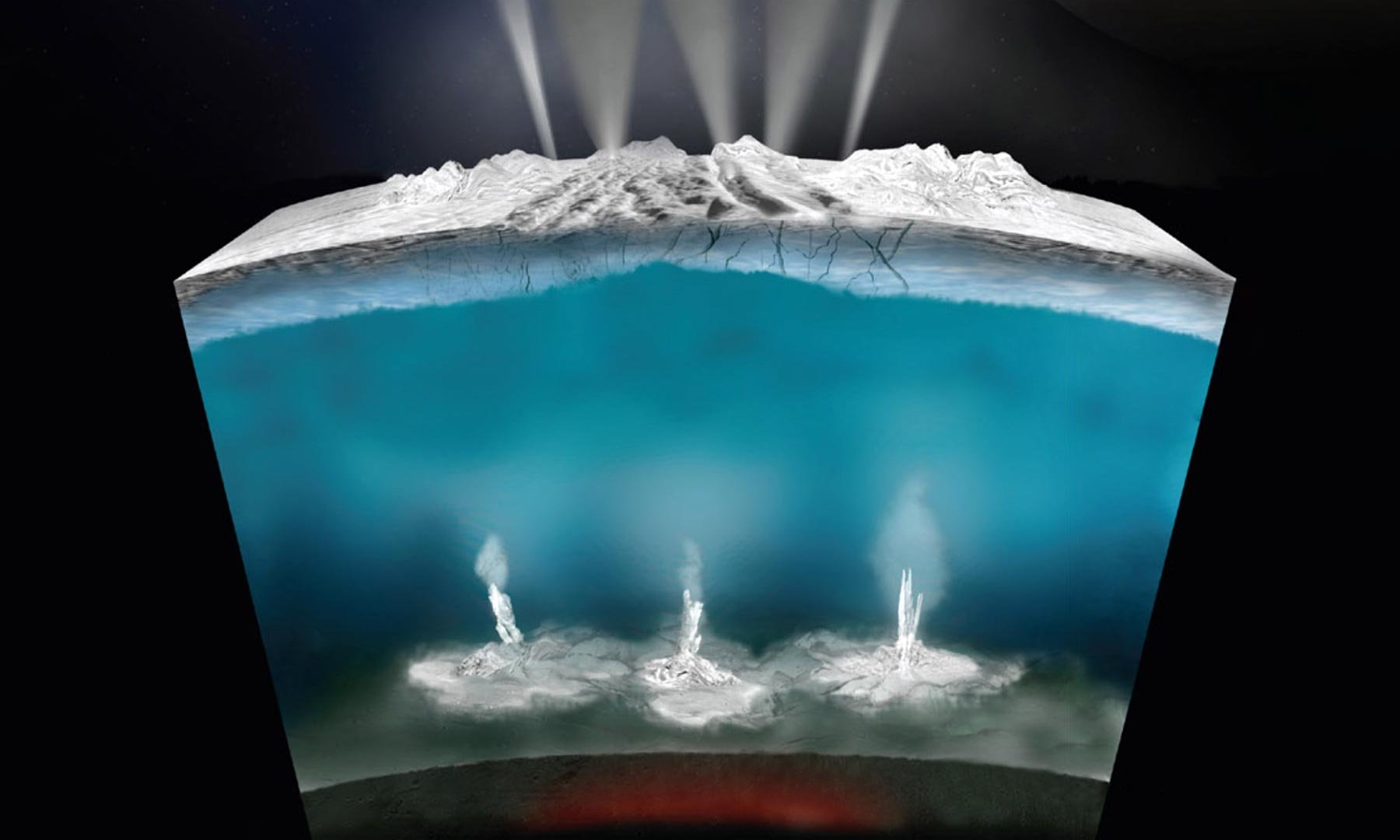
Scientists studying Saturn’s icy moon, Enceladus, have discovered that its ocean forms layers that slow the upward movement of life’s chemical signatures.
If microbial life exists in Enceladus’ deep sea, its biological traces might degrade before reaching the surface, making them undetectable to passing spacecraft. This new finding challenges how we look for extraterrestrial life and suggests future space missions need more advanced strategies.
Challenges of Detecting Life in Alien Oceans
Finding life in alien oceans may be harder than scientists once believed, even when we have direct access to their waters.
A new study on Enceladus, Saturn’s icy moon that ejects ocean water into space through surface cracks, suggests that the unique physics of its ocean could keep evidence of deep-sea life hidden from detection.
Published today (February 6, 2025) in Communications Earth and Environment, the study reveals that Enceladus’ ocean forms distinct layers, which significantly slow the movement of material from the seafloor to the surface.
Biological Signatures May Not Survive the Journey
Chemical traces, microbes, and organic material – telltale signatures of life that scientists look for – could break down or transform as they travel through the ocean’s distinct layers. These biological signatures might become unrecognizable by the time they reach the surface where spacecraft can sample them, even if life thrives in the deep ocean below.
Flynn Ames, lead author at the University of Reading, said: “Imagine trying to detect life at the depths of Earth’s oceans by only sampling water from the surface. That’s the challenge we face with Enceladus, except we’re also dealing with an ocean whose physics we do not fully understand.
“We’ve found that Enceladus’ ocean should behave like oil and water in a jar, with layers that resist vertical mixing. These natural barriers could trap particles and chemical traces of life in the depths below for hundreds to hundreds of thousands of years. Previously, it was thought that these things could make their way efficiently to the ocean top within several months.
“As the search for life continues, future space missions will need to be extra careful when sampling Enceladus’s surface waters.”
The Need for New Space Mission Strategies
Using computer models similar to those used to study Earth’s oceans, the study has important implications for the search for life in the solar system and beyond. As scientists discover more ice-covered ocean worlds orbiting the outer planets and distant stars, similar ocean dynamics could confine evidence of life and its building blocks to deeper waters, undetectable from the surface. Even on worlds like Enceladus, where ocean material is conveniently sprayed into space for sampling, the long journey from deep ocean to surface could erase crucial evidence.
Reference: “Ocean stratification impedes particulate transport to the plumes of Enceladus” by Flynn Ames, David Ferreira, Arnaud Czaja and Adam Masters, 6 February 2025, Communications Earth & Environment.
DOI: 10.1038/s43247-025-02036-3
Never miss a breakthrough: Join the SciTechDaily newsletter.
Follow us on Google and Google News.
2 Comments
Unfortunately, we are alone in the entire galaxy. There are no traces of life, not even microbes, on the moon Enceladus. You know that the conditions for life next to a star-like star in the solar system will be very, very rare. In my opinion, the existence of life like Earth is possible in six hundred thousand trillion galaxies
Nonsense. Life is very tenacious and adaptable and almost every star has at least one planet. Humans have had contacts with 50-100 different species in ufos. And yes ufos leave ground traces. Probably we already share the planet with another technology or at least the solar system.