

Researchers at North Carolina State University (NC State) have successfully applied CRISPR gene-editing technology to breed poplar trees with reduced levels of lignin, a significant barrier to the sustainable production of wood fibers. The research, which offers potential for more efficient, eco-friendly fiber production, was published in the journal Science. The findings hold promise to make fiber production for everything from paper to diapers greener, cheaper, and more efficient.
The Power of CRISPR
Led by NC State CRISPR pioneer Rodolphe Barrangou and tree geneticist Jack Wang, a team of researchers used predictive modeling to set goals of lowering lignin levels, increasing the carbohydrate-to-lignin (C/L) ratio, and increasing the ratio of two important lignin building blocks – syringyl to guaiacyl (S/G) – in poplar trees. These combined chemical characteristics represent a fiber production sweet spot, Barrangou and Wang say.
“We’re using CRISPR to build a more sustainable forest,” said Barrangou, the Todd R. Klaenhammer Distinguished Professor of Food, Bioprocessing and Nutrition Sciences at NC State and co-corresponding author of the paper. “CRISPR systems provide the flexibility to edit more than just single genes or gene families, allowing for greater improvement to wood properties.”
Achieving Optimal Gene-Editing Strategies
The team utilized a machine-learning model to predict and sort through almost 70,000 different gene-editing strategies targeting 21 important genes associated with lignin production – some changing multiple genes at a time. The process led to the identification of 347 strategies; more than 99% of those strategies targeted at least three genes.
From there, the researchers selected the seven best strategies that modeling suggested would lead to trees that would attain the chemical sweet spot – 35% less lignin than wild, or unmodified, trees; C/L ratios that were more than 200% higher than wild trees; S/G ratios that were also more than 200% higher than wild trees; and tree growth rates that were similar to wild trees.

Producing New Poplar Tree Varieties
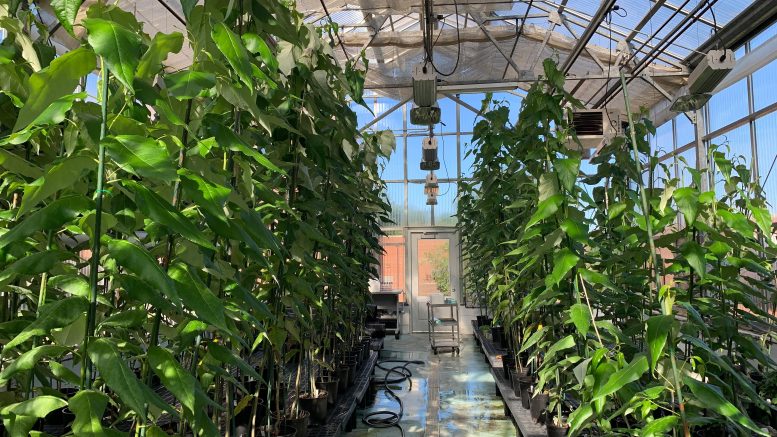
From these seven strategies, the researchers used CRISPR gene editing to produce 174 lines of poplar trees. After six months in an NC State greenhouse, an examination of those trees showed reduced lignin content of up to 50% in some varieties, as well as a 228% increase in the C-L ratio in others.
Multi-gene Edits for Improved Fiber Production
Interestingly, the researchers say, more significant lignin reductions were shown in trees with four to six gene edits, although trees with three gene edits showed lignin reduction of up to 32%. Single-gene edits failed to reduce lignin content much at all, showing that using CRISPR to make multigene changes could confer advantages in fiber production.
The Impact on Pulp Production
The study also included sophisticated pulp production mill models that suggest reduced lignin content in trees could boost pulp yield and reduce so-called black liquor, the primary byproduct of pulping. This could help mills increase the production of sustainable fibers by up to 40%.
Climate Impact and Future Steps
Finally, the efficiencies found in fiber production could reduce greenhouse gases associated with pulp production by up to 20% if reduced lignin and increased C/L and S/G ratios are achieved in trees at industrial scale.
Forest trees represent the largest biogenic carbon sink on earth and are paramount in efforts to curb climate change. They are pillars of our ecosystems and the bioeconomy. In North Carolina, forestry contributes over $35 billion to the local economy and supports approximately 140,000 jobs.
“Multiplex genome editing provides a remarkable opportunity to improve forest resilience, productivity, and utilization at a time when our natural resources are increasingly challenged by climate change and the need to produce more sustainable biomaterials using less land,” said Wang, assistant professor and director of the Forest Biotechnology Group at NC State and co-corresponding author of the paper.
Next steps include continued greenhouse tests to see how the gene-edited trees perform compared to wild trees. Later, the team hopes to use field trials to gauge whether the gene-edited trees can handle the stresses provided by life outdoors, outside the controlled greenhouse environment.
Toward a Sustainable Future
The researchers stressed the importance of multidisciplinary collaboration that enabled this study, encompassing three NC State colleges, multiple departments, the N.C. Plant Sciences Initiative, NC State’s Molecular Education, Technology and Research Innovation Center (METRIC), and partner universities.
“An interdisciplinary approach to tree breeding that combines genetics, computational biology, CRISPR tools, and bio-economics has profoundly expanded our knowledge of tree growth, development, and forest applications,” said Daniel Sulis, a postdoctoral scholar at NC State and the first author of the paper. “This powerful approach has transformed our ability to unravel the complexity of tree genetics and deduce integrated solutions that could improve ecologically and economically important wood traits while reducing the carbon footprint of fiber production.”
Building on the long-standing legacy of innovations in the fields of plant sciences and forestry at NC State, Barrangou and Wang created a startup company called TreeCo to advance the use of CRISPR technologies in forest trees. This collaborative effort led by NC State faculty members aims to combine tree genetic insights with the power of genome editing to breed a healthier and more sustainable future.
Reference: “Multiplex CRISPR editing of wood for sustainable fiber production” by Daniel B. Sulis, Xiao Jiang, Chenmin Yang, Barbara M. Marques, Megan L. Matthews, Zachary Miller, Kai Lan, Carlos Cofre-Vega, Baoguang Liu, Runkun Sun, Henry Sederoff, Ryan G. Bing, Xiaoyan Sun, Cranos M. Williams, Hasan Jameel, Richard Phillips, Hou-min Chang, Ilona Peszlen, Yung-Yun Huang, Wei Li, Robert M. Kelly, Ronald R. Sederoff, Vincent L. Chiang, Rodolphe Barrangou and Jack P. Wang, 13 July 2023, Science.
DOI: 10.1126/science.add4514
Researchers from several NC State departments co-authored the paper, along with researchers from the University of Illinois at Urbana-Champaign, Beihua University and Northeast Forestry University. Funding was provided by National Institute of Food and Agriculture of the U.S. Department of Agriculture – Agriculture and Food Research Initiative grant 2018-67021-27716; the National Science Foundation Small Business Technology Transfer Program grant 2044721; Cooperative State Research Service of the U.S. Department of Agriculture grant NCZ04214; North Carolina Specialty Crop Block Grants 19-019-4018, 19-092-4012, and 20-070-4013; an NC State University Chancellor’s Innovation Fund grant 190549MA; and an NC State University Goodnight Early Career Innovator Award.
Abstract: The domestication of forest trees for a more sustainable fiber bioeconomy has long been hindered by the complexity and plasticity of lignin, a biopolymer in wood that is recalcitrant to chemical and enzymatic degradation. Here, we show that multiplex-CRISPR-editing enables precise woody-feedstock-design for combinatorial improvement in lignin composition and wood properties. By assessing every possible combination of 69,123 multigenic-editing strategies for 21 lignin biosynthesis genes, we deduced 7 unique genome-editing strategies targeting the concurrent alteration of up to 6 genes, and produced 174 edited-poplar variants. CRISPR-editing increased wood carbohydrate-to-lignin ratio up to 228% of wildtype, leading to more efficient fiber pulping. The edited-wood alleviates a major fiber-production bottleneck regardless of changes in tree growth rate, and could bring unprecedented operational efficiencies, bioeconomic opportunities, and environmental benefits.
Never miss a breakthrough: Join the SciTechDaily newsletter.
Follow us on Google and Google News.