
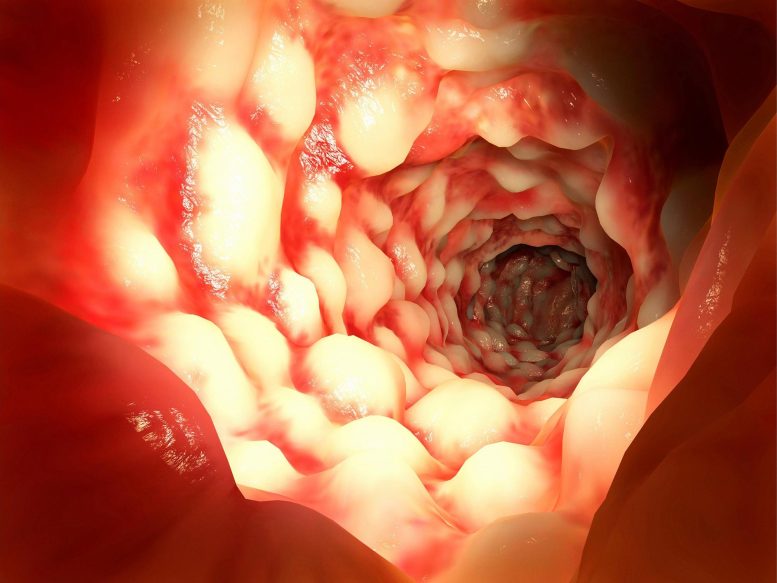
Researchers found that a lack of API5 protein production, triggered by norovirus infection, may cause Crohn’s disease in genetically susceptible individuals.
New research may have solved a mystery surrounding Crohn’s disease, a type of inflammatory bowel disease where immune defenses meant to attack invading microbes mistakenly target the body’s own digestive tract instead. Norovirus is a common infection that causes vomiting and diarrhea. It is also one of several viruses and bacteria thought to trigger disease onset in people with Crohn’s disease, but the field does not know why.
Norovirus is a very contagious virus that causes vomiting and diarrhea. Anyone can get infected and sick with norovirus, and outbreaks are common. You may hear norovirus illness be called “food poisoning,” “stomach bug,” or “stomach flu.” Although noroviruses are the leading cause of foodborne illness, other germs and chemicals can also cause foodborne illness.
One clue emerged when past studies discovered that a certain genetic change (mutation) is present in most people with the condition. This genetic mutation makes gut lining cells more vulnerable to damage. However, the mystery deepened again when it was learned that half of all Americans have this same risk-conferring genetic mutation, but fewer than half a million develop Crohn’s disease.
Norovirus Blocks API5 Secretion
Published on October 5, 2022, in the journal Nature, the new research in mice and in human tissue revealed for the first time that in healthy individuals, immune defenders called T cells secrete a protein called apoptosis inhibitor 5 (API5), which signals the immune system to stop the attack on gut lining cells. This protein adds an extra layer of protection against immune damage, so even those with the mutation can have a healthy gut. However, the scientists also discovered that norovirus infection blocks T cell secretion of API5 in mice bred to have a rodent form of Crohn’s disease, killing gut lining cells in the process.
Led by scientists at NYU Grossman School of Medicine, the research findings support the theory that API5 protects most people with the mutation against the disease until a second trigger, such as norovirus infection, pushes some across the disease threshold.
In experiments centered on mice genetically modified to have the mutation linked to Crohn’s disease in humans, mice that received an injection of API5 survived, while half of the untreated group died. This confirmed the hypothesis that the protein protects gut cells, say the study authors. In human tissue, the investigators found that those with Crohn’s disease had between 5- and 10-fold fewer API5-producing T cells in their gut tissue than those without the illness.
“The results of our investigation help explain why the genetic links to Crohn’s disease are much broader than the actual number of people who have the disease.” Shohei Koide, PhD
Potential for API5-Based Treatments
“Our findings offer new insight into the key role that apoptosis inhibitor 5 plays in Crohn’s disease,” says Yu Matsuzawa-Ishimoto, MD, PhD, the study’s lead author and a gastroenterologist. “This molecule may provide a new target for treating this chronic autoimmune illness, which has proven difficult to manage over the long term.”
According to Dr. Matsuzawa-Ishimoto, a postdoctoral research fellow at NYU Langone Health, current therapies, which work by suppressing the immune system, put patients at high risk for infection and often become less effective after a few years of use. A treatment method targeting API5, he adds, might avert those issues.
In another set of experiments, the investigators created organ-like structures out of tissue collected from humans who tested positive for the mutation. Notably, these structures were made only of gut-lining cells. Then, the research team dropped API5 into these “mini guts” and found that this treatment protected gut lining cells. In addition, adding API5-producing T cells also protected the gut lining.
“Our study suggests that when norovirus infects those with a weakened ability to produce apoptosis inhibitor 5, it tips the balance toward a full-blown autoimmune disease.” Ken H. Cadwell, PhD
“The results of our investigation help explain why the genetic links to Crohn’s disease are much broader than the actual number of people who have the disease,” says Shohei Koide, PhD, the study’s co-senior author and a biochemist. Dr. Koide is a professor in the Department of Biochemistry and Molecular Pharmacology and a member of Perlmutter Cancer Center at NYU Langone.
“Our study suggests that when norovirus infects those with a weakened ability to produce apoptosis inhibitor 5, it tips the balance toward a full-blown autoimmune disease,” adds study co-senior author and microbiologist Ken H. Cadwell, PhD, the Recanati Family Professor of Microbiology at NYU Langone.
Dr. Cadwell cautions that while the study authors derived API5 protein from human tissue rather than rodents, it remains unclear whether the injection treatment can be safely administered in humans.
Next, the research team plans to explore the long-term effects of API5 injections to better understand whether the prospective treatment can effectively manage Crohn’s disease, which can flare up repeatedly over a long period.
Reference: “The γδ IEL effector API5 masks genetic susceptibility to Paneth cell death” by Yu Matsuzawa-Ishimoto, Xiaomin Yao, Akiko Koide, Beatrix M. Ueberheide, Jordan E. Axelrad, Bernardo S. Reis, Roham Parsa, Jessica A. Neil, Joseph C. Devlin, Eugene Rudensky, M. Zahidunnabi Dewan, Michael Cammer, Richard S. Blumberg, Yi Ding, Kelly V. Ruggles, Daniel Mucida, Shohei Koide and Ken Cadwell, 5 October 2022, Nature.
DOI: 10.1038/s41586-022-05259-y
In addition to Dr. Matsuzawa-Ishimoto, Dr. Koide, and Dr. Cadwell, other NYU Langone investigators involved in the study were Xiaomin Yao, PhD; Akiko Koide, PhD; Beatrix M. Ueberheide, PhD; Jordan E. Axelrad, MD, MPH; Jessica Neil, PhD; Joseph Devlin, PhD; Eugene Rudensky, PhD; M. Zahidunnabi Dewan, PhD; Michael Cammer, PhD; Kelly V. Ruggles, PhD; and Daniel Mucida, PhD. Other study investigators were Bernardo Reis, PhD, and Roham Parsa, PhD, at The Rockefeller University in New York City; Richard Blumberg, PhD, at Harvard Medical School in Boston; and Yi Ding, PhD, at Geisinger Health in Danville, Pennsylvania.
Funding for the study was provided by National Institutes of Health grants R0IL123340, R0IDK093668, R0IAI140754, R0IAI121244, R0IAI130945, R0IDK124336, and R0IDK088199. Further funding was provided by the Howard Hughes Medical Institute, the Kenneth Rainin Foundation, the Crohn’s & Colitis Foundation, and the Takeda-Columbia-NYU Alliance.
Dr. Cadwell has received research support from Pfizer, Takeda, Pacific Biosciences, Genentech, and Abbvie, and has served as a consultant for Puretech Health, which develops microbiome therapies, as well as GentiBio and Synedgen. Dr. Koide has received research support from Argenx BVBA, Black Diamond Therapeutics, and Puretech Health, and has served as a consultant for Black Diamond Therapeutics. NYU Langone has patents pending (10,722,600, 62/935,035, and 63/157,225) for therapies developed from this treatment approach, from which Dr. Cadwell, Dr. Koide, Dr. Matsuzawa-Ishimoto, and NYU Langone may benefit financially. The terms and conditions of these relationships are being managed in accordance with the policies of NYU Langone.
Never miss a breakthrough: Join the SciTechDaily newsletter.
Follow us on Google and Google News.