
In two new studies, NASA’s Curiosity Rover reveals details about the Martian atmosphere and clues about how Mars may have lost much of its original atmosphere.
A pair of new papers report measurements of the Martian atmosphere’s composition by NASA’s Curiosity rover, providing evidence about the loss of much of Mars’ original atmosphere.
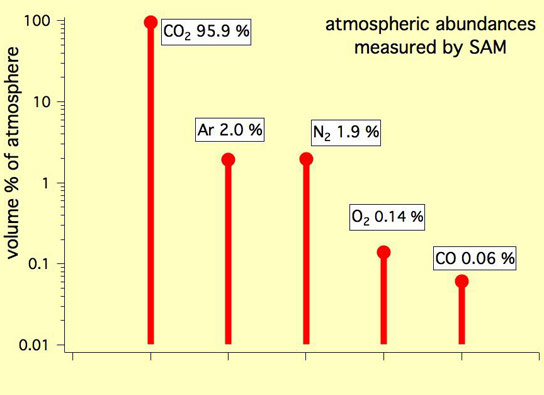
Curiosity’s Sample Analysis at Mars (SAM) suite of laboratory instruments inside the rover has measured the abundances of different gases and different isotopes in several samples of Martian atmosphere. Isotopes are variants of the same chemical element with different atomic weights due to having different numbers of neutrons, such as the most common carbon isotope, carbon-12, and a heavier stable isotope, carbon-13.
SAM checked ratios of heavier to lighter isotopes of carbon and oxygen in the carbon dioxide that makes up most of the planet’s atmosphere. Heavy isotopes of carbon and oxygen are both enriched in today’s thin Martian atmosphere compared with the proportions in the raw material that formed Mars, as deduced from proportions in the sun and other parts of the solar system. This provides not only supportive evidence for the loss of much of the planet’s original atmosphere, but also a clue to how the loss occurred.
“As atmosphere was lost, the signature of the process was embedded in the isotopic ratio,” said Paul Mahaffy of NASA Goddard Space Flight Center, Greenbelt, Maryland. He is the principal investigator for SAM and lead author of one of the two papers about Curiosity results in the July 19 issue of the journal Science.
Other factors also suggest Mars once had a much thicker atmosphere, such as evidence of the persistent presence of liquid water on the planet’s surface long ago even though the atmosphere is too scant for liquid water to persist on the surface now. The enrichment of heavier isotopes measured in the dominant carbon-dioxide gas points to a process of loss from the top of the atmosphere — favoring loss of lighter isotopes — rather than a process of the lower atmosphere interacting with the ground.
Curiosity measured the same pattern in isotopes of hydrogen, as well as carbon and oxygen, consistent with a loss of a substantial fraction of Mars’ original atmosphere. Enrichment in heavier isotopes in the Martian atmosphere has previously been measured on Mars and in gas bubbles inside meteorites from Mars. Meteorite measurements indicate much of the atmospheric loss may have occurred during the first billion years of the planet’s 4.6-billion-year history. The Curiosity measurements reported this week provide more precise measurements to compare with meteorite studies and with models of atmospheric loss.
The Curiosity measurements do not directly measure the current rate of atmospheric escape, but NASA’s next mission to Mars, the Mars Atmosphere and Volatile Evolution Mission (MAVEN), will do so. “The current pace of the loss is exactly what the MAVEN mission now scheduled to launch in November of this year is designed to determine,” Mahaffy said.
The new reports describe the analysis of Martian atmosphere samples with two different SAM instruments during the initial 16 weeks of the rover’s mission on Mars, which is now in its 50th week. SAM’s mass spectrometer and tunable laser spectrometer independently measured virtually identical ratios of carbon-13 to carbon-12. SAM also includes a gas chromatograph and uses all three instruments to analyze rocks and soil, as well as atmosphere.
“Getting the same result with two very different techniques increased our confidence that there’s no unknown systematic error underlying the measurements,” said Chris Webster of NASA’s Jet Propulsion Laboratory, Pasadena, California. He is the lead scientist for the tunable laser spectrometer and the lead author for one of the two papers. “The accuracy in these new measurements improves the basis for understanding the atmosphere’s history.”
Curiosity landed inside Mars’ Gale Crater on August 6, 2012 Universal Time (on August 5 PDT). The rover this month began a drive of many months from an area where it found evidence for a past environment favorable for microbial life, toward a layered mound, Mount Sharp, where researchers will seek evidence about how the environment changed.
References:
“Abundance and Isotopic Composition of Gases in the Martian Atmosphere from the Curiosity Rover” by Paul R. Mahaffy, et al., 19 July 2013, Science.
DOI: 10.1126/science.1237966
“Isotope Ratios of H, C, and O in CO2 and H2O of the Martian Atmosphere” by Chris R. Webster, Paul R. Mahaffy, Gregory J. Flesch, Paul B. Niles, John H. Jones, Laurie A. Leshin, Sushil K. Atreya, Jennifer C. Stern, Lance E. Christensen, Tobias Owen, Heather Franz, Robert O. Pepin, Andrew Steele and the MSL Science Team, 19 July 2013, Science.
DOI: 10.1126/science.1237961
Never miss a breakthrough: Join the SciTechDaily newsletter.
Follow us on Google and Google News.
4 Comments
I noticed that there is a 95% ratio of carbon dioxide gas, and 14% oxygen based on the findings.Could it be said that if we bombarded the Martian surface with tons of organic plants from Earth( including the microbial bacteria that survives in the harshest environments here),plus chlorophyll & iodide compounds.Would we be able to create clouds and a Earth like atmosphere in the foreseeable future??
The amount of oxygen is 0.14% not 14%. The biggest obstacle there is the issue with solar radiation. Mars has a very thin atmosphere and lacks an ozone layer like our planet. Any plants I know of would die very quickly in such an environment.
I think the primary reason is due to the lack of a sizeable magnetosphere powered by its core, there is no detectable activity at its volcanos which would indicate an active core. Any atmosphere provided to the planet above the current thin later it has would be stripped away by solar radiation. So even if an ozone was provided and then organisms which undergo photosynthesis were sent there(with the water needed also, if acquired from the icy stores under the terrain or interplanetary travel) there’s still no juice in the core, well, that we know of yet.
Is there enough gravity to hold an atmosphere if one was created?
Is Mars a dead planet? Does it have seismic activity?