
Close Menu
    Facebook X (Twitter) Instagram
    SciTechDaily
    • Biology
    • Chemistry
    • Earth
    • Health
    • Physics
    • Science
    • Space
    • Technology
    Facebook X (Twitter) Pinterest YouTube RSS
    SciTechDaily
    Home»Space»The Interaction Between Interstellar Dust and Our Galaxy’s Magnetic Field
    Space

    The Interaction Between Interstellar Dust and Our Galaxy’s Magnetic Field

    By European Space AgencyDecember 16, 2014No Comments3 Mins Read
    Facebook Twitter Pinterest Telegram LinkedIn WhatsApp Email Reddit
    Share
    Facebook Twitter LinkedIn Pinterest Telegram Email Reddit
    Portrait of the Interaction between Interstellar Dust in the Milky Way
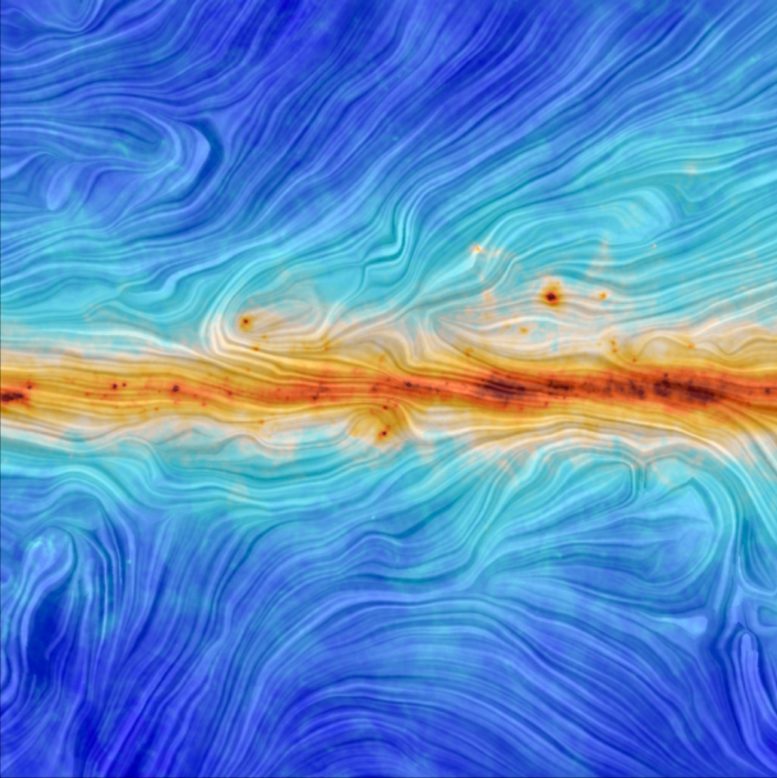
    The image portrays the interaction between interstellar dust in the Milky Way and the structure of our Galaxy’s magnetic field. Credit: ESA/Planck Collaboration, Acknowledgment: M.-A. Miville-Deschênes, CNRS – Institut d’Astrophysique Spatiale, Université Paris-XI, Orsay, France

    Using data from the Planck collaboration, this newly released image portrays the interaction between interstellar dust in the Milky Way and the structure of our Galaxy’s magnetic field.

    While the pastel tones and fine texture of this image may bring to mind brush strokes on an artist’s canvas, they are in fact a visualization of data from ESA’s Planck satellite. The image portrays the interaction between interstellar dust in the Milky Way and the structure of our Galaxy’s magnetic field.

    Between 2009 and 2013, Planck scanned the sky to detect the most ancient light in the history of the Universe – the cosmic microwave background. It also detected significant foreground emission from diffuse material in our Galaxy which, although a nuisance for cosmological studies, is extremely important for studying the birth of stars and other phenomena in the Milky Way.

    Among the foreground sources at the wavelengths probed by Planck is cosmic dust, a minor but crucial component of the interstellar medium that pervades the Galaxy. Mainly gas, it is the raw material for stars to form.

    Interstellar clouds of gas and dust are also threaded by the Galaxy’s magnetic field, and dust grains tend to align their longest axis at right angles to the direction of the field. As a result, the light emitted by dust grains is partly ‘polarized’ – it vibrates in a preferred direction – and, as such, could be caught by the polarization-sensitive detectors on Planck.

    Scientists in the Planck collaboration are using the polarized emission of interstellar dust to reconstruct the Galaxy’s magnetic field and study its role in the build-up of structure in the Milky Way, leading to star formation.

    In this image, the color scale represents the total intensity of dust emission, revealing the structure of interstellar clouds in the Milky Way. The texture is based on measurements of the direction of the polarized light emitted by the dust, which in turn indicates the orientation of the magnetic field.

    This image shows the intricate link between the magnetic field and the structure of the interstellar medium along the plane of the Milky Way. In particular, the arrangement of the magnetic field is more ordered along the Galactic plane, where it follows the spiral structure of the Milky Way. Small clouds are seen just above and below the plane, where the magnetic field structure becomes less regular.

    From these and other similar observations, Planck scientists found that filamentary interstellar clouds are preferentially aligned with the direction of the ambient magnetic field, highlighting the strong role played by magnetism in galaxy evolution.

    The emission from dust is computed from a combination of Planck observations at 353, 545, and 857 GHz, whereas the direction of the magnetic field is based on Planck polarisation data at 353 GHz.

    Never miss a breakthrough: Join the SciTechDaily newsletter.
    Follow us on Google and Google News.

    Astronomy European Space Agency Milky Way Planck Mission Popular
    Share. Facebook Twitter Pinterest LinkedIn Email Reddit

    Related Articles

    Scientists Surprised by Sleeping Giant – Most Massive Stellar Black Hole in Our Galaxy Found Lurking Nearby

    Starquakes! Gaia Spacecraft Sees Strange Stars in Most Detailed Milky Way Survey to Date

    Gaia Spacecraft Discovers Parts of the Milky Way Are Much Older Than Thought

    To the Milky Way’s Anticenter and Beyond: Gaia’s New Detailed Data From More Than 1.8 Billion Stars

    Survey of the Stars: Hubble Captures Great Barred Spiral Galaxy in a Fiery Furnace

    Galactic Crash With Sagittarius May Have Triggered the Formation of Our Solar System

    A Galactic Collision Warped the Milky Way

    Planck Space Telescope Reveals the Magnetic Field Lines of the Milky Way

    Detailed Map Reveals New Information about the Age, Contents and Origins of the Universe

    Leave A Reply Cancel Reply

    • Facebook
    • Twitter
    • Pinterest
    • YouTube

    Don't Miss a Discovery

    Subscribe for the Latest in Science & Tech!

    Trending News

    Scientists May Have Found the Key to Jupiter and Saturn’s Moon Mystery

    Scientists Uncover Brain Changes That Link Pain to Depression

    Saunas May Do More Than Raise Body Temperature – They Activate Your Immune System

    Exercise in a Pill? Metformin Shows Surprising Effects in Cancer Patients

    Hidden Oceans of Magma Could Be Protecting Alien Life

    New Study Challenges Alzheimer’s Theories: It’s Not Just About Plaques

    Artificial Sweeteners May Harm Future Generations, Study Suggests

    Splashdown! NASA Artemis II Returns From Record-Breaking Moon Mission

    Follow SciTechDaily
    • Facebook
    • Twitter
    • YouTube
    • Pinterest
    • Newsletter
    • RSS
    SciTech News
    • Biology News
    • Chemistry News
    • Earth News
    • Health News
    • Physics News
    • Science News
    • Space News
    • Technology News
    Recent Posts
    • Ancient DNA Reveals Irish Goats Have a 3,000-Year-Old Lineage Still Alive Today
    • Historians Reveal Secrets of the Strange Hat Wars That Shook Early Modern England
    • “A Plague Is Upon Us”: The Mass Death That Changed an Ancient City Forever
    • This Strange Material Can Turn Superconductivity on and off Like a Switch
    • Scientists Discover Game-Changing New Way To Treat High Cholesterol
    Copyright © 1998 - 2026 SciTechDaily. All Rights Reserved.
    • Science News
    • About
    • Contact
    • Editorial Board
    • Privacy Policy
    • Terms of Use

    Type above and press Enter to search. Press Esc to cancel.