
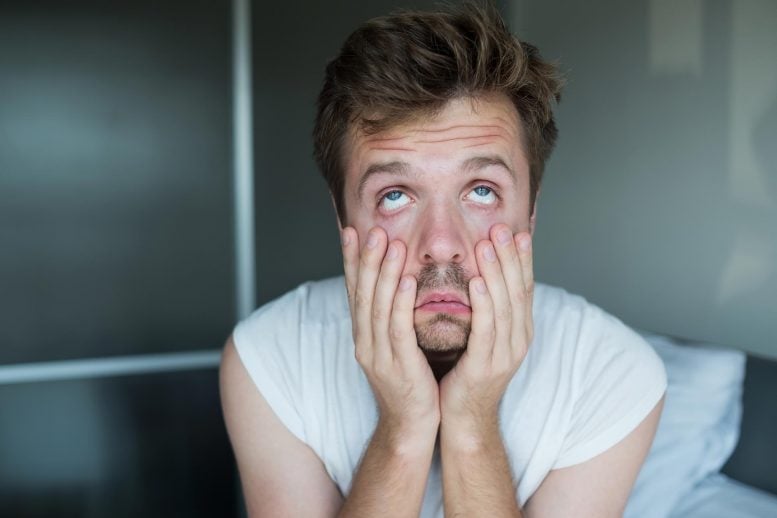
Michigan State University’s Sleep and Learning Lab has conducted one of the largest sleep studies to date, revealing that sleep deprivation affects us much more than prior theories have suggested.
Published in the Journal of Experimental Psychology: General, the research is not only one of the largest studies, but also the first to assess how sleep deprivation impacts placekeeping — or, the ability to complete a series of steps without losing one’s place, despite potential interruptions. This study builds on prior research from MSU’s sleep scientists to quantify the effect lack of sleep has on a person’s ability to follow a procedure and maintain attention.
“Our research showed that sleep deprivation doubles the odds of making placekeeping errors and triples the number of lapses in attention, which is startling,” Fenn said. “Sleep-deprived individuals need to exercise caution in absolutely everything that they do, and simply can’t trust that they won’t make costly errors. Oftentimes — like when behind the wheel of a car — these errors can have tragic consequences.”
By sharing their findings on the separate effects sleep deprivation has on cognitive function, Fenn — and co-authors Michelle Stepan, MSU doctoral candidate and Erik Altmann, professor of psychology — hope that people will acknowledge how significantly their abilities are hindered because of a lack of sleep.
“Our findings debunk a common theory that suggests that attention is the only cognitive function affected by sleep deprivation,” Stepan said. “Some sleep-deprived people might be able to hold it together under routine tasks, like a doctor taking a patient’s vitals. But our results suggest that completing an activity that requires following multiple steps, such as a doctor completing a medical procedure, is much riskier under conditions of sleep deprivation.”
The researchers recruited 138 people to participate in the overnight sleep assessment; 77 stayed awake all night and 61 went home to sleep. All participants took two separate cognitive tasks in the evening: one that measured reaction time to a stimulus; the other measured a participant’s ability to maintain their place in a series of steps without omitting or repeating a step — even after sporadic interruptions. The participants then repeated both tasks in the morning to see how sleep deprivation affected their performance.
“After being interrupted there was a 15% error rate in the evening and we saw that the error rate spiked to about 30% for the sleep-deprived group the following morning,” Stepan said. “The rested participants’ morning scores were similar to the night before.
“There are some tasks people can do on auto-pilot that may not be affected by a lack of sleep,” Fenn said. “However, sleep deprivation causes widespread deficits across all facets of life.”
Reference: “Effects of total sleep deprivation on procedural placekeeping: More than just lapses of attention.” by Michelle E. Stepan, Erik M. Altmann and Kimberly M. Fenn, 21 November 2019, Journal of Experimental Psychology: General.
DOI: 10.1037/xge0000717
Never miss a breakthrough: Join the SciTechDaily newsletter.
Follow us on Google and Google News.
2 Comments
Ask any MD or RN on call for surgical, ER, etc emergencies and what it is like to work on your feet for more than 24 hrs at a time. And then go home and tend to family needs. And then it is time to go back to work after a “nap” of an hour or less. Most of us have decided that a very cold shower will get you alert enough to drive to work and the routine of your work will carry you through the next day. I spent the first ten years of retirement sleeping 16 hours a day. Apparently I finally caught up as I now sleep 8 hours a night. Ah yes sleep. . it is wonderful.
Wow. Thanks for the comment.