
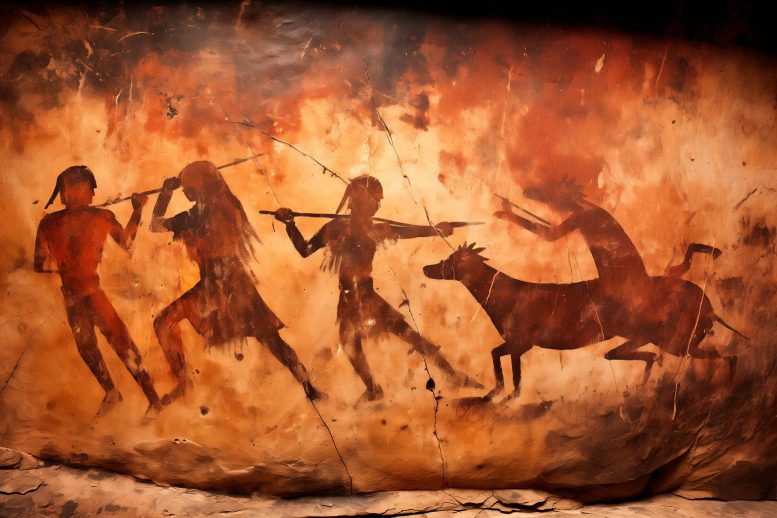
Archaeological findings from Peru indicate that ancient big-game hunters included women, challenging the “Man the Hunter” narrative.
Archeological evidence from Peru has revealed that some ancient big-game hunters were, in fact, women, challenging what science writer James Gorman wrote was “one of the most widely held tenets about ancient hunters and gatherers — that males hunted and females gathered.”
“Man the Hunter” is a narrative of human origins developed by early 20th-century anthropologists armed with their imaginations and a handful of fossils. They viewed hunting — done by men — as the prime driver of human evolution, bestowing upon our early ancestors bipedalism, big brains, tools and a lust for violence. In this narrative, hunting also gave rise to the nuclear family, as women waited at home for men to bring home the meat.
A France24 report on the Peru findings.
As an anthropologist who studies hunting and gathering societies, I was thrilled by the discovery of female skeletons buried with big-game hunting paraphernalia, a pattern that raises important questions about ancient gender roles. But I found most of the media coverage it generated disappointingly inaccurate. Responding to the finding, journalist Annalee Newitz wrote: “Nicknamed ‘man the hunter,’ this is the notion that men and women in ancient societies had strictly defined roles: Men hunted, and women gathered. Now, this theory may be crumbling.”
In fact, that theory died a well-deserved death decades ago.
Hunting Origins
In 1966, 75 anthropologists (70 of whom were men) held a symposium called “Man the Hunter” at the University of Chicago to address one of humanity’s grand questions: How did people live before agriculture? The researchers had lived with and studied contemporary populations of hunting and gathering peoples around the world, from jungle to tundra.
It was there in Chicago that real-life data confronted the myth of Man the Hunter. Researchers showed that women worked just as hard as men, and plant foods gathered by women were crucially important in hunter-gatherer diets. Hunter-gatherer movement patterns were driven by a variety of ecological factors, not just game. And many hunter-gatherers were quite peaceful and egalitarian. Hunting wasn’t the sole driver or unifying theory of human evolution after all.
By the late 1970s, as anthropologists carried out further research on hunter-gatherers and paid attention to issues of gender, the myth of Man the Hunter fell into disfavor.
Updating Beliefs
Even so, subsequent research has affirmed a simple division of labor among hunter-gatherers: men mostly hunt and women mostly gather. When anthropologist Carol Ember surveyed 179 societies, she found only 13 in which women participated in hunting.
But it is a mistake to conflate this pattern of “most hunters are men” among hunter-gatherers with the myth of Man the Hunter. That myth was born of assumptions, not careful empirical research.
Through decades of field research, anthropologists have developed a more flexible and capacious view of human labor. According to this view, women are not bound by biology to gather, nor men to hunt. In fact, several accounts of women’s hunting in foraging societies had emerged by the mid-1980s.
In this context, ancient female hunters are an expectation, not a surprise. And the focus on Man the Hunter distracts from the more important question of how a society with female big-game hunters might be constructed. After all, women are perfectly capable of hunting, yet in most hunter-gatherer societies they don’t do it very often.
Hunting and Childcare
One prominent explanation, elaborated in 1970 by feminist anthropologist Judith Brown, is that the demands of hunting conflict with the provision of child care. This was supported in a recent review of women’s hunting that surveyed traditional societies around the world; the authors found that pregnant or lactating women do not often hunt, and those with dependents only hunt when child care is available or rich hunting grounds are close to camp.
These constraints play a role in shaping risk preferences. In hunter-gatherers, men’s hunting is risky, meaning it carries a high chance of failure. Men tend to hunt alone or in small groups and target big game with projectile weapons, which often requires fast-paced, long-distance travel. In contrast, women prefer to hunt in groups and focus on smaller, easier-to-capture prey closer to camps, often with the aid of dogs.
Women are often crucial to the hunting success of others, whether through logistical or ritual assistance. Husbands and wives sometimes work collaboratively; in these instances women may help trap an animal, then club it to death and carry the meat home. And in big-game hunting societies, women provide support to hunters by manufacturing clothing, weaponry, and transportation equipment. They may also participate in hunting directly by locating, then surrounding and driving game toward a killing location, as seen among high-latitude reindeer hunters and Plains bison hunters. As the authors of the new paper speculate, this is likely how the Peruvian female hunters killed game.
Updated views on plant gathering provide insight into why women may choose not to hunt altogether. No one questioned that hunting is hard, but early anthropologists often assumed women’s gathering was simple and easy. This turns out to be wrong. Like hunting, gathering demands extensive ecological knowledge and skill that is socially learned and cultivated over a lifetime.
As a result, hunter-gatherers face tough choices about how to divide difficult labor in a 24-hour day. In this context, economic considerations show that it pays to specialize: modest comparative advantages — speed and strength, and the incompatibilities posed by child care — can lead to divisions of labor that increase overall food acquisition by the group. From this perspective, women’s decisions to hunt less than men may be a rational decision about allocating effort.
The Batek People
Many have assumed that by not hunting, women are relegated to lower status. But is that true?
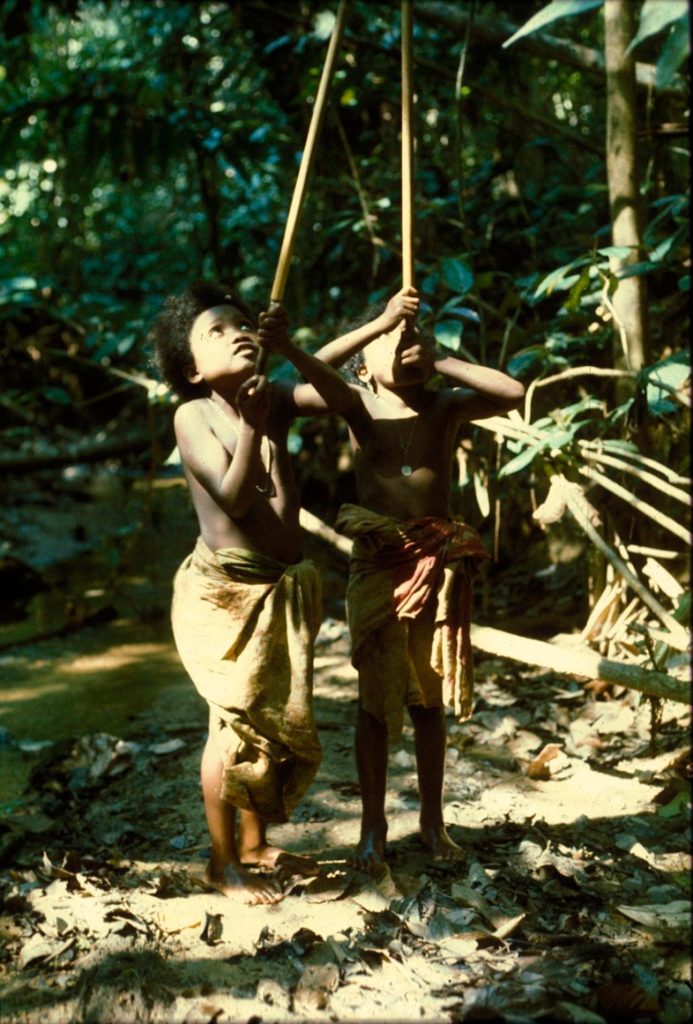
I conduct my work among the Batek people, hunter-gatherers from the rainforests of Malaysia who are widely considered one of the most gender-egalitarian societies in the world. They have little material inequality, share food widely, abhor violence and emphasize individual autonomy.
When day breaks at camp, Batek men trek far, usually alone, to hunt monkeys with blowpipes. The women gather tubers or fruit in small groups closer to camp. Nothing prohibits women from hunting, as is the case with some hunter-gatherers where, for example, touching hunting weapons is forbidden. Batek women sometimes join in group hunts of bamboo rats, but it is otherwise rare. However, there are exceptions. Some teenage girls establish an interest in blowpipe hunting that carries into adulthood.
The Batek people say this division of labor comes down to strength differences, incompatibility with child care, and differences in knowledge specialization. Hunting has great cultural significance, but women’s knowledge of plant distributions is crucial for collective decisions like moving camp. The Batek conceive of themselves as a cooperative and interdependent group in which each person makes a unique and important contribution toward a communal goal.
Beyond Man the Hunter
Contrary to news reports, the archeological findings from Peru accord well with current knowledge about how and why men and women divide labour among hunter-gatherers. And it has little to do with the myth of Man the Hunter.
The Peruvian hunter-gatherers were big-game specialists who used spear-throwing technologies that were likely relatively easy to learn. This may have enabled more flexible divisions of labor and broader participation in hunting by women, similar to what we see among some hunter-gatherers today.
The social implications beyond these facts are not clear. That’s because one’s role in food collection has no simple relation to status or power dynamics. New research on neglected topics like the determinants of women’s status and risk-seeking economic behaviour in traditional societies promises to shed light on this issue. But as the case with the Batek people shows, among a liberated society of equals, status and power has little to do with who brings in the meat.
Written by Vivek V. Venkataraman, Assistant Professor of Anthropology and Archaeology, University of Calgary.
Adapted from an article originally published in The Conversation.
Never miss a breakthrough: Join the SciTechDaily newsletter.
Follow us on Google and Google News.
4 Comments
Yeah, sure…
This is an editorial from a leftwing online magazine, where “I was thrilled by the discovery” sets what the author wants to be true, and “women’s status…power dynamics” sets the lens as feminist. The author uses a weird strawman argument of “Women didn’t hunt”, like “Professors wear clothes”, and then mostly confirms it, with a few exceptions. The “debunking” evidence is a study cited in the first sentence, which found a high-Andes ancient-Peruvian female buried proximate to hunting tools. That might imply the female did “Big-game hunting” in the Andes, specifically limited to types of deer.
I’m unsure what the purpose of this conversation is, so I don’t know why the strawman is necessary. People did what they had to for survival, including hunting the terrifying deer. I’m going to file this under Feminist Archaeology, with the sticky-note they should also consider intersectional race and class and gender and queer theories too, as their Andean “woman” may have actually been a quadruply-oppressed proletariat lesbian Latinx trans-man.
The natural world is competitive – predators and prey – where there are no rules. Things either survive or they don’t. We humans invented a notional “cave” to live in and nurture our kind, protected from the. mindless “outside” competition.
Inside our cave, unlike nature, we had rules, the first rule of nurture being, “Sharing and fair exchange without violence and no doubt grew from our mammalian altricality. Using our ability to communicate, store and apply information, that cave evolved into a huge complex cave called human civilisation – the simple rule evolved to become our ethics, morals and rights. They are indoor human things – nature still doesn’t have any rules outside.
The human brain has two sides (for this discussion) – an objective, “male” side, dealing with outside the self, and a subjective, “female” side, dealing with inside the self.
On her own, a woman has to use both sides, but when in a breeding pair, she is free to concentrate on the subjective side, while a male partner is free to concentrate on the male side. It’s automatic – more efficient – evolution’s fitness..
Men thus evolved to “go out” of civilisation more regularly and become predators in nature, to compete where there are no rules, to win big resources, take them into ownership and bring them back to civilisation for distribution. Hence men prefer competitive hunting and ownership, while women prefer safer hunting (gathering) and sharing.
The same arrangement drives our economics and politics.
no worries about women hunting; however,that cave painting looks as if a couple of women are trying to spear to death a couple of unarmed blokes. no doubt that happened as well, but it is best not to talk about that sort of thing.