

Close Menu
    Facebook X (Twitter) Instagram
    SciTechDaily
    • Biology
    • Chemistry
    • Earth
    • Health
    • Physics
    • Science
    • Space
    • Technology
    Facebook X (Twitter) Pinterest YouTube RSS
    SciTechDaily
    Home»Biology»Decoding Aspirin: New Research Unveils the Secrets Behind Its Powerful Effects
    Biology

    Decoding Aspirin: New Research Unveils the Secrets Behind Its Powerful Effects

    By American Society for Biochemistry and Molecular BiologyApril 8, 20231 Comment3 Mins Read
    Facebook Twitter Pinterest Telegram LinkedIn WhatsApp Email Reddit
    Share
    Facebook Twitter LinkedIn Pinterest Telegram Email Reddit
    Aspirin
    New research sheds light on the mechanism of action of aspirin, a widely used medication for pain, fever, inflammation, and reducing cardiovascular disease risk. Although aspirin’s inhibition of the cyclooxygenase enzyme (COX) is known, its detailed cellular targets have remained unclear. Findings from a study led by Subhrangsu Mandal, a professor at the University of Texas at Arlington, could help develop safer aspirin alternatives and potentially improve cancer immunotherapies.

    Understanding how aspirin reduces inflammation could lead to alternatives with fewer side effects.

    New research has revealed important information about how aspirin works. Even though this drug has been available commercially since the late 1800s, scientists have not yet fully elucidated its detailed mechanism of action and cellular targets. The new findings could pave the way to safer aspirin alternatives and might also have implications for improving cancer immunotherapies.

    Aspirin, which is a nonsteroidal anti-inflammatory drug, is one of the most widely used medications in the world. It is used to treat pain, fever, and inflammation, and an estimated 29 million people in the U.S. take it daily to reduce the risk of cardiovascular diseases.

    Scientists know that aspirin inhibits the cyclooxygenase enzyme, or COX, which creates messenger molecules that are crucial in the inflammatory response. Researchers led by Subhrangsu Mandal, a professor of chemistry and biochemistry at the University of Texas at Arlington, have discovered more about this process.
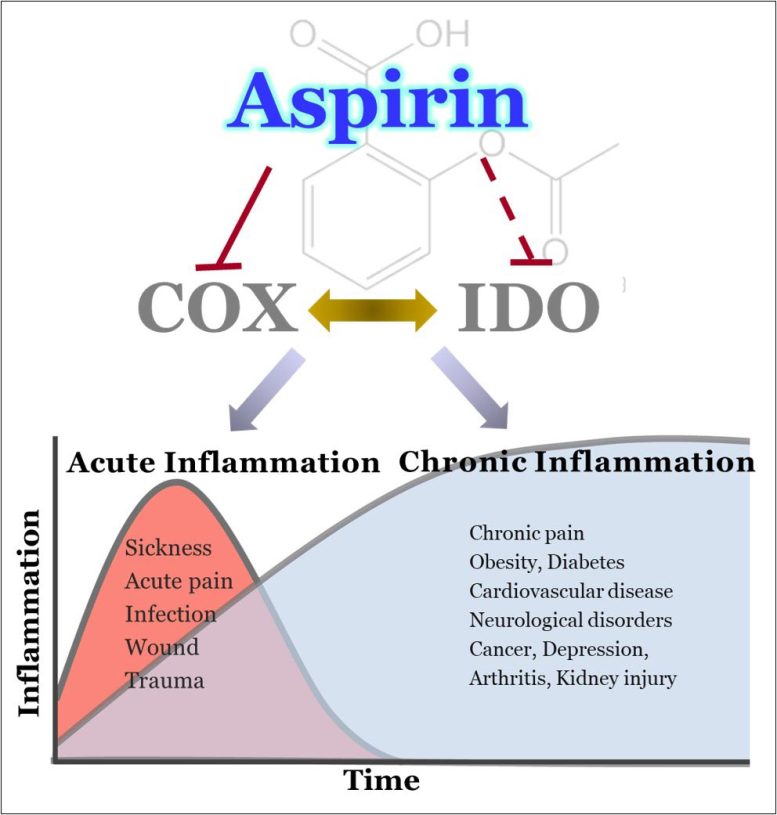
    Aspirin’s Mechanism of Action
    Researchers have made new discoveries about aspirin’s mechanism of action and cellular targets. Their findings suggest potential interplay between cyclooxygenase enzyme, or COX, and indoleamine dioxygenases, or IDOs, during inflammation. Credit: Subhrangsu Mandal, University of Texas at Arlington

    Prarthana Guha, a graduate student in Mandal’s lab, presented the team’s findings at Discover BMB, the annual meeting of the American Society for Biochemistry and Molecular Biology, March 25–28 in Seattle. Avisankar Chini also made significant contributions to the study.

    “Aspirin is a magic drug, but long-term use of it can cause detrimental side effects such as internal bleeding and organ damage,” Mandal said. “It’s important that we understand how it works so we can develop safer drugs with fewer side effects.”

    Aspirin’s Effects on Tryptophan Metabolism

    The team found that aspirin controls transcription factors required for cytokine expression during inflammation while also influencing many other inflammatory proteins and noncoding RNAs that are critically linked to inflammation and immune response. Mandal said this work has required a unique interdisciplinary team with expertise in inflammation signaling biology and organic chemistry.

    They also showed that aspirin slows the breakdown of the amino acid tryptophan into its metabolite kynurenine by inhibiting associated enzymes called indoleamine dioxygenases, or IDOs. Tryptophan metabolism plays a central role in the inflammation and immune response.

    “We found that aspirin downregulates IDO1 expression and associated kynurenine production during inflammation,” Mandal said. “Since aspirin is a COX inhibitor, this suggests potential interplay between COX and IDO1 during inflammation.”

    Implications for Cancer Immunotherapy

    IDO1 is an important target for immunotherapy, a type of cancer treatment that helps the body’s immune system seek out and destroy cancer cells. Because COX inhibitors modulate the COX–IDO1 axis during inflammation, the researchers predict that COX inhibitors might also be useful as drugs for immunotherapy.

    Mandal and his team are now creating a series of small molecules that modulate COX–IDO1 and will explore their potential use as anti-inflammatory drugs and immunotherapeutic agents.

    Meeting: Discover BMB

    Research in Mandal’s lab is funded by National Institute of Health grant R15 HL142032-01.

    Never miss a breakthrough: Join the SciTechDaily newsletter.
    Follow us on Google and Google News.

    Biochemistry Molecular Biology Pharmaceuticals Popular
    Share. Facebook Twitter Pinterest LinkedIn Email Reddit

    Related Articles

    Advanced New Artificial Intelligence Software Can Compute Protein Structures in 10 Minutes

    Evolution Reconstructed: New Proteins “Out of Nothing”

    A Surprisingly Simple Biochemistry Rule Drives the Evolution of Useless Complexity

    Scientists Find Neurochemicals – Dopamine and Serotonin – Have Unexpectedly Profound Roles in the Human Brain

    Missing Link Discovered in the Evolution of Photosynthesis and Carbon Fixation

    Toxic Masculinity: Solving the Puzzle of Why Male Funnel-Web Spiders Are So Deadly

    Low-Cost Second-Generation Ethanol Production Powered by Genetically Engineered Enzyme Cocktail

    Rutgers Scientists Have Discovered the Origins of the Building Blocks of Life

    Scientists Find Link in How Cells Start Process Necessary for Life

    1 Comment

    1. ARMANDO on April 9, 2023 6:40 am

      EXCELLENT ARTICLE.

      Reply
    Leave A Reply Cancel Reply

    • Facebook
    • Twitter
    • Pinterest
    • YouTube

    Don't Miss a Discovery

    Subscribe for the Latest in Science & Tech!

    Trending News

    5 Simple Ways To Remember More and Forget Less

    The Atomic Gap That Could Cost the Semiconductor Industry Billions

    Researchers Finally Solve 50-Year-Old Blood Group Mystery

    Scientists Discover “Molecular Switch” That Fuels Alzheimer’s Brain Inflammation

    Trees Emit Tiny Lightning Flashes During Storms and Scientists Finally Prove It

    Pomegranate Compound Could Help Protect Against Heart Disease

    Your Blood Test Might Already Show Alzheimer’s Risk

    Scientists Were Wrong About This Strange “Rule-Breaking” Particle

    Follow SciTechDaily
    • Facebook
    • Twitter
    • YouTube
    • Pinterest
    • Newsletter
    • RSS
    SciTech News
    • Biology News
    • Chemistry News
    • Earth News
    • Health News
    • Physics News
    • Science News
    • Space News
    • Technology News
    Recent Posts
    • Harvard Breakthrough Brings Powerful UV Light Sources Onto a Chip
    • This Strange Quantum “Dance” Could Rewrite Superconductivity
    • Scientists Make Breakthrough in Turning Plastic Trash Into Clean Fuel Using Sunlight
    • Scientists Complete Largest 3D Map of the Universe to Probe Dark Energy
    • Hidden Parasite Found in Popular Portuguese Lake Raises Health Concerns
    Copyright © 1998 - 2026 SciTechDaily. All Rights Reserved.
    • Science News
    • About
    • Contact
    • Editorial Board
    • Privacy Policy
    • Terms of Use

    Type above and press Enter to search. Press Esc to cancel.