
Researchers created the first bi-paternal mouse by modifying imprinting genes, advancing reproductive science but facing challenges like sterility and low survival rates.
A team of stem cell scientists has successfully engineered a bi-paternal mouse—one with two male parents—using embryonic stem cell technology. The mouse survived to adulthood, marking a significant breakthrough in reproductive science. Their findings, published on January 28, 2025, in Cell Stem Cell, detail how they overcame longstanding barriers to unisexual reproduction in mammals by precisely modifying key genes involved in reproduction.
Scientists have attempted to create bi-paternal mice before, but the embryos developed only to a certain point and then stopped growing. Here, the investigators, led by corresponding author Wei Li of the Chinese Academy of Sciences (CAS) in Beijing, focused on targeting imprinting genes, which regulate gene expression in a number of ways. “This work will help to address a number of limitations in stem cell and regenerative medicine research,” says Li.
“The unique characteristics of imprinting genes have led scientists to believe that they are a fundamental barrier to unisexual reproduction in mammals,” says co-corresponding author Qi Zhou, also of CAS. “Even when constructing bi-maternal or bi-paternal embryos artificially, they fail to develop properly, and they stall at some point during development due to these genes.”
Engineering a Bi-Paternal Mouse
Earlier attempts to make a bi-paternal mouse used ovarian organoids to derive oocytes from male pluripotent stem cells; those ooctyes were then fertilized with sperm from another male. However, when the homologous chromosomes—the chromosomes that divide during meiosis to create oocytes and sperm—originated from the same sex, imprinting abnormalities arose, leading to severe developmental defects.
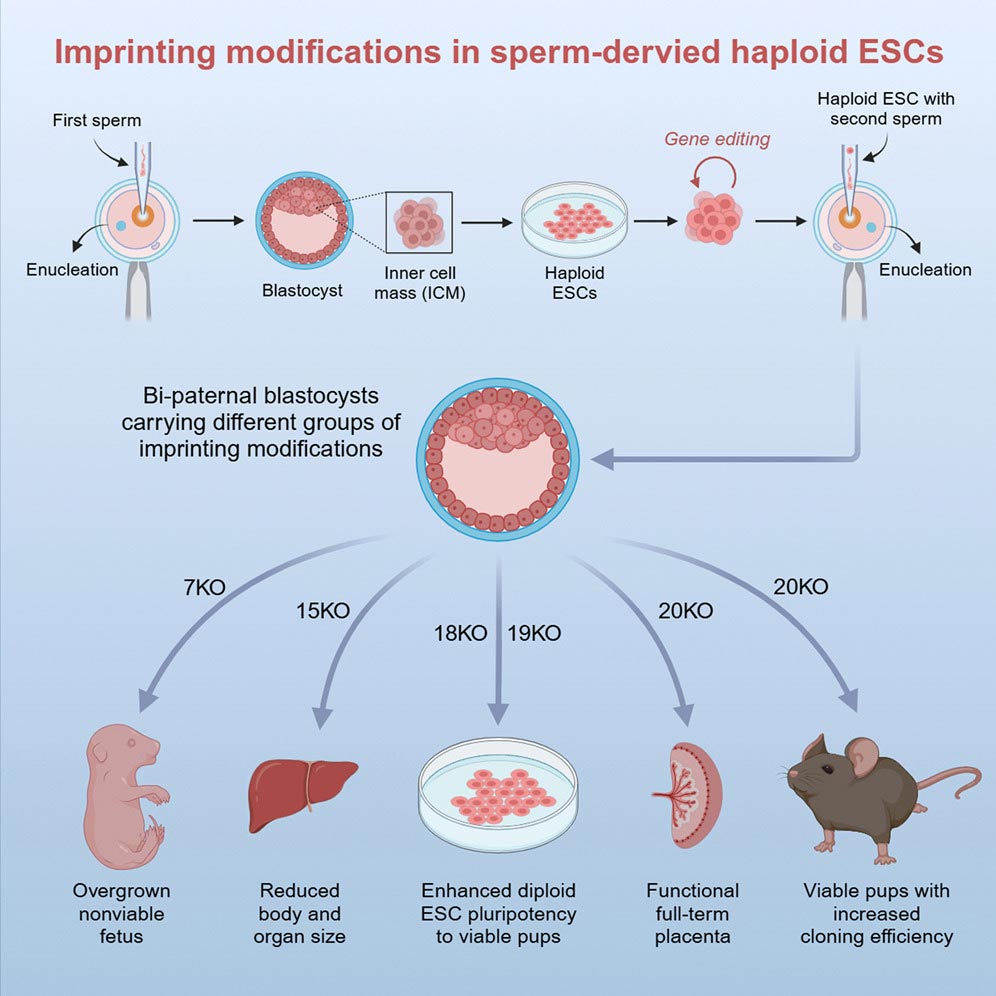
In this study, the researchers modified 20 key imprinting genes individually using a number of different techniques, including frameshift mutations, gene deletions, and regulatory region edits. They found that not only did these edits allow the creation of bi-paternal animals that sometimes lived to adulthood, but they also led to stem cells with more stable pluripotency.
“These findings provide strong evidence that imprinting abnormalities are the main barrier to mammalian unisexual reproduction,” says co-corresponding author Guan-Zheng Luo of Sun Yat-sen University in Guangzhou. “This approach can significantly improve the developmental outcomes of embryonic stem cells and cloned animals, paving a promising path for the advancement of regenerative medicine.”
Challenges and Future Research
The researchers note several limitations that their work still needs to address. For one thing, only 11.8% of the viable embryos were capable of developing until birth, and not all the pups that were born lived to adulthood due to developmental defects. Most of those that did live to adulthood had altered growth and a shortened lifespan. Also, the mice that lived to adulthood were sterile, although they did exhibit increased cloning efficiency.
“Further modifications to the imprinting genes could potentially facilitate the generation of healthy bi-paternal mice capable of producing viable gametes and lead to new therapeutic strategies for imprinting-related diseases,” says co-corresponding author Zhi-Kun Li of CAS.
The team will continue to study how modifying imprinting genes may lead to embryos with higher developmental potential. They also aim to extend the experimental approaches developed in mice to larger animals, including monkeys. However, they note that this will require considerable time and effort because the imprinting gene combinations in monkeys differ significantly from those in mice. Whether this technology will ultimately be applied to solving human disease remains unclear. The International Society for Stem Cell Research’s ethical guidelines for stem cell research does not allow heritable genome editing for reproductive purposes nor the use of human stem cell-derived gametes for reproduction because they are deemed as currently unsafe.
Reference: “Adult bi-paternal offspring generated through direct modification of imprinted genes in mammals” by Zhi-kun Li, Li-bin Wang, Le-yun Wang, Xue-han Sun, Ze-hui Ren, Si-nan Ma, Yu-long Zhao, Chao Liu, Gui-hai Feng, Tao Liu, Tian-shi Pan, Qing-tong Shan, Kai Xu, Guan-zheng Luo, Qi Zhou and Wei Li, 28 January 2025, Cell Stem Cell.
DOI: 10.1016/j.stem.2025.01.005
Funding: Strategic Priority Research Program of the Chinese Academy of Sciences, National Natural Science Foundation of China, National Key Research and Development Program of China
Never miss a breakthrough: Join the SciTechDaily newsletter.
Follow us on Google and Google News.
7 Comments
Disgusting
I guess the whole gay men community of the world will be rejoicing on this abomination news
And here I thought at least the Chinese would be anti-woke…
Gross.
And I thought that Schwarzenegger’s researcher in “Junior” was unrealistic. OK, but what for? How does this improve human life? A fool w/a Ph.D remains a fool. How about reducing pregnancy problems for women? There are still women, aren’t there?
This is so unethical on many levels, especially to the mice and then potentially humans they will want to experiment on.
Not defying biology. Perhaps defying evolved mating systems but that’s pretty moot. OUR AGE LIMIT IS DEFYING EVOLVED BOUNDARIES