

Alzheimer’s disease and other dementias are increasing more rapidly in China than in other parts of the world, fueled by factors such as population growth, elevated blood sugar levels, smoking, and obesity.
China is facing a rapidly growing challenge: Alzheimer’s disease and other forms of dementia are rising faster there than almost anywhere else in the world, according to a new study published in PLOS ONE by researchers Siyu Liu and Daoying Geng from Fudan University.
Dementia already affects millions worldwide, but the situation in China is especially urgent. With one of the fastest-aging populations on the planet, the country is seeing a sharper increase in cases than the global average. Yet, until now, there’s been a major gap in understanding how deeply Alzheimer’s and related conditions are impacting the country.
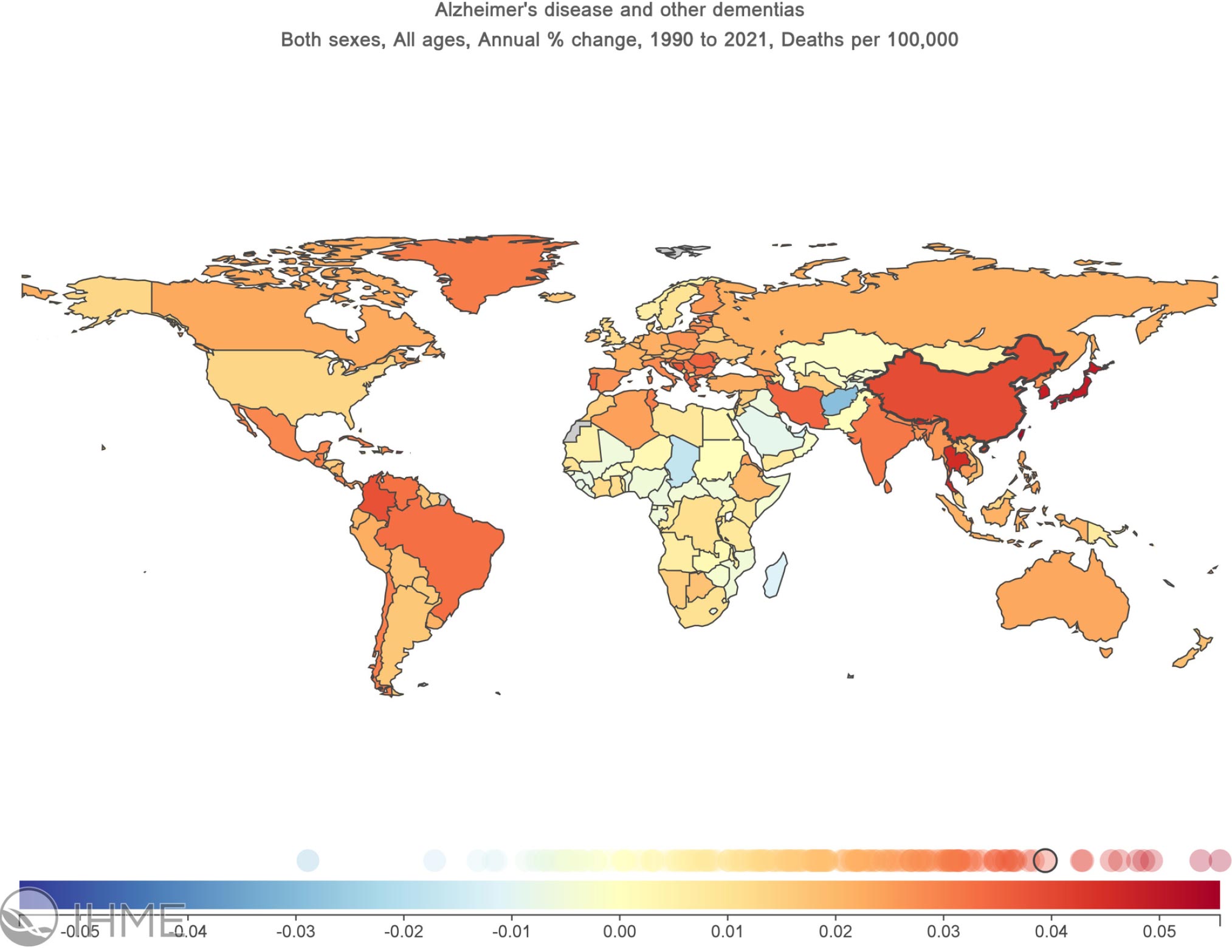
To address this, the researchers analyzed more than 30 years of global health data from the Global Burden of Disease (GBD) project. Their findings are sobering: between 1990 and 2021, dementia cases in China tripled, while the global number of cases merely doubled.
The study also highlights gender differences. Women in China carry a greater share of the disease burden, largely because they live longer. However, men are slightly more likely to die from the condition.
Looking ahead, the researchers used advanced statistical models to forecast trends for the next 15 years. The outlook is clear: without stronger public health interventions, dementia cases in China will continue to rise steeply.
Projecting the Future and Identifying Key Risks
When focusing on risk factors for ADD, the study showed that high blood sugar (from conditions like diabetes) is now the leading preventable risk factor for dementia worldwide, including in China. Smoking and high body weight are also major contributors, particularly among men.
The authors conclude that the increase in ADD in China is mostly being driven by population growth and shifting age demographics, but that efforts to reduce high blood sugar and smoking – especially among older adults – could slow the increase in dementia cases.
The authors add: “ADD is one of the diseases with the heaviest global disease burden. The disease burden of ADD in China and globally has increased year by year from 1990 to 2021.”
Reference: “A systematic analysis for disease burden, risk factors, and trend projection of Alzheimer’s disease and other dementias in China and globally” by Siyu Liu and Daoying Geng, 7 May 2025, PLOS ONE.
DOI: 10.1371/journal.pone.0322574
The funding organization of the National Nature Science Foundation of China (82372048) is National Natural Science Foundation of China (NSFC). The funding organization of the Science and Technology Commission of Shanghai Municipality (22TS1400900, 23S31904100, 22ZR1409500, 24SF1904200, 24SF1904201) is Shanghai Municipal Science and Technology Commission. DG is the recipient of the funding awards listed above.
Never miss a breakthrough: Join the SciTechDaily newsletter.
Follow us on Google and Google News.
2 Comments
From the perspective of a now eighty-one year old lay American male with a family history of food allergies and dementia and a personal history of multiple food allergies and two temporary incidents of short-term memory problems (e.g., a serious calcium deficiency from early 2009 to late 2010 and a very serious phosphorus deficiency from early 2021 through late 2024) who’s never been to China, I believe they have the risk factors all wrong. Undiagnosed nearly subclinical non-IgE-mediated food allergies (e.g., Dr. Arthur F. Coca, by 1935) aggravated (or not) with officially (FDA in the US) approved food poisoning (e.g., soy [late 1960s], TBHQ [1972] and MSG ([1980], minimally) are the primary risk factors. As to obesity and diabetes, epidemic in the US by 1990 and 1994, respectively (CDC data). As to women having a higher “burden,” child bearing takes a heavy toll on on a woman’s calcium reserves and estrogen is protective against uric acid. As to men having a higher mortality rate, I can only postulate that undiagnosed very, very mild allergies to tobacco are common in China. As to increases in ADD due to population, stands to reason to worsen if the primary risk factors are not correctly identified and suitably remedied.
Focusing not on cause, but on prevention, suggest six-month trial of 40 Hz light 8 a.m. to 11 p.m., and Curcumin with black pepper, daily 800mg capsule. 82 y.o. female with severe dementia, recommended hospice care, but instead daily treatment including physical therapy. Now age 85, talking, able to sit and, with assistance, walk, follow directions. Initial symptom of change was no anger, no screaming. Robert (Journal on facebook, Messenger)